
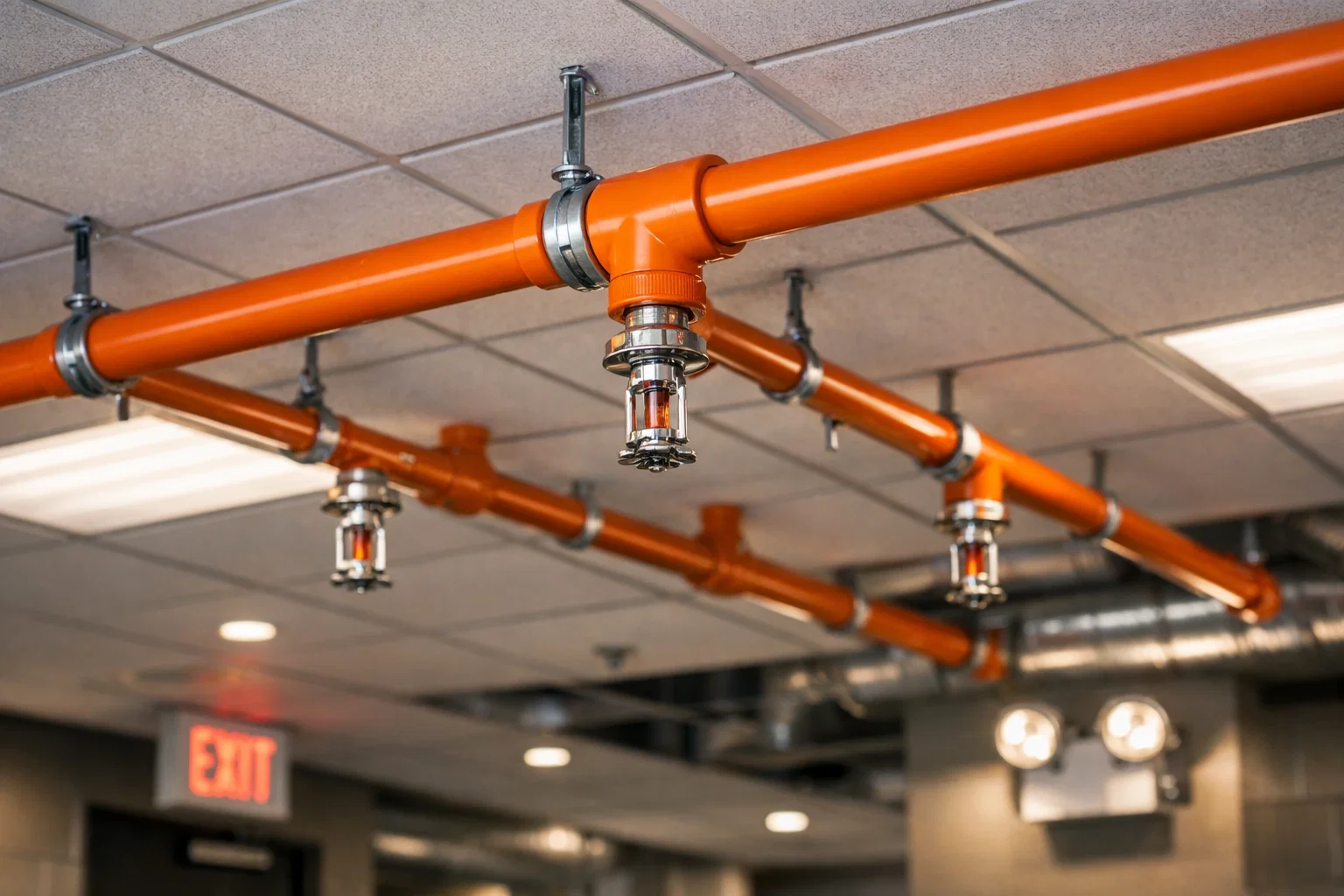
A fire breaks out. Seconds matter. And the one thing standing between a small incident and complete disaster is your sprinkler system — more specifically, the pipes carrying water to those sprinkler heads.
Most building owners think about the sprinkler heads. Very few think carefully about the pipe material. That is a costly oversight.
The wrong pipe can fail under heat, corrode over years, or be too rigid to route through modern construction. That is where CPVC pipes for fire sprinkler systems have changed the game entirely.
In this guide, you will learn exactly what pipe type works best for fire protection, why CPVC leads the field, and what you need to know before specifying or buying — whether you are a contractor, facility manager, or building developer.
Not every pipe is built to handle fire protection demands. Fire sprinkler systems operate under sustained pressure, must survive heat without warping, and need to deliver instant, high-volume water flow the moment they are triggered.
There are five main pipe types used in fire suppression:
The traditional standard for decades. Strong and heat-resistant, but heavy, prone to internal corrosion over time, and costly to install due to threading and welding requirements.
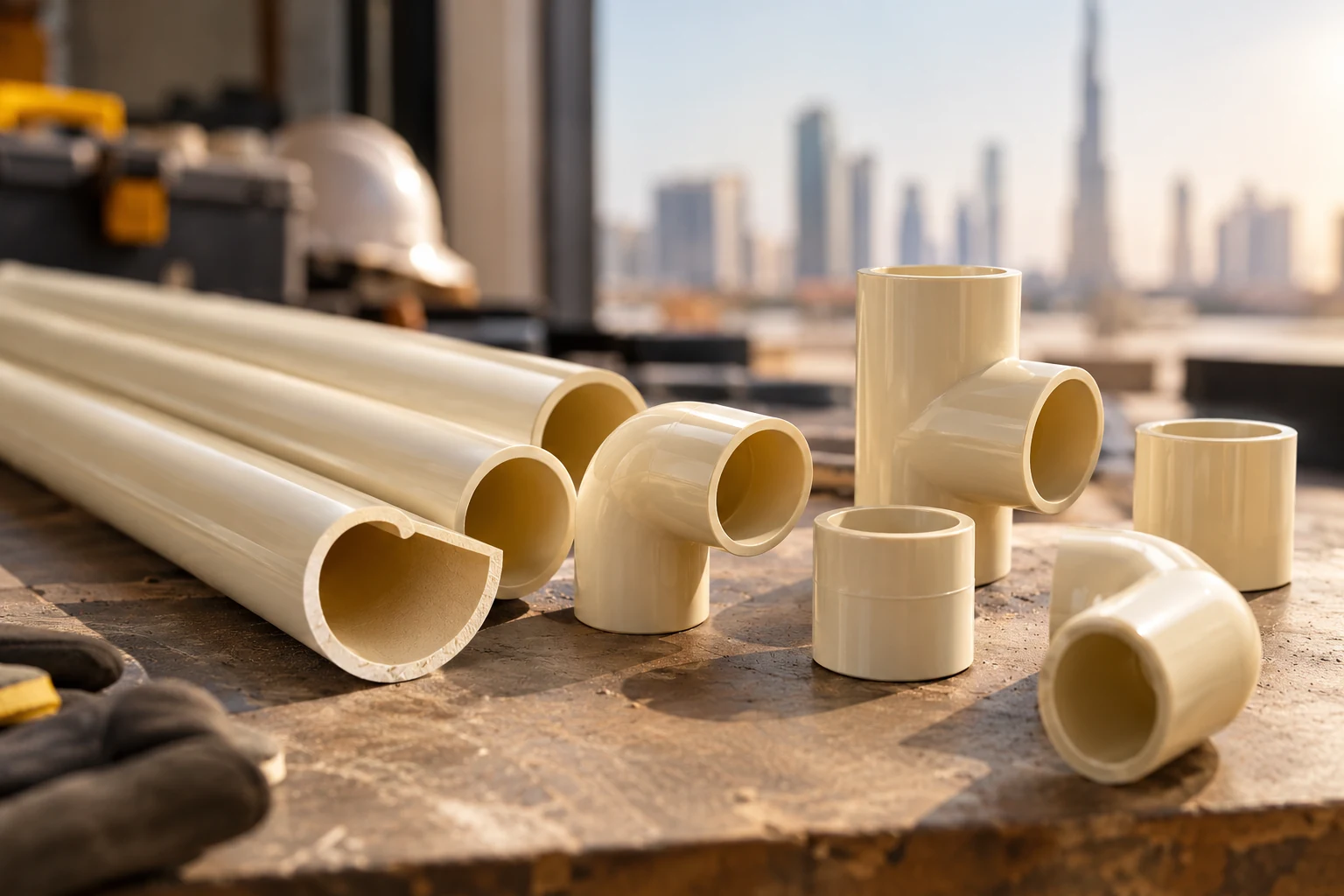
The modern go-to for residential and light commercial fire sprinkler systems. Engineered specifically for fire protection, CPVC handles temperatures up to 93°C (200°F) — well above what standard PVC pipe temperature ratings allow. It is lightweight, corrosion-proof, and faster to install.
Read: PVC Pipe Temperature Ratings — Complete Guide
Standard PVC is NOT rated for fire protection. Many people confuse the two — and the consequences can be serious. CPVC goes through an additional chlorination process that fundamentally changes its heat resistance and pressure rating.
Read: CPVC vs PVC Pipe Comparison
Durable and corrosion-resistant, but costly. Used in high-end residential installations — less common in commercial settings.
Used rarely in fire systems, primarily in underground supply mains.
Read: HDPE Pipe — Complete Guide
For most residential and light commercial applications, CPVC is the specification standard — and for good reason.
Standard PVC softens around 60°C. CPVC is engineered to withstand up to 93°C continuously. In a fire scenario, the pipe needs to hold pressure right until the sprinkler heads open — CPVC does exactly that.
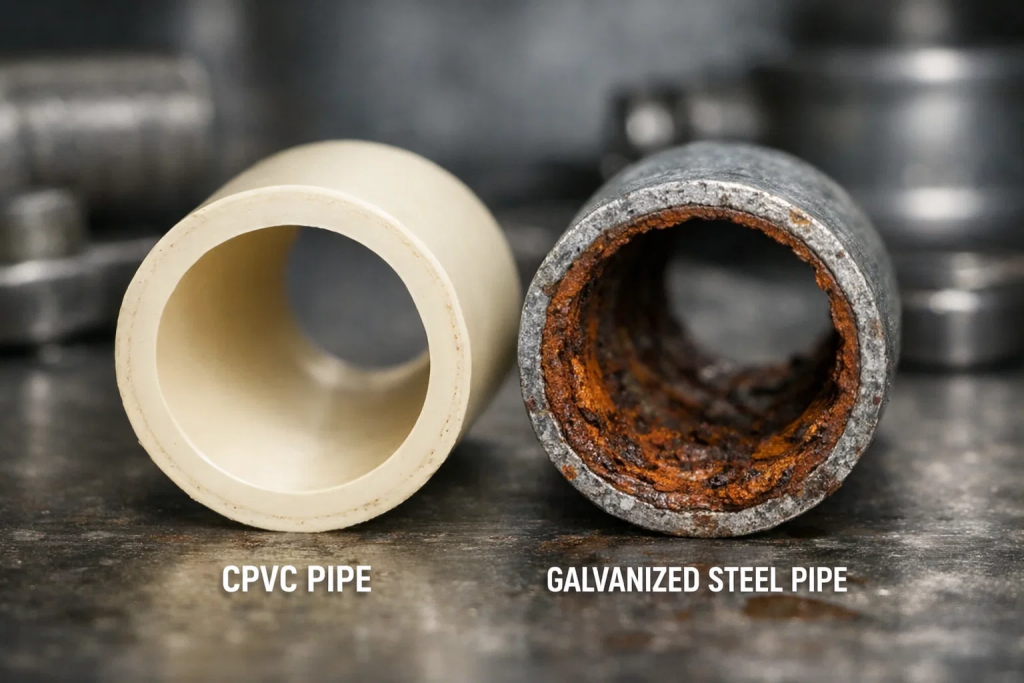
Steel pipes — especially galvanized — corrode from the inside over time. This scale buildup narrows the internal diameter, reduces flow rate, and can eventually block sprinkler heads. CPVC is chemically inert. It does not rust, does not scale, and maintains flow rates decade after decade.
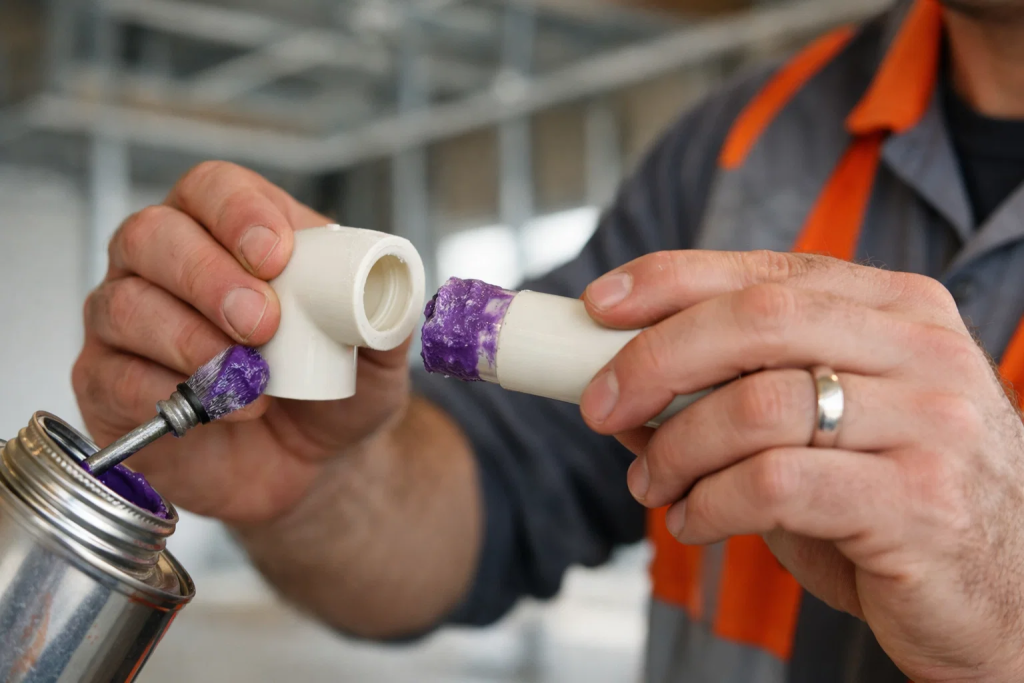
Steel requires threading or welding on site. CPVC uses a simple solvent cement joint. Installation is faster, requires fewer skilled trades, and results in clean, pressure-tested joints.
Read: How to Glue PVC Pipe — Technique Guide
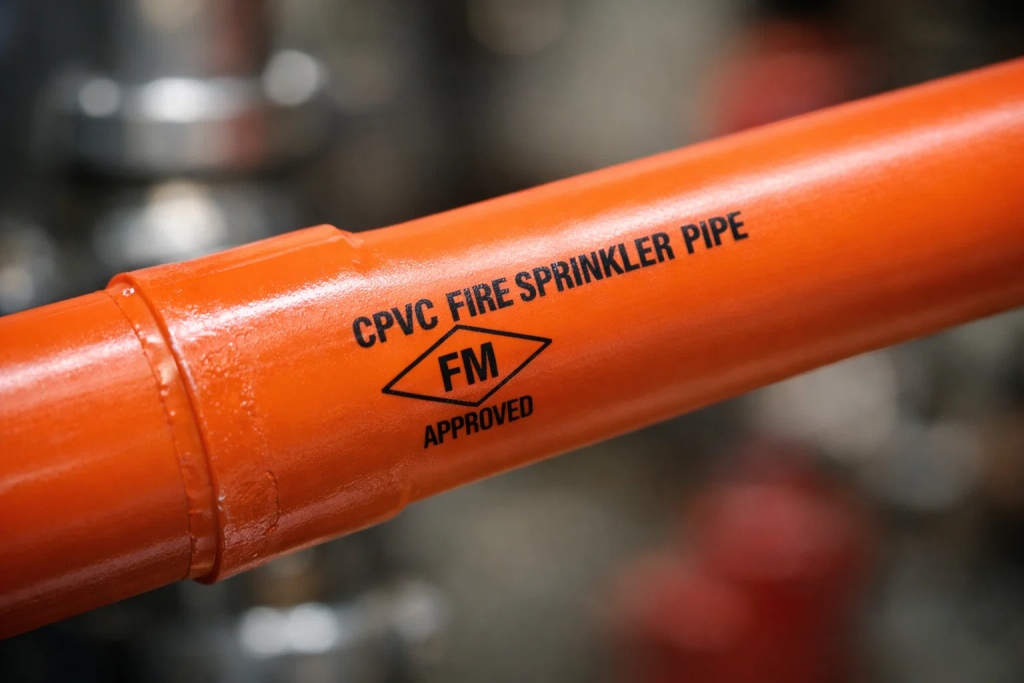
Fire-rated CPVC pipe carries FM Approvals (Factory Mutual) and UL Listing — the two gold standards for fire protection products. This means it meets NFPA 13 (standard for sprinkler systems) and NFPA 13R (residential systems).
Modern buildings have complex layouts. CPVC’s lighter weight makes routing through walls, ceiling cavities, and tight spaces much more practical compared to rigid steel.
Read: How to Install PVC Pipes Underground
| Feature | CPVC Pipe | Steel (Black / Galvanized) |
| Temperature Rating | Up to 93°C (200°F) | Up to 200°C and beyond |
| Corrosion Resistance | Excellent — no rust | Poor — internal corrosion over time |
| Installation Method | Solvent cement (fast) | Threading or welding (slow) |
| Weight | Light — easy to handle | Heavy — needs added supports |
| Maintenance | Minimal | Regular flushing required |
| Fire Safety Rating | FM Approved, UL Listed | Industry standard |
| Best For | Residential, light commercial | Industrial, high-rise |
Bottom line: For residential buildings, hotels, schools, and light commercial spaces — CPVC is faster, cleaner, and more reliable long-term. Steel still dominates heavy industrial and high-rise applications where extreme temperatures are a factor.
Learn more: Thermoplastic Polymers Guide to Plastic Pipes
Fire-rated CPVC is typically available in Schedule 10 and Schedule 40. For most residential systems, Schedule 10 is sufficient. Know your working pressure requirements before ordering.
Read: PN10 vs PN16 Pressure Rating Guide
Sprinkler system pipes range from ¾ inch branch lines up to 4 inches for mains. Measure carefully before ordering — incorrect measurements are a common and costly site error.
Read: How to Measure Pipe Size
Not all CPVC pipe is fire-rated. You must specifically use CPVC listed under FM Approvals Standard 1635. Standard plumbing CPVC — used for hot water — is not a substitute.
Read: Difference Between UPVC and CPVC Pipes
Every joint in a fire sprinkler system is critical. CPVC fire pipe must be paired with compatible CPVC fittings and the manufacturer’s listed solvent cement — mixing brands can void FM approval.
Source approved products: CPVC Pipes and Fittings Supplier in Dubai
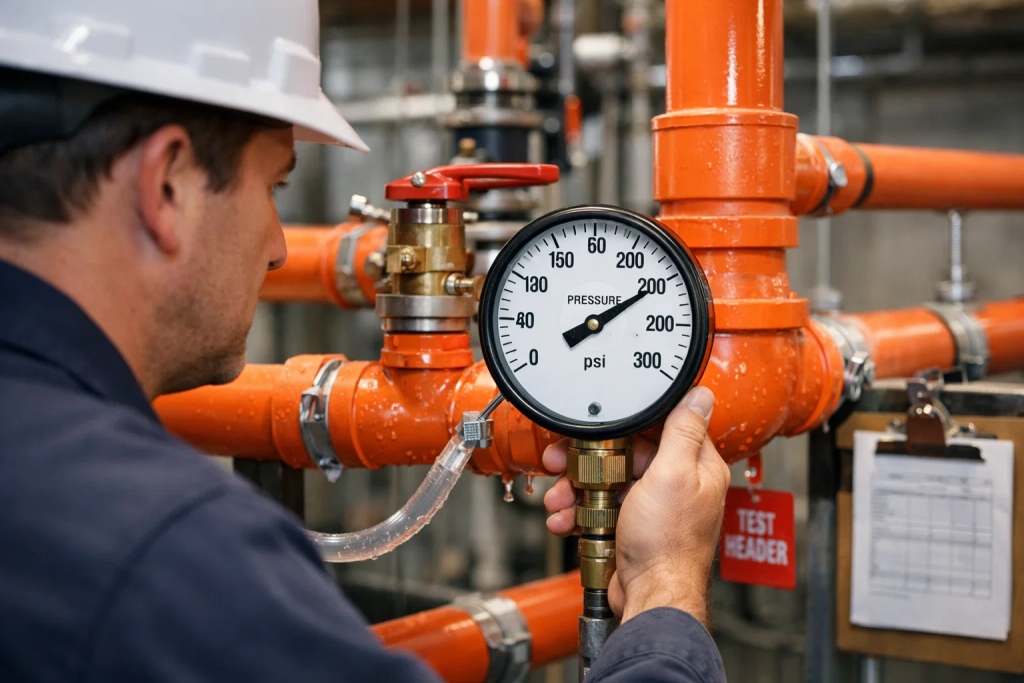
Every fire sprinkler system must be hydrostatically pressure-tested before handover. Hydrostatic test at 200 psi (or 50 psi above working pressure) for two hours minimum.
Read: How to Pressure Test PVC Pipe
Step 1: Plan Your Layout
Map the sprinkler head locations based on the fire protection design. Calculate pipe sizing per NFPA 13. Check ceiling heights and routing paths before buying materials.
Step 2: Cut the Pipe to Length
Use a ratchet cutter or fine-tooth saw. Always deburr cut ends. See our cutting guide linked below.
Step 3: Dry Fit the System
Assemble without cement first. Check alignment, clearances, and that all fittings seat properly at each joint.
Step 4: Apply Solvent Cement
Use only the listed solvent cement for fire-rated CPVC. Apply primer, then cement, then push fittings in with a quarter-turn. Hold for 30 seconds.
Step 5: Allow Full Cure Time
Do not pressure test for at least one hour — 24 hours is best. Rushing this step is one of the most common installation errors.
Step 6: Pressure Test the System
Hydrostatic test at 200 psi for two hours minimum. No leaks allowed. Document all results for the fire authority inspection.
Step 7: Connect to the Water Supply
Tie into the building water main or dedicated fire supply. Ensure a PVC high pressure valve is installed at the system isolation point.
Cutting technique: How to Cut PVC Pipe
Valve selection: PVC High Pressure Valves
Mistake 1: Using Standard Plumbing CPVC Instead of Fire-Rated
Why it’s a problem: Fails FM Approval requirements and could invalidate your building fire certificate.
Fix: Always specify FM-approved CPVC with the correct listing mark visible on the pipe.
Mistake 2: Mixing Solvent Cement Brands
Why it’s a problem: Voids manufacturer listing and leaves joint integrity unverified.
Fix: Use only the solvent cement listed with your specific CPVC pipe brand — no exceptions.
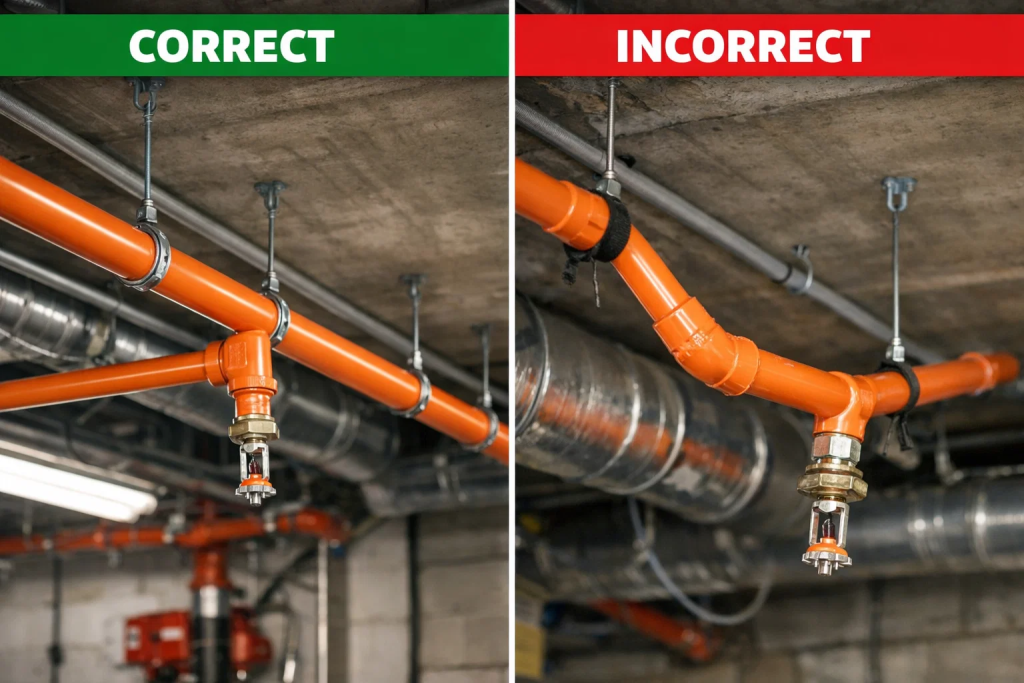
Mistake 3: Inadequate Hangers and Supports
Why it’s a problem: CPVC expands with temperature changes. Unsupported runs sag and stress joints over time.
Fix: Follow the manufacturer support spacing — typically every 6 feet for ¾ inch pipe.
Mistake 4: Ignoring Pipe Quality
Why it’s a problem: Not all pipe sold as CPVC meets fire-grade standards.
Fix: Buy from a verified supplier and check quality before installation.
Mistake 5: Wrong Pipe Sizing
Why it’s a problem: Undersized pipes reduce flow and may cause sprinklers to not activate at the required discharge density.
Fix: Use hydraulic calculation software or a qualified fire engineer to size the system.
Quality guide: How to Check PVC Pipe Quality
Pipe sizing reference: Standard Sizes of PVC Pipe
A: No. Standard PVC is not rated for fire protection. It lacks the temperature resistance and FM Approval required for fire systems. Only CPVC specifically listed for fire protection should be used — this is a code requirement, not just a recommendation.
A: Yes. FM-approved CPVC is widely accepted in residential and light commercial buildings under NFPA 13D and 13R. It is one of the most commonly installed pipe materials in new residential fire systems today.
A: With correct installation and no chemical contamination, CPVC fire pipe can last 50 years or more. It does not corrode or scale internally — a significant long-term advantage over steel.
A: Fire-rated CPVC is rated for continuous service at up to 93°C (200°F). Standard sprinkler heads typically activate between 57 and 79°C — well within CPVC’s safe range.
A: Dave Pools supplies FM-approved CPVC pipes and fittings in Dubai. Visit our CPVC supplier page or contact our team directly for product specifications and availability.
CPVC is not just a trend in fire protection — it is the standard that residential and commercial fire engineers rely on. It is heat-resistant, corrosion-proof, fast to install, and meets the highest fire safety approvals in the industry.
If you are planning a fire sprinkler system, specifying the right pipe material from day one avoids costly rework, ensures code compliance, and ultimately protects lives and property.
Ready to source CPVC pipes and fittings for your project in Dubai? Visit our CPVC Pipes and Fittings Supplier Page →
Ensure compliance, durability, and long-term safety with certified CPVC piping solutions.
Speak with our experts today to get the right specifications for your project.