Are you struggling to make sense of PVC pipe sizes for your next project? The confusion surrounding pipe dimensions can lead to costly mistakes, wasted materials, and potential safety hazards. But don’t worry – we’ve got you covered. In this comprehensive guide, we’ll demystify the world of standard sizes of PVC pipe, equipping you with the knowledge to make informed decisions and ensure the success of your plumbing, irrigation, or construction endeavors.
Quick Facts
PVC pipe sizes are governed by ASTM D1785 in the US and ISO 1452 internationally — “nominal size” is a label, not the exact diameter.
A 1-inch Schedule 40 pipe has a 0.133-inch wall; the same size in Schedule 80 jumps to 0.179 inches — nearly 35% thicker.
That extra wall thickness raises the pressure rating: 1-inch Schedule 40 handles 450 psi, while Schedule 80 handles 630 psi at room temperature.
Standard sizes run from 1/2 inch up to 24 inches, covering everything from a bathroom sink line to municipal water mains.
Quality PVC piping systems routinely exceed a 50-year service life when sized and installed correctly.
Need the Right Pipe Size for Your Next Project?
Guessing on pipe size leads to flow problems, pressure loss, or fittings that don’t seat right. Dave Pools carries the full standard size range – from 1/2 inch residential lines to large-diameter industrial pipe – all manufactured to ASTM and ISO specifications.
Understanding the standard sizes of PVC pipe is crucial for several reasons:
Proper System Functionality: Choosing the correct pipe size ensures optimal flow rates and pressure management in your plumbing or irrigation system.
Cost-Effectiveness: Selecting the right size prevents overengineering and unnecessary expenses while avoiding undersized pipes that may require costly replacements.
Compliance with Regulations: Many building codes and industry standards specify required pipe sizes for different applications, making knowledge of standard sizes essential for compliance.
System Efficiency: Properly sized pipes contribute to energy efficiency by reducing pumping requirements and minimizing pressure losses.
Compatibility: Understanding standard sizes ensures compatibility with fittings, valves, and other system components, simplifying installation and maintenance
Standard Sizes of PVC Pipe: A Comprehensive Overview
PVC pipes come in a wide range of standard sizes to accommodate various applications. Here’s a breakdown of the most common sizes you’ll encounter:
Small Diameter Pipes (1/2 inch to 1 inch)
These sizes are frequently used in residential plumbing for water supply lines and small-scale irrigation systems.
1/2 inch (15mm)
3/4 inch (20mm)
1 inch (25mm)
Medium Diameter Pipes (1 1/4 inch to 2 inches)
Medium-sized pipes are often found in larger residential or small commercial applications, such as main water supply lines or larger irrigation systems.
1 1/4 inch (32mm)
1 1/2 inch (40mm)
2 inches (50mm)
Large Diameter Pipes (3 inches and above)
These sizes are typically used in municipal water supply systems, large-scale irrigation, and industrial applications.
3 inches (80mm)
4 inches (100mm)
6 inches (150mm)
8 inches (200mm)
10 inches (250mm)
12 inches (300mm)
Up to 24 inches (600mm) for specialized applications
It’s important to note that PVC pipes are categorized not only by their nominal size (which approximates the inner diameter) but also by their schedule, which determines the wall thickness and pressure rating.
Key Takeaway
Bigger isn’t automatically better. Oversized pipe wastes money and can actually reduce flow velocity below what your system needs — match the size to the application, not to “just to be safe.”
Decoding PVC Pipe Specifications
To fully understand PVC pipe sizes, you need to be familiar with the following specifications:
Nominal Size: This is the approximate inner diameter of the pipe, often expressed in inches. However, the actual inner diameter may vary slightly from the nominal size.
Outer Diameter (OD): The actual measured outside diameter of the pipe. This measurement is crucial for ensuring proper fit with fittings and connectors.
Inner Diameter (ID): The actual measured inside diameter of the pipe, which affects flow capacity.
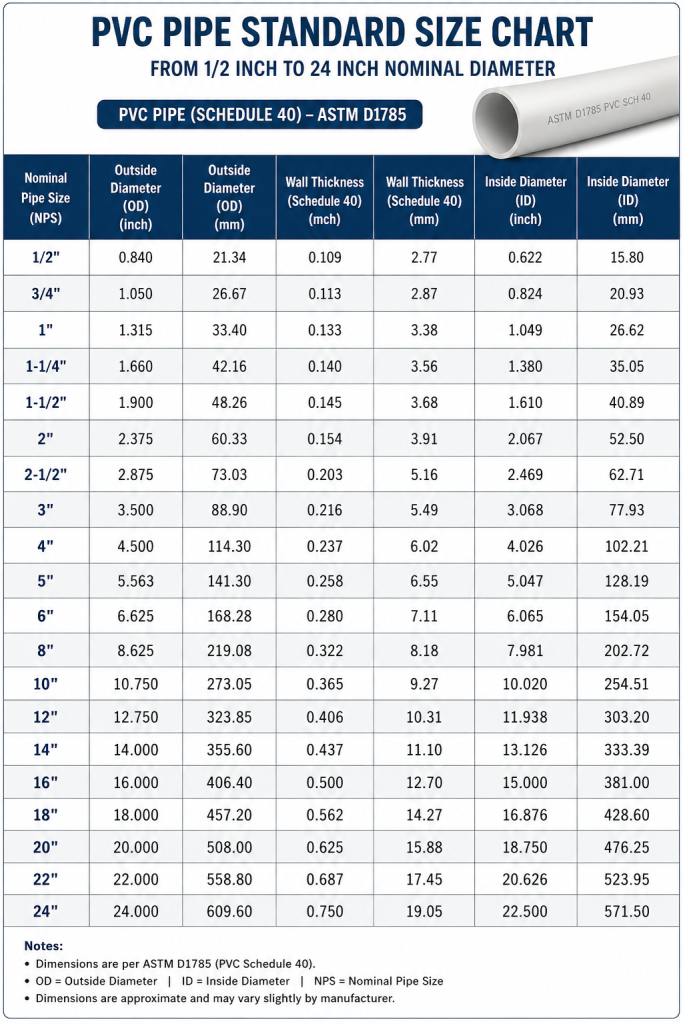
Wall Thickness: The thickness of the pipe wall, which varies depending on the pipe’s schedule. For example, a 1-inch Schedule 40 pipe has a wall thickness of 0.133 inches, while a Schedule 80 pipe of the same size has a wall thickness of 0.179 inches.
Schedule: This refers to the pipe’s wall thickness and pressure rating. Common schedules include Schedule 40, Schedule 80, and Schedule 120, with higher numbers indicating thicker walls and higher pressure ratings.
Pressure Rating: The maximum internal pressure the pipe can safely withstand. This rating decreases as the pipe diameter increases and varies with temperature.
These dimensions aren’t arbitrary — they’re locked in by ASTM D1785 in the US (and ISO 1452 internationally), which is exactly why a 1-inch Schedule 40 pipe from any reputable manufacturer has the same 0.133-inch wall thickness, whether you buy it in Dubai or Denver.Understanding these specifications is essential for selecting the appropriate PVC pipe for your specific application and ensuring system safety and efficiency.
Key Takeaway
Nominal size is a label, not a tape-measure reading. Always confirm the actual outer diameter against a sizing chart before ordering fittings — assuming “2-inch pipe measures 2 inches” is how mismatched connections happen.
Common Applications for Different PVC Pipe Sizes
Different PVC pipe sizes are suited for various applications across residential, commercial, and industrial sectors. Here’s an overview of common uses for different size ranges:
Determine the Application: Identify the specific use of the pipe, whether it’s for water supply, drainage, irrigation, or industrial processes.
Calculate Flow Requirements: Estimate the required flow rate and pressure for your system. This will help determine the minimum inner diameter needed.
Consider Pressure Ratings: Ensure the chosen pipe size and schedule can handle the maximum pressure in your system, including any potential pressure spikes.
Account for Future Expansion: If applicable, choose a slightly larger size to accommodate potential increases in demand or system expansion.
Check Local Codes and Regulations: Verify that your chosen pipe size complies with local building codes and industry standards.
Consult PVC Pipe Size Charts: Use manufacturer-provided charts to match your requirements with the appropriate pipe size and schedule.
Consider Installation and Maintenance: Larger pipes may be more challenging to install and maintain, so factor in accessibility and ease of handling.
Evaluate Cost-Effectiveness: Balance the initial cost of the pipe with long-term performance and efficiency benefits.
By following these steps, you can ensure that you select the most appropriate standard size of PVC pipe for your specific needs, maximizing system efficiency and longevity.
PVC Pipe Size Charts and Measurement Guidelines
To accurately determine the standard sizes of PVC pipe for your project, it’s essential to understand how to read and interpret PVC pipe size charts. Here’s a guide to help you navigate these charts effectively:
Nominal Size: This is the size you’ll typically see listed first on the chart. Remember that this is an approximation and not the actual measured size.
Outer Diameter (OD): This measurement is crucial for fitting compatibility. It’s usually listed in both inches and millimeters.
Inner Diameter (ID): This affects the flow capacity of the pipe and is typically smaller than the nominal size due to wall thickness.
Wall Thickness: This varies depending on the pipe schedule and is listed in inches or millimeters.
Weight: The weight per foot or meter is often included, which can be helpful for transportation and installation planning.
Maximum Pressure Rating: This indicates the highest pressure the pipe can safely handle at a specific temperature, usually 73°F (23°C).
When measuring PVC pipes:
Always measure the outer diameter, not the inner diameter.
Use a caliper or pipe gauge for accurate measurements.
Take multiple measurements around the pipe to ensure consistency.
Remember that fittings are sized to match the pipe’s outer diameter.
By understanding these charts and measurement guidelines, you can confidently select the correct standard size of PVC pipe for your project, ensuring proper fit and performance.
Comparing Schedule 40 and Schedule 80 PVC Pipes
When selecting PVC pipes, you’ll often encounter two main schedules: Schedule 40 and Schedule 80. Understanding the differences between these two is crucial for choosing the right pipe for your application.The 450 psi vs. 630 psi figures aren’t marketing claims — they’re the room-temperature pressure ratings set out in the same ASTM specification, tested under controlled hydrostatic conditions. Both numbers drop once water temperature climbs much past 73°F (23°C).
Schedule 40 PVC Pipes
Most commonly used in residential and light commercial applications
Thinner walls compared to Schedule 80
Lower pressure ratings
Lighter weight and easier to handle
More cost-effective for low-pressure applications
Suitable for most residential plumbing and irrigation systems
Schedule 80 PVC Pipes
Used in industrial and high-pressure applications
Thicker walls provide higher pressure ratings
Heavier and more durable
More expensive than Schedule 40
Better suited for applications requiring higher pressure resistance
Often used in chemical processing plants and industrial settings
Key Differences:
Wall Thickness: Schedule 80 pipes have thicker walls, reducing the inner diameter compared to Schedule 40 pipes of the same nominal size.
Pressure Rating: Schedule 80 pipes can withstand higher pressures. For example, a 1-inch Schedule 40 pipe is rated for 450 psi, while a 1-inch Schedule 80 pipe is rated for 630 psi at room temperature.
Flow Capacity: Due to the thicker walls, Schedule 80 pipes have a slightly lower flow capacity than Schedule 40 pipes of the same nominal size.
Cost: Schedule 80 pipes are generally more expensive due to the increased material used in their construction.
Applications: While Schedule 40 is sufficient for most residential and light commercial uses, Schedule 80 is preferred for industrial applications or where higher pressure resistance is required.
When choosing between Schedule 40 and Schedule 80 PVC pipes, consider the specific requirements of your project, including pressure needs, environmental factors, and budget constraints.
Key Takeaway
Schedule 80’s thicker wall buys you pressure capacity, not a magic upgrade. If your system runs well under 450 psi at room temperature, Schedule 40 is the more cost-effective choice — save Schedule 80 for genuinely high-pressure or industrial use.
Environmental Considerations and PVC Pipe Usage
As sustainability becomes increasingly important in construction and infrastructure projects, it’s crucial to consider the environmental impact of PVC pipe usage:
Durability and Longevity: PVC pipes have a long lifespan, often exceeding 50 years, which reduces the need for frequent replacements and associated environmental impacts.
Energy Efficiency: The smooth interior surface of PVC pipes reduces friction, leading to lower pumping energy requirements compared to some alternative materials.
Recyclability: PVC pipes can be recycled multiple times without significant loss of properties, contributing to a circular economy approach.
Production Concerns: The manufacturing process of PVC involves chlorine, which has raised some environmental concerns. However, advancements in production techniques have reduced these impacts over time.
End-of-Life Management: Proper disposal and recycling of PVC pipes are essential to minimize environmental impact. Many recycling programs now accept PVC pipes for processing.
Water Conservation: The corrosion resistance and leak-free joints of PVC pipes contribute to water conservation efforts by reducing water loss in distribution systems.
Carbon Footprint: When considering the entire lifecycle, PVC pipes often have a lower carbon footprint compared to alternative materials due to their longevity and lower transportation weight.
To minimize the environmental impact of PVC pipe usage:
Choose the appropriate pipe size to optimize material use and system efficiency.
Implement proper installation techniques to maximize the lifespan of the pipes.
Participate in PVC recycling programs when replacing or removing old pipes.
Consider using recycled PVC pipes for non-potable water applications where applicable.
Look for NSF/ANSI certification when sourcing pipe for potable water lines — it’s the independent verification that the material and manufacturing process meet drinking-water safety requirements, separate from the pressure and size standards above.By considering these environmental factors, you can make more sustainable choices when selecting and using standard sizes of PVC pipe for your projects and check PVC pipe quality before you buy.
Key Takeaway
For potable water lines specifically, check for NSF/ANSI certification on top of the size and schedule — it’s a separate, independent check that the material itself is safe for drinking water.
Future Trends in PVC Pipe Technology
The PVC pipe industry is continuously evolving, with new technologies and innovations shaping the future of pipe systems. Here are some emerging trends to watch:
Larger Diameter Pipes: There’s a growing trend towards using larger-diameter PVC pipes, particularly for municipal water and sewer applications. This shift is driven by the need for more efficient and reliable urban infrastructure.
Advanced Manufacturing Techniques: Innovations such as multilayer technology and molecular orientation in PVC-O pipes are enhancing product performance and sustainability. These techniques result in stronger, more durable pipes that can handle higher pressures.
Smart PVC Pipes: Integration of sensors and IoT technology into PVC pipes is on the horizon, allowing for real-time monitoring of flow rates, pressure, and potential leaks.
Improved Recycling Processes: Advancements in recycling technologies are making it easier to recycle PVC pipes, contributing to a more circular economy in the construction industry.
Bio-Based PVC: Research is ongoing into developing PVC pipes from renewable, bio-based sources, potentially reducing the environmental impact of production.
Enhanced UV Resistance: New additives and surface treatments are being developed to improve the UV resistance of PVC pipes, expanding their use in outdoor applications.
Antimicrobial Properties: Some manufacturers are exploring the incorporation of antimicrobial agents into PVC pipes to prevent biofilm formation, particularly for water distribution systems.
Customized Sizing: With advancements in manufacturing, there may be a trend towards more customized PVC pipe sizes to meet specific project requirements.
As these trends develop, they may influence the standard sizes of PVC pipe available in the market and expand the applications for PVC piping systems. Staying informed about these advancements can help you make future-proof decisions for your projects
FAQs About Standard Sizes of PVC Pipe
What are the standard sizes for PVC pipe?
They run from 1/2 inch all the way up to 24 inches. The most common ones you’ll run into are 1/2, 3/4, 1, 1.5, 2, 3, and 4 inch — anything bigger is usually for municipal or industrial work.
What size PVC pipe is used in residential plumbing?
For water supply lines, you’re typically looking at 1/2, 3/4, or 1 inch. Drain lines and main sewer connections usually step up to 1.5 through 4 inch, depending on how much wastewater needs to move.
What does “size” actually mean on a PVC pipe?
It refers to the nominal diameter — a labeling convention used to categorize the pipe. Worth knowing: the nominal size doesn’t always match the pipe’s actual measured outer diameter exactly.
How do I measure a PVC pipe’s size without guessing?
Grab a caliper or pipe gauge and measure the outer diameter, not the inner one. Take a few measurements around the pipe for consistency, then match it against a standard sizing chart.
What’s actually different between Schedule 40 and Schedule 80?
Wall thickness, mainly. Schedule 80 walls are noticeably thicker, which pushes its pressure rating higher — 630 psi versus 450 psi for a 1-inch pipe. Schedule 40 covers most homes; Schedule 80 shows up in industrial settings.
Can different PVC pipe sizes go in the same pool system?
Definitely, and it’s actually common. A lot of installations run 2-inch pipe for the main lines and step down to 1.5-inch for the returns, matched to where higher or lower flow is needed.
Can PVC pipe handle hot water?
Not for continuous use — standard PVC can warp or degrade under sustained heat. If hot water’s part of the picture, CPVC is the material built to handle it without that risk.
How long do PVC pipes actually last?
With decent installation and normal use, 20 to 30 years is typical, and well-maintained systems often go longer. Water chemistry and environmental conditions play a role, so periodic inspection still matters.
What’s the max pressure a PVC pipe can take?
It depends on size and schedule. A 1-inch Schedule 40 pipe is rated around 450 psi at room temperature; Schedule 80 of the same size handles about 630 psi. Both ratings drop as water temperature rises.
Can PVC pipe carry air or gas?
No — steer clear of PVC for compressed air or gas lines. It’s not built for the pressure and temperature swings those applications create. Stick to materials specifically rated for air and gas service.
Conclusion: Mastering PVC Pipe Size Selection
Understanding the standard sizes of PVC pipe is crucial for the success of any plumbing, irrigation, or construction project. By familiarizing yourself with the various sizes, schedules, and applications of PVC pipes, you can make informed decisions that ensure optimal system performance, cost-effectiveness, and longevity.
Remember to consider factors such as flow requirements, pressure ratings, and local regulations when selecting PVC pipe sizes. Utilize the information provided in this guide, including size charts, measurement guidelines, and environmental considerations, to choose the most appropriate PVC pipe for your specific needs.
As the PVC pipe industry continues to evolve with new technologies and innovations, staying informed about emerging trends will help you make future-proof decisions. Whether you’re working on a small residential project or a large-scale industrial application, mastering the selection of standard PVC pipe sizes will contribute to the success and efficiency of your endeavors.
Not sure which PVC pipe size is right for your project?
Explore our range of PVC pipes, including PVC HP pipes and fittings, and find the right fit for your plumbing, drainage, or irrigation needs.