
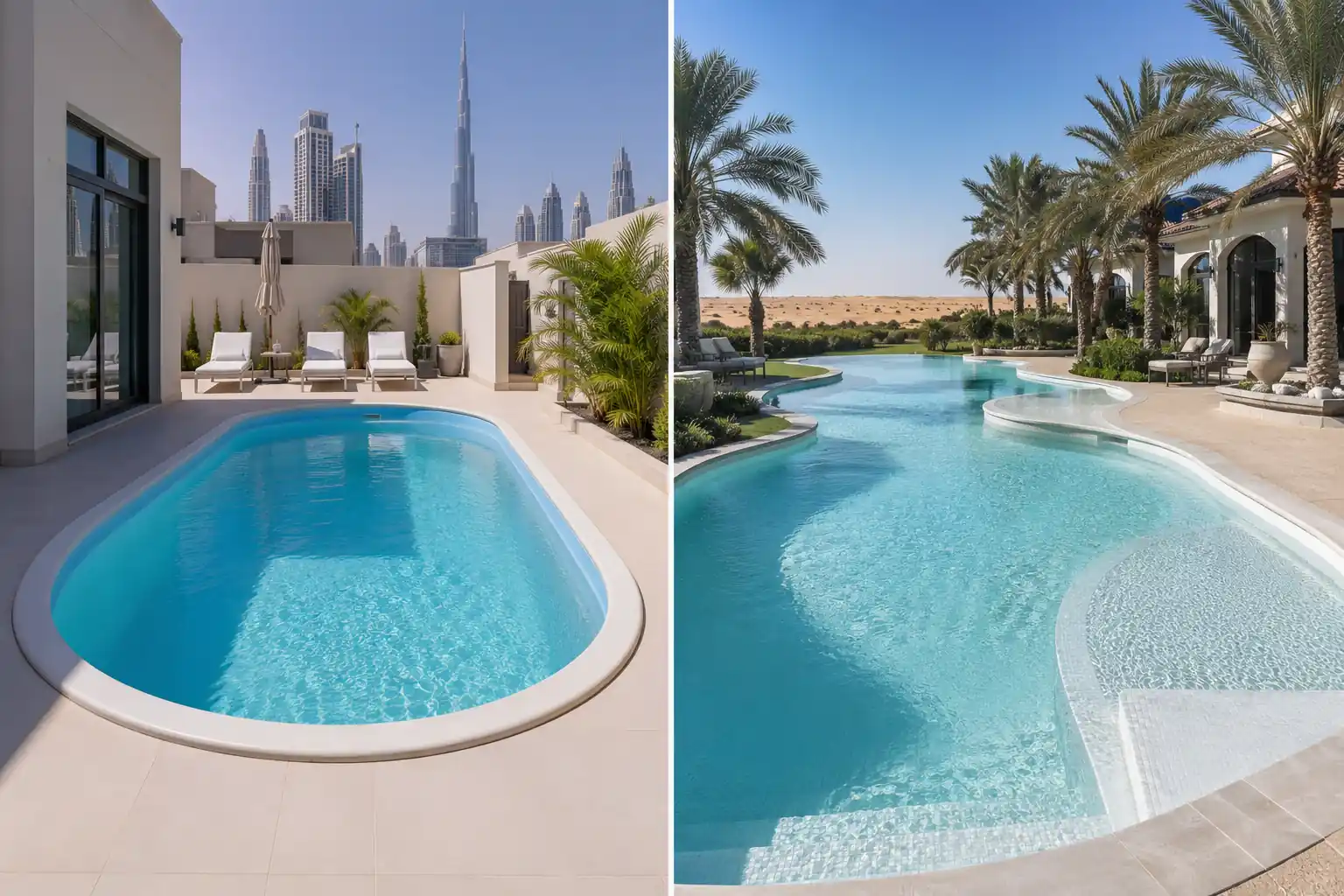
Walk into any pool showroom in Dubai and you’ll face the same question every homeowner does: fibreglass or concrete? Both work. Both look great. But they’re fundamentally different investments — and the wrong choice for your situation can cost you significantly more over time. This guide cuts through the marketing and gives you an honest, side-by-side comparison for fibreglass vs concrete pool based on Dubai’s specific climate, build conditions, and lifestyle.
Table of Contents
If you want the short version, here it is. We’ll go deeper on each factor below.
| Factor | Fibreglass Pool | Concrete Pool |
|---|---|---|
| Upfront Cost | AED 70,000 – 140,000 | AED 90,000 – 280,000+ |
| Installation Time | 3–5 weeks | 8–14 weeks |
| Design Options | Limited to manufacturer shapes | Fully custom — any shape or size |
| Maintenance Cost | Lower — smooth surface resists algae | Higher — porous surface needs more chemicals |
| Heat Performance | Good — but colour can fade in UV | Excellent — handles Dubai heat very well |
| Long-term Durability | 20–25 years (gelcoat may need resurfacing) | 25–50 years (replastering every 10–15 yrs) |
| Chemical Usage | Less — non-porous surface | More — porous plaster absorbs chemicals |
| Best For | Speed, lower maintenance, smaller spaces | Custom design, larger pools, luxury builds |
Fibreglass pools are generally cheaper to install than concrete — primarily because the shell is manufactured off-site and the installation is quicker. A comparable 5m x 10m pool will cost roughly AED 20,000–50,000 less in fibreglass than concrete, depending on finish choices and contractor.
But upfront cost tells only half the story.
Concrete pools have higher ongoing costs:
Fibreglass has its own long-term cost: the gelcoat surface can oxidise and fade in Dubai’s intense UV environment, and osmotic blistering (water bubbles behind the gel coat) is possible — though much rarer in modern fibreglass pools than it was 15 years ago. Gelcoat resurfacing costs AED 10,000 – AED 25,000 when needed.
10-Year Total Cost of Ownership (Approximate — Medium Pool):
Fibreglass typically wins on 10-year economics for similar sizes.
This is where Dubai-specific conditions matter more than any general advice you’ll find online.
Dubai summers bring sustained temperatures of 42–48°C and UV Index levels that regularly hit 11–12 (extreme). This accelerates surface degradation of both pool types — but in different ways:
Dubai’s sandy and sometimes saline soil presents a specific risk for fibreglass pools: hydrostatic pressure. If the pool is drained for maintenance and ground water pressure builds up underneath, a fibreglass shell can pop out of the ground (“pool float”). This isn’t common — but it does happen when proper backfill procedures aren’t followed. A good installer will anchor the shell and use the right backfill material. Always check this.
Concrete pools are heavier and naturally more resistant to hydrostatic pressure.
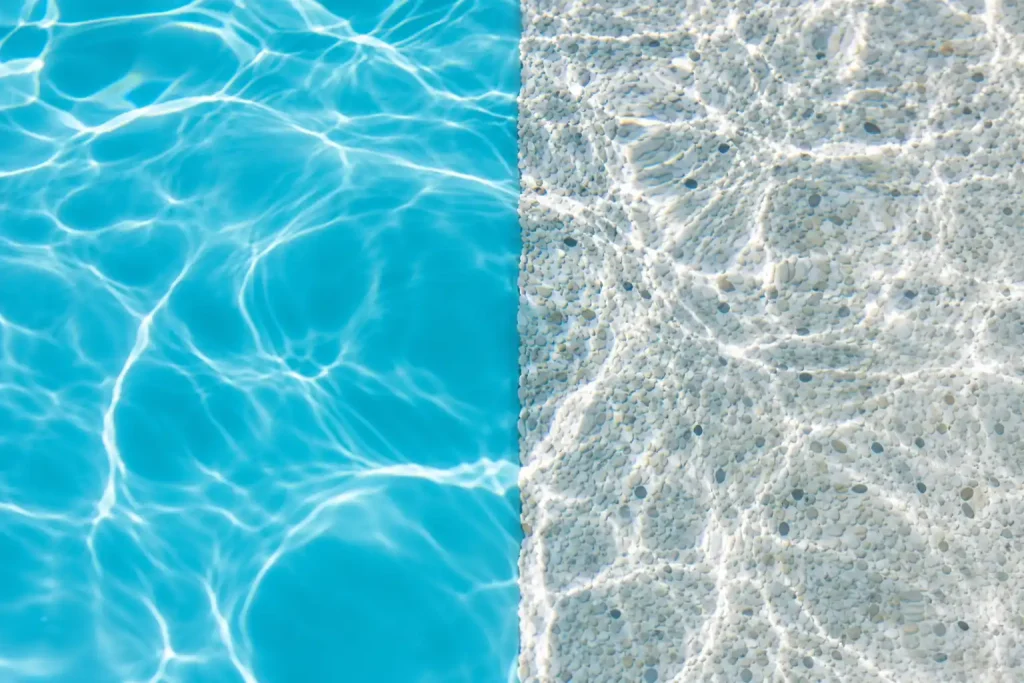
For most Dubai homeowners, this is the deciding factor.
The smooth, non-porous gelcoat surface of a fibreglass pool is genuinely easier to maintain:
Concrete pools require more active maintenance:
For a busy Dubai family using the pool seasonally, the difference in monthly maintenance time is roughly 1–2 extra hours per month for a concrete pool versus fibreglass. That’s not much — but the chemical and labour costs add up.
If you’re using a pool filter on a concrete pool, consider upgrading to a cartridge or DE filter, which handles the finer particles concrete pools generate more effectively than a basic sand filter.
This is where concrete wins decisively — and for many Dubai villa owners, it’s the main reason they choose it.
You’re choosing from a catalogue. Most manufacturers offer 20–40 shapes and sizes, and within those you choose the colour. That’s it. If your garden requires an unusual dimension, or you want a fully bespoke design to match your villa’s architecture, fibreglass simply won’t deliver it.
For Dubai villas where the pool is a visual centrepiece — and where neighbours’ pools are all visible from the same community — design differentiation matters. That’s why the majority of premium villa builds in Emirates Hills, Palm Jumeirah, and Arabian Ranches choose concrete.
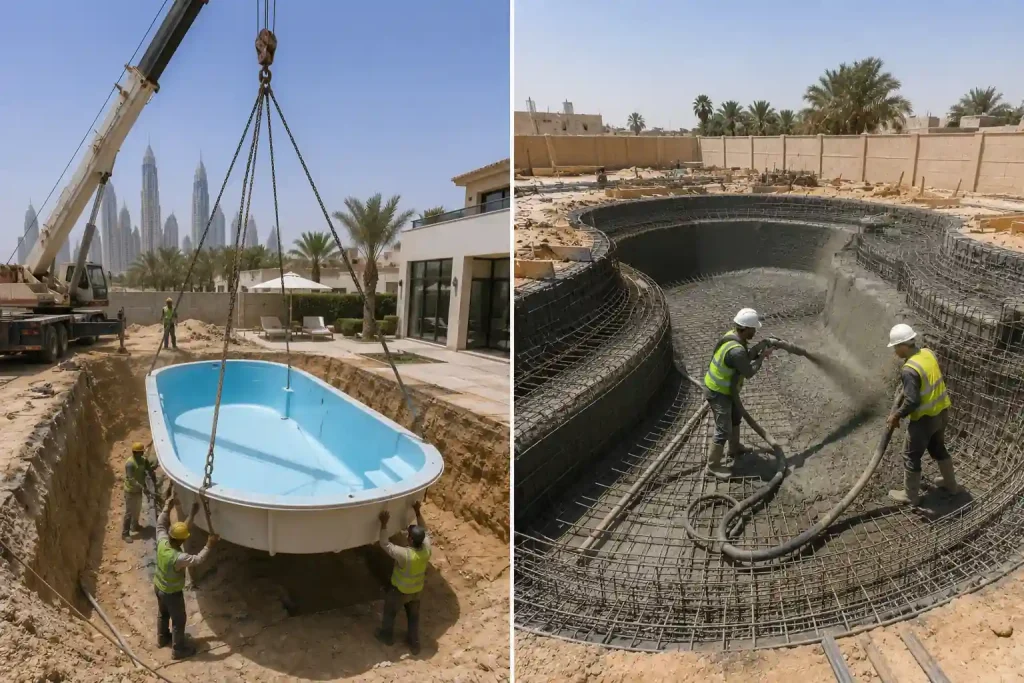
Once the permit is approved and the shell manufactured (which may take 4–8 weeks if not in stock), a fibreglass pool can be excavated, installed, plumbed, and filled in 3–5 weeks. The crane delivery of the shell is the most visually dramatic part — and requires clear access to your garden.
The faster timeline means less disruption to your home and landscaping. If you want to use the pool by next season, fibreglass gets you there quicker.
Concrete pools are built entirely on site. Excavation, steel reinforcement, gunite spray, tile setting, and curing all take time — typically 8–14 weeks for a standard pool. The build site will be active throughout, with machinery, materials, and workers regularly on your property.
Plan the build during the cooler months (October–March) if possible — extreme summer heat slows concrete curing and restricts outdoor labour hours under UAE law.
Here’s a straightforward decision guide based on what matters most to you:
| Choose Fibreglass if… | Choose Concrete if… |
|---|---|
| You want it done quickly (3–5 weeks) | You want a fully custom shape or size |
| Lower maintenance is your priority | Design and aesthetics are the priority |
| Your space fits a standard shell shape | You want an infinity edge, spa, or water features |
| Budget is a constraint upfront | Long-term permanence is important |
| You’re a buy-to-let owner wanting practicality | You’re building your forever home in Dubai |
There is no universally “better” option. The right choice depends entirely on your priorities, budget, garden dimensions, and what you want the pool to look like in 10 years.
Yes — modern fibreglass pools are UV-stabilised and handle Dubai heat well. The main risk is colour fading over time, which is why choosing a reputable manufacturer with a UV-resistant gelcoat is important. Avoid dark colours if long-term colour retention matters to you.
Concrete is more resistant to ground movement and hydrostatic pressure, which matters in some Dubai locations. A properly installed fibreglass pool with good backfill is safe and structurally sound — but concrete does have a slight edge in challenging soil conditions. Always ask your contractor about ground conditions during the site assessment.
Both work with salt chlorination, but fibreglass is more compatible long-term. The smooth, non-porous surface holds up better to the salt environment. Concrete pools with plaster finishes can experience faster surface deterioration in salt water — this is one reason many Dubai pool owners with concrete pools stick to traditional chlorine systems.
A quality fibreglass pool from a reputable manufacturer should last 20–30 years with proper care. The gelcoat surface may need resurfacing (AED 10,000–25,000) after 15–20 years, depending on UV exposure and chemical management. Cheaper shells from unverified suppliers have failed in as little as 8–10 years in UAE conditions.
A high-quality concrete pool with premium tile or pebble finish generally adds more resale value to a Dubai villa than a fibreglass pool — primarily because buyers associate the custom finish with quality. That said, a well-maintained fibreglass pool is far better for resale than a poorly maintained concrete pool.
Building a Pool in Dubai? Start with the Right Equipment.
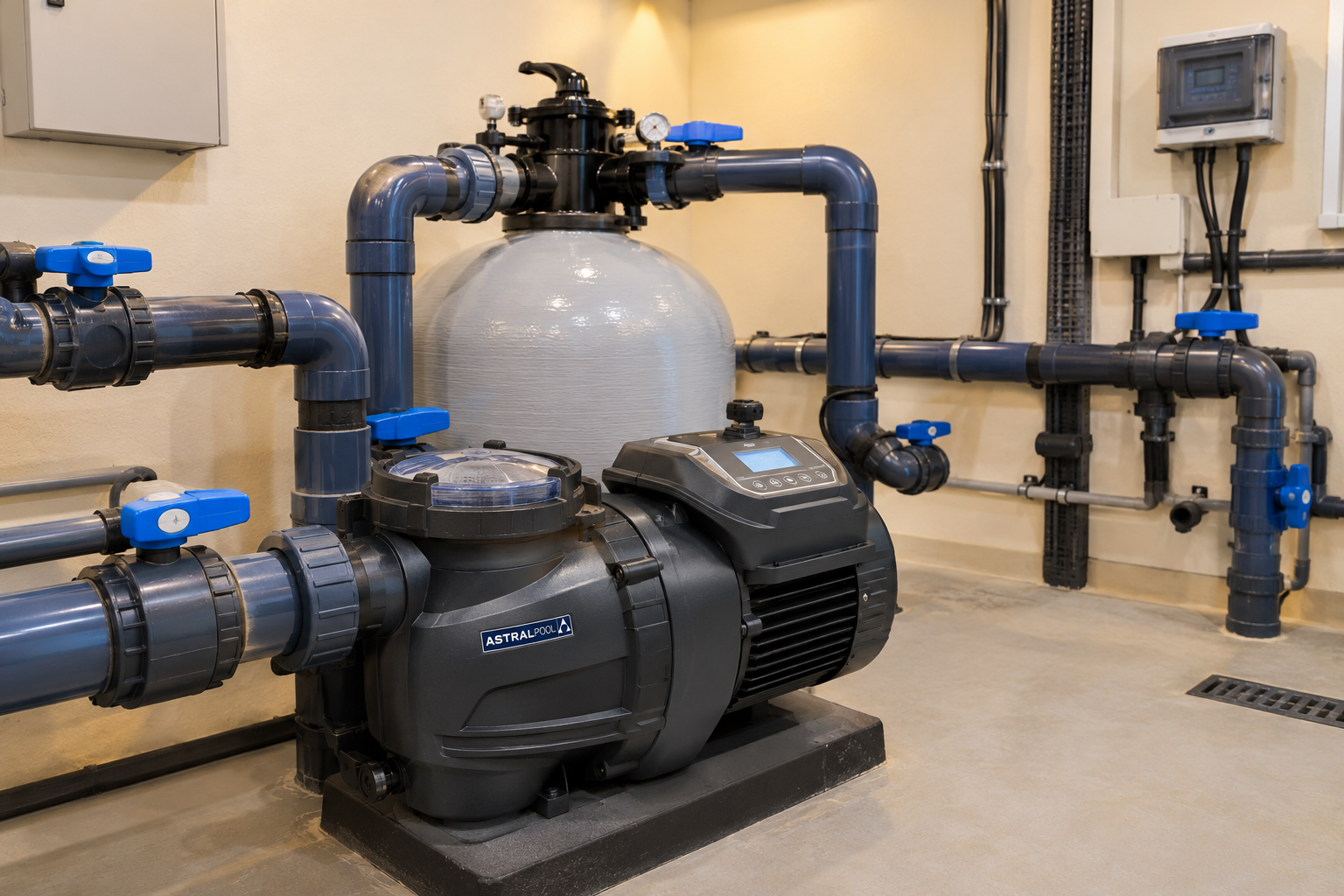
Whatever pool type you choose, Dave Pools supplies premium pool equipment, filtration systems, and pool chemicals from trusted brands including AstralPool and Cepex — delivered across Dubai and the UAE.