
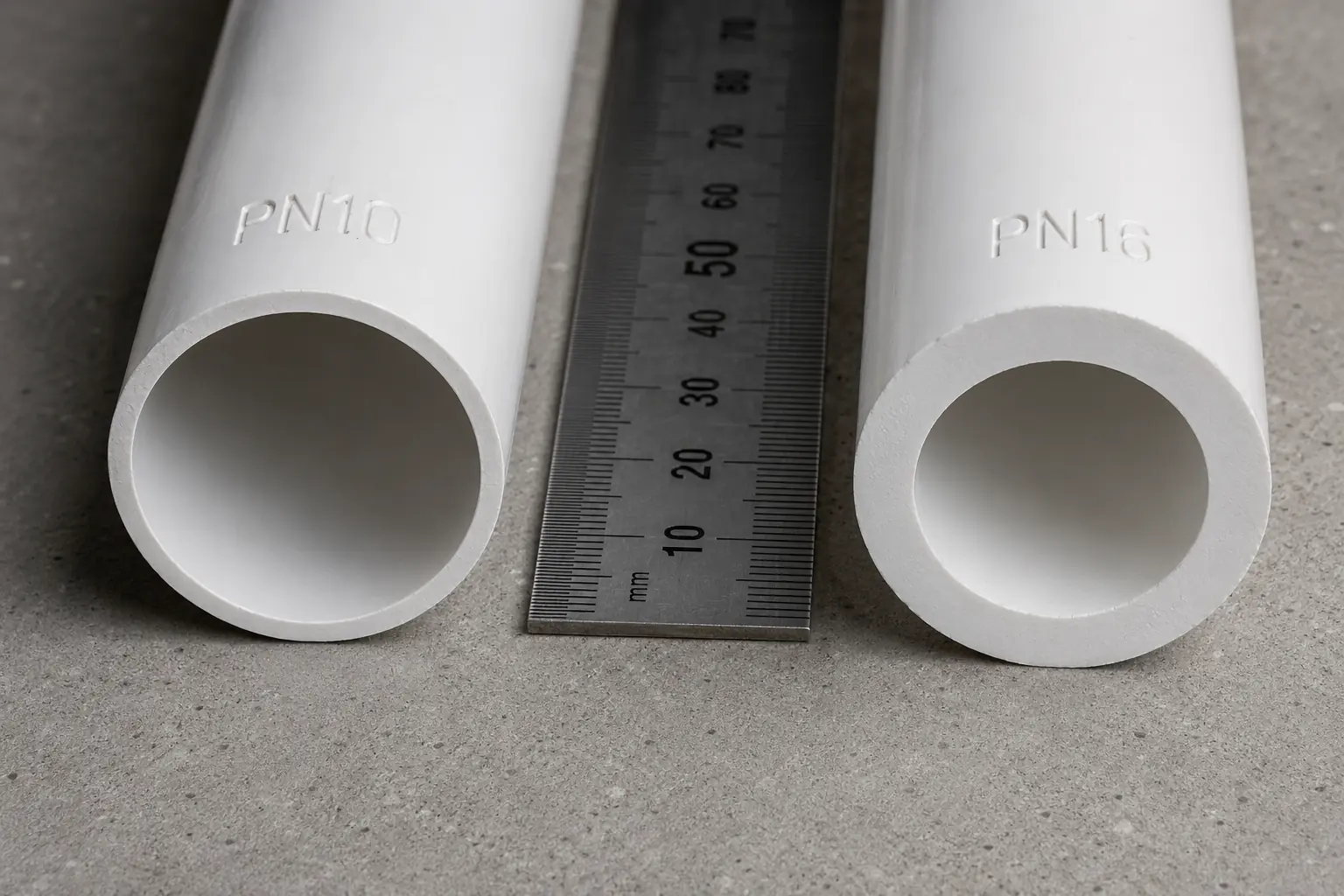
You’re looking at a shelf of PVC pipes or ordering fittings online and you see it printed on every item: PN10, PN16, sometimes PN20. Most buyers either ignore it or just pick the cheaper one. That’s a mistake — and in some installations, it’s a dangerous one. PN ratings tell you how much pressure a pipe or fitting can safely handle. Get it wrong and you get leaks, joint failures, or worse — a fitting that blows out under pressure. This guide explains what PN ratings actually mean in plain terms, how to read them correctly, and exactly when to use PN16 vs PN10 for pools, irrigation, plumbing, and industrial systems.
Table of Contents
hese ratings aren’t just a Dave Pools convention — they come straight from ISO 1452 (published in Europe as EN 1452), the standard that governs PVC-U pressure pipe classification. Under that standard, the PN class a pipe can carry depends on its diameter: pipes under 90mm can be rated anywhere from PN6 to PN20, while larger diameters follow a different pressure series. That’s why two pipes with similar wall thickness can still carry different ratings depending on size.
PN stands for Pression Nominale — French for “Nominal Pressure.” It’s a European standard (adopted internationally through ISO and DIN standards) that defines the maximum working pressure a pipe, fitting, or valve can safely handle at 20°C water temperature.
The number that follows PN is the pressure in bar. So:
To put those numbers in context: 1 bar is roughly equal to 14.5 psi, or the pressure exerted by 10 metres of water column. UAE mains water supply typically arrives at your property at 2–4.5 bar. A standard swimming pool pump generates 1.5–4 bar depending on size and speed. Industrial systems and fire suppression lines can go much higher.
Important: The PN rating is a maximum working pressure, not a burst pressure. Pipes are manufactured to burst at significantly higher pressures than their PN rating — but operating continuously at or near the PN limit shortens their lifespan considerably. A 30–50% safety margin below the PN rating is standard practice for permanent installations.
PN10 pipe is rated to handle up to 10 bar (145 psi) at 20°C. For most residential and light commercial water applications, that’s more than enough headroom. UAE mains supply pressure rarely exceeds 5 bar, and most irrigation and pool systems operate between 1.5 and 4 bar.
Because PN10 pipe has thinner walls than PN16, it uses less material. That makes it lighter, easier to handle, and cheaper per metre. For large irrigation projects where hundreds of metres of pipe are laid, the cost saving from using PN10 on low-pressure sections is meaningful — and perfectly safe when the system is designed correctly.
For standard residential irrigation systems in UAE villas, PN10 uPVC or HDPE pipe is typically the right call for the lateral distribution lines feeding drip emitters and micro-sprayers. See our guide on choosing the best pipe material for irrigation systems.
PN16 pipe handles up to 16 bar (232 psi) at 20°C — that’s 60% more pressure capacity than PN10. It achieves this through thicker walls and, in some materials, denser formulations. You pay more for it and it weighs more, but in the right application it’s not a luxury — it’s a requirement.
Rule of thumb used by professional installers: If you’re not 100% certain the pressure in a section will stay below 6 bar at all times — including during pump startup, valve closure, and abnormal conditions — use PN16. The cost difference per fitting is small. A failed joint or burst pipe costs far more.
| Factor | PN10 | PN16 |
|---|---|---|
| Max working pressure at 20°C | 10 bar (145 psi) | 16 bar (232 psi) |
| Wall thickness (25mm OD pipe, PVC) | ~1.9mm | ~2.8mm (approx. 47% thicker) |
| Pipe weight | Lighter | Heavier |
| Cost per metre | Lower (15–30% cheaper than PN16) | Higher |
| Resistance to water hammer | Moderate | High |
| Performance at elevated temperatures | Pressure rating drops faster with heat | Retains rating better at higher temps |
| Suitable for pump pressure side | ⚠️ Marginal — not recommended | ✅ Yes |
| Suitable for irrigation laterals | ✅ Yes | ✅ Yes (overkill for low-pressure zones) |
| Suitable for fire systems | ❌ Not recommended | ✅ Yes (minimum standard) |
| Suitable for hot water (PPR) | ⚠️ Only at lower temperatures | ✅ Yes — standard for hot water PPR |
| ISO/DIN standard compliance | ISO 4422 / DIN 8062 | ISO 4422 / DIN 8062 |
A quick way to sanity-check your choice: Required PN rating = (supply pressure + elevation head + pump pressure) × 1.3. That 1.3 multiplier builds in a 30% safety margin for surges and long-term wear. Most municipal water supply runs at just 2–5 bar, which is exactly why PN10 covers the majority of return and suction-side plumbing without issue.For the pressure-side plumbing where PN16 is non-negotiable, pair it with properly rated high-pressure PVC valves rather than standard fittings.
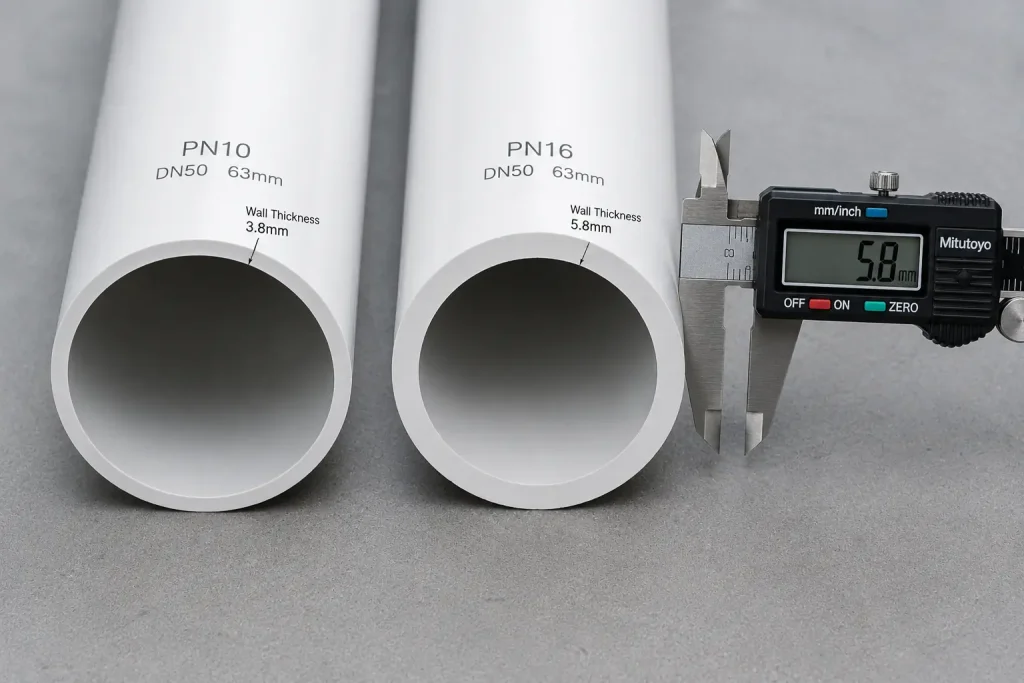
The single most visible difference between PN10 and PN16 pipe is wall thickness. Since the outside diameter (OD) of both ratings is the same for a given nominal size, the inner bore diameter is smaller on PN16 pipe. This is important to understand when calculating flow rates — a PN16 pipe of the same nominal size carries slightly less volume than a PN10 pipe because the bore is narrower.
Here are reference wall thicknesses for standard PVC pipe sizes at both ratings:
| Nominal Size (DN) | Outside Diameter (mm) | PN10 Wall Thickness (mm) | PN16 Wall Thickness (mm) |
|---|---|---|---|
| DN20 | 25mm | 1.9mm | 2.8mm |
| DN25 | 32mm | 2.4mm | 3.2mm |
| DN32 | 40mm | 2.4mm | 3.7mm |
| DN40 | 50mm | 3.0mm | 4.6mm |
| DN50 | 63mm | 3.8mm | 5.8mm |
| DN65 | 75mm | 4.5mm | 7.1mm |
| DN80 | 90mm | 5.4mm | 8.2mm |
| DN100 | 110mm | 6.6mm | 10.0mm |
When you’re buying pipe and you’re not sure if it’s PN10 or PN16, a wall thickness measurement with a digital calliper against these reference values will tell you immediately. The PN rating should also be printed or embossed on the pipe itself — always check this before installation. For how to verify pipe quality before you buy, read our guide on how to check PVC pipe quality.
This is the part most people don’t know — and it’s critically important in the UAE.
PN ratings are specified at 20°C water temperature. As temperature rises, the pipe material softens slightly, and its safe working pressure decreases. For PVC and uPVC pipe specifically, this de-rating is significant at the temperatures common in UAE water systems.
| Water Temperature | PN10 Actual Safe Pressure | PN16 Actual Safe Pressure |
|---|---|---|
| 20°C (standard) | 10 bar | 16 bar |
| 30°C | ~8.8 bar | ~14.0 bar |
| 40°C (UAE summer mains) | ~7.5 bar | ~12.0 bar |
| 50°C (hot water lines) | ~6.0 bar | ~9.5 bar |
| 60°C | ~4.5 bar (significant reduction) | ~7.2 bar |
What this means for UAE installations specifically:
UAE Practical Rule: In any outdoor or exposed above-ground piping in the UAE, apply a temperature de-rating. Do not rely on the 20°C PN specification for a pipe exposed to direct summer sunlight — even if it’s carrying cold water, the pipe surface itself gets extremely hot. Either shade the pipe, insulate it, or upgrade to the next PN rating.
Here’s a practical guide to what you should be using in common UAE and general plumbing, irrigation, and pool applications:
| Application | Recommended PN | Notes |
|---|---|---|
| Irrigation mainline (buried) | PN10 | UAE mains supply is well within PN10 range when buried |
| Irrigation mainline (above ground, exposed to sun) | PN16 | Temperature de-rating applies; use PN16 or shade/insulate PN10 |
| Drip irrigation laterals | PN10 | Operating pressure is very low — PN10 is more than adequate |
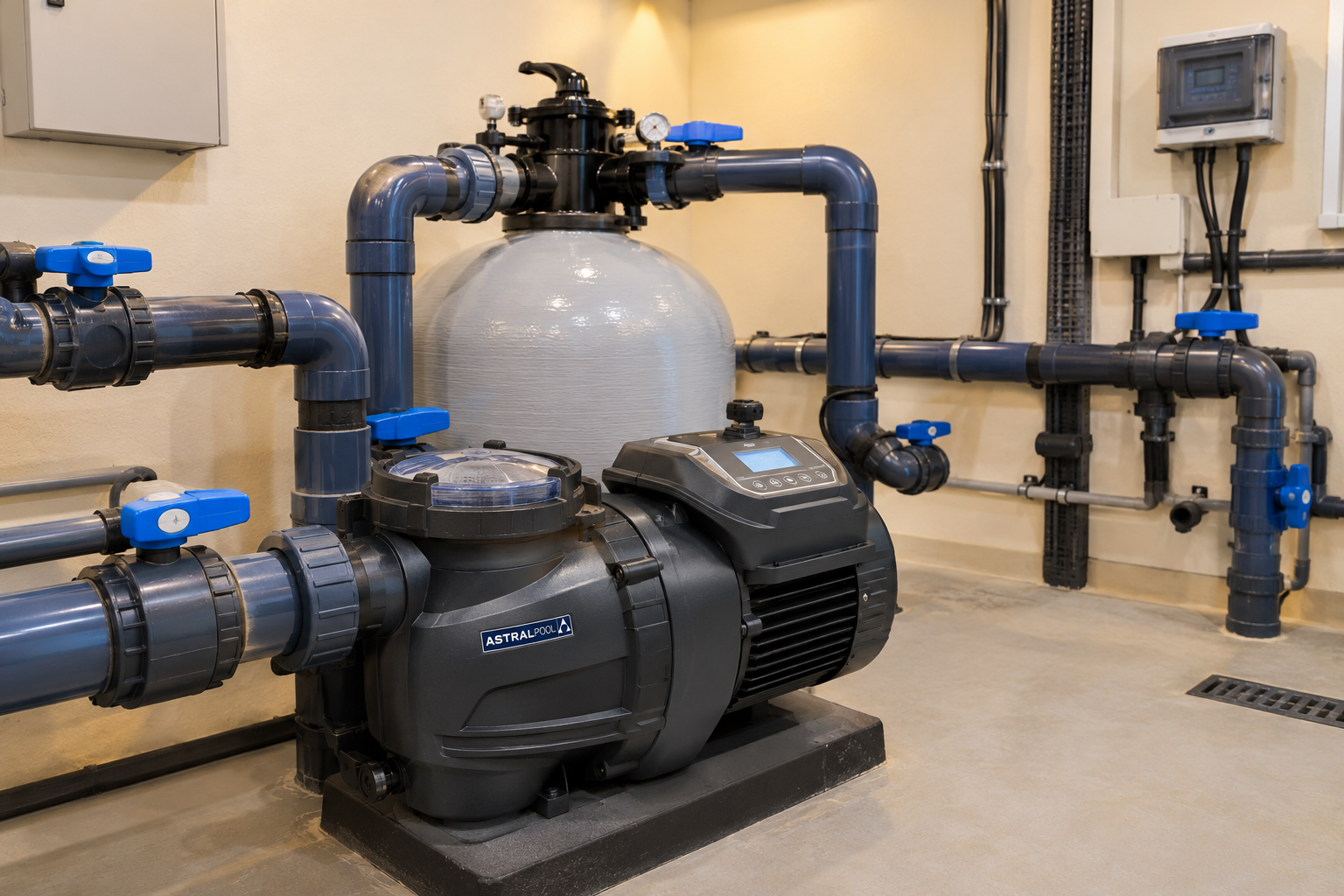
| Pool pump pressure side (pump to filter) | PN16 | Highest pressure point in any pool system — do not use PN10 |
| Pool filter to return lines | PN10 | Pressure is reduced after the filter — PN10 is acceptable |
| Pool suction lines (skimmer/drain to pump) | PN10 | Negative pressure — PN10 adequate but use good quality fittings |
| Residential cold water supply (below 4 bar) | PN10 | Standard mains pressure in UAE falls within this safely |
| Residential hot water supply (PPR) | PN20 minimum | Temperature de-rating at 60°C requires higher base PN for PPR |
| Fire sprinkler supply lines | PN16 minimum (CPVC) | Fire safety standards require PN16 or higher — never use PN10 |
| High-rise building water supply (pump-boosted) | PN16 | Booster pumps lifting water to upper floors generate high pressure |
| Drainage and sewage lines | PN10 or unrated drainage pipe | Gravity-flow drainage operates at near-zero pressure |
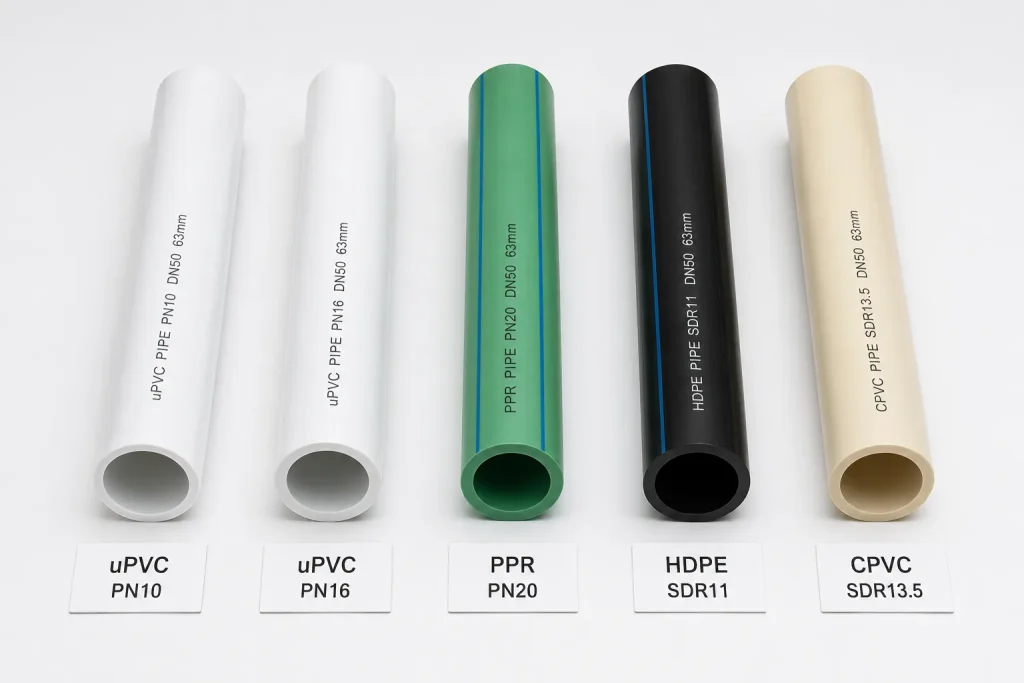
PN ratings apply across all pipe materials, not just PVC. But the way each material handles its PN rating differs — and understanding this helps you choose the right pipe type for each job.
Available in PN6, PN10, and PN16. Standard for cold water supply, irrigation, drainage, and pool plumbing. uPVC is the UV-stabilised version — always use uPVC for outdoor applications in UAE. PVC degrades rapidly under the UAE’s high UV index. See our standard PVC pipe sizes guide and our full breakdown of what PVC pipe is and how it’s used.
Available in PN10, PN16, PN20, and PN25. PPR is the gold standard for hot and cold water plumbing inside buildings. It handles high temperatures far better than PVC — making the PN rating more reliable at actual UAE operating temperatures. For hot water lines, PN20 is the minimum; PN25 is specified for commercial systems. Read our complete guide on PPR pipes and fittings.
HDPE pipe uses a different but related pressure classification system — SDR (Standard Dimension Ratio), which defines the ratio of outside diameter to wall thickness. SDR 11 roughly corresponds to PN16 pressure capacity; SDR 17 is closer to PN10. HDPE is extremely flexible and durable — it’s the preferred pipe for buried water mains, gas lines, and industrial applications. Read our SDR 11 vs SDR 17 comparison and our complete HDPE pipe guide.
CPVC (Chlorinated PVC) carries the same PN rating system as PVC but is rated for higher temperature service than standard PVC. It’s the standard pipe material for fire sprinkler systems (CPVC PN16) and for some hot water applications. See our guide on CPVC vs PVC pipe comparison.
Why it happens: PN10 pipe is cheaper and buyers don’t always distinguish between the pressure side and suction side of a pump system.
Why it’s a problem: The pressure immediately after a pool pump or booster pump can reach 3–5 bar under normal operation and spike to 6–8 bar during pump startup or if a valve is closed suddenly (water hammer). PN10’s theoretical maximum is 10 bar — but with temperature de-rating in UAE heat, the real safe limit is 7–8 bar. That’s a dangerously thin margin.
Fix: Always use PN16 from the pump outlet to and including the filter. No exceptions.
Why it happens: A job runs short of PN16 elbows and a PN10 one gets used as a substitute.
Why it’s a problem: Your system’s pressure limit is defined by its weakest component. One PN10 fitting in a PN16 zone creates a failure point under pressure spikes or water hammer.
Fix: Maintain rating consistency throughout each pressure zone. Never substitute down.
Why it happens: Buyers specify the right pipe rating but buy generic or unrated fittings because they look the same and cost less.
Why it’s a problem: Fittings — especially elbows, tees, and reducers — experience the same pressure as the pipe. An unrated or incorrectly rated fitting is the most common failure point in a plumbing system.
Fix: Always match the PN rating of your fittings to your pipe. The PN marking should be visible on every fitting. See our guide on pipe fitting types and how to identify them.
Why it happens: PN ratings are specified at 20°C, but pipe spec sheets are often not adjusted for actual operating temperatures.
Why it’s a problem: As shown in the temperature table above, a PN10 pipe at 40°C has an effective safe pressure of only ~7.5 bar. For systems with any pressure uncertainty in a hot UAE environment, this leaves very little margin.Temperature plays a role too — if your pool deals with heater discharge or high ambient heat, check pressure capacity against our PVC pipe temperature rating guide before finalizing your PN selection.
Fix: Always apply temperature de-rating to your pressure calculations for UAE installations. When in doubt, upgrade to the next PN rating.
Why it happens: As a safety measure, some buyers specify PN16 everywhere, including low-pressure drainage and gravity systems.
Why it’s a problem: Not a safety problem — but a cost and flow problem. PN16 has a narrower bore for the same OD. In large-diameter drainage or gravity irrigation lines, the narrower bore slightly reduces flow capacity and adds cost unnecessarily.
Fix: Use the right rating for each zone. Reserve PN16 for pressure zones that genuinely need it.
A: It’s short for “Pressure Nominal 10” — the pipe or fitting is rated to handle up to 10 bar, or about 145 psi, at 20°C. It’s an international standard, so a PN10 pipe from any reputable manufacturer performs the same way.
A: PN16 means the component can safely handle pressure up to 16 bar, or roughly 232 psi, at 20°C. That’s about 60% more pressure tolerance than PN10, which is why PN16 shows up on the high-pressure side of pool and plumbing systems.
A: You can, but it’s not ideal. Your system’s true pressure limit is only as strong as its weakest-rated part. If you do mix ratings, make sure the PN10 sections are only ever exposed to pressure well below their limit.
A: Check the side of the pipe first — most quality manufacturers print the rating right on it. No marking? Measure the wall thickness instead. PN16 pipes are noticeably thicker than PN10 pipes of the same diameter.
A: Yes. PN ratings are set at 20°C and drop as temperature rises. A PN16 pipe running water at 45°C might only handle 12 to 13 bar safely instead of the full 16 — worth checking if your system runs warm.
A: Not necessarily. It costs 15 to 30% more and isn’t needed everywhere. If your pressure stays comfortably under 10 bar — which covers most residential return lines — PN10 does the job just fine and saves you money.
A: Most residential pools do well with PN10 on the suction side and returns, and PN16 right after the pump and before the filter, where pressure spikes hardest. High-performance pumps may push you toward PN16 throughout.
A: They’re different systems measuring similar things. As a rough guide, Schedule 40 lines up closest to PN10–12, and Schedule 80 is closer to PN16–20 — though the exact match shifts depending on the pipe’s actual diameter.If you’re not sure which Schedule or PN class matches your project, our guide to standard PVC pipe sizes breaks down both systems side by side.
A: The PN rating itself doesn’t change with saltwater, but most pros lean toward PN16 anyway. The thicker walls hold up better against the slightly more corrosive environment that salt chlorination creates over time.
A: It can. Variable-speed pumps usually run at lower pressure to save energy, but at full speed they can generate more pressure than a single-speed pump with the same horsepower. Double-check your plumbing can handle the pump’s peak output, not just its average.
Need the Right PN-Rated Pipes and Fittings for Your Project?
Dave Pools supplies a complete range of PN10 and PN16 PVC, uPVC, CPVC, PPR, and HDPE pipes and fittings across Dubai and the UAE — from leading brands including Cosmoplast, Raktherm, and Hepworth. Our team can help you specify the correct pressure rating for every zone in your system.