
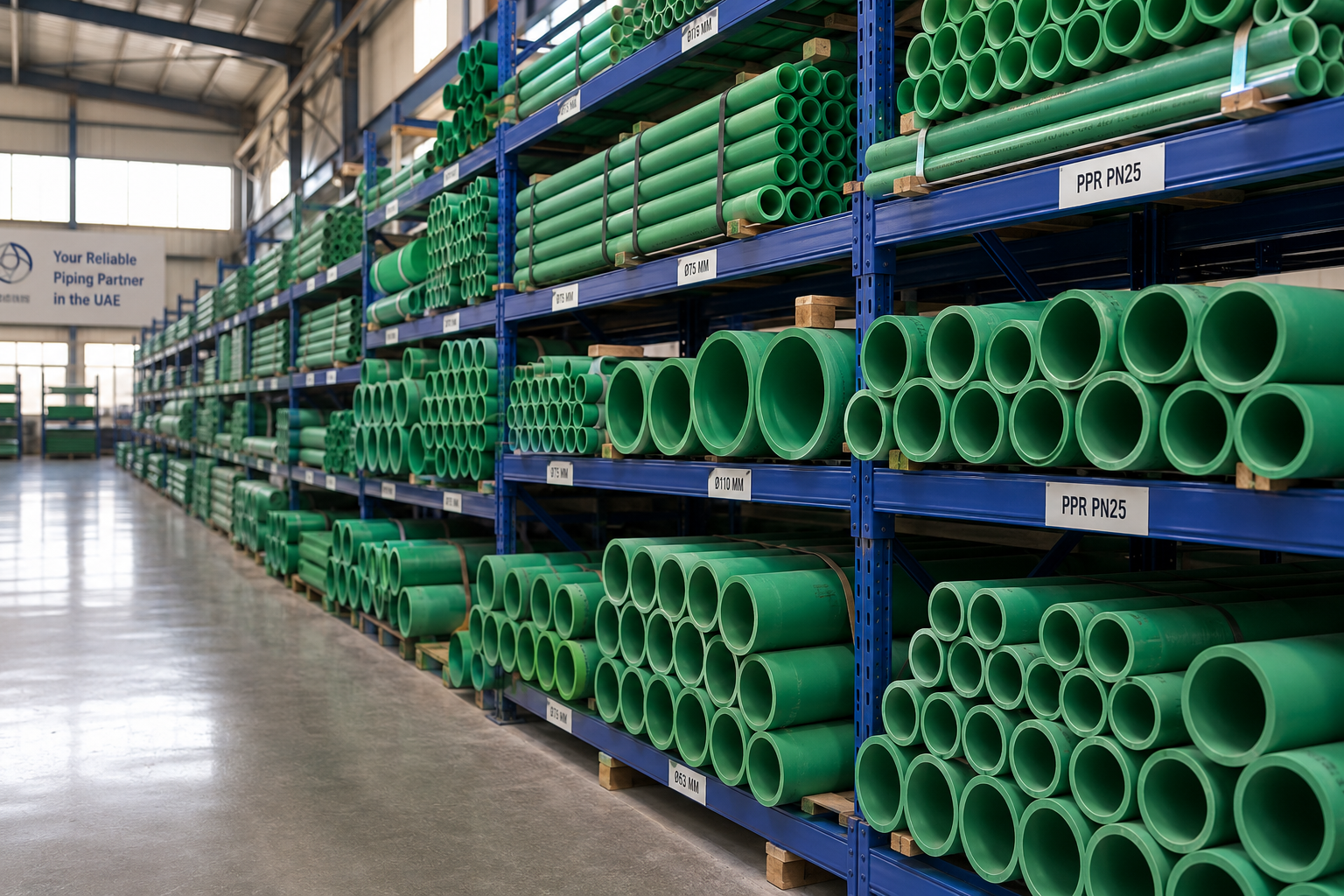
PPR pipe price in Dubai is set by four things — outside diameter, PN pressure class, pipe construction (plain, fibre composite or aluminium composite), and the certification behind it. Two quotes for “25mm PPR” can describe two very different pipes. This guide shows you exactly what to specify so you compare like with like.
Here’s the problem most buyers in Dubai run into.
You send the same enquiry to three suppliers. One comes back cheap, one sits in the middle, one is noticeably higher. Nothing on the paperwork explains the gap. So the decision gets made on the number at the bottom — and eighteen months later, a hot water riser in a villa starts sweating at a fitting.
The gap is almost never random. It’s usually PN class, wall thickness, or paperwork. Once you can read those three things, the pricing stops being a mystery.
We don’t publish live rates on this page, because PPR pricing moves with raw material, brand, and order volume. What we can do is teach you to spec the pipe properly — then request a quote that’s actually comparable.
Who this is for: MEP contractors, villa developers, facility managers and plumbing traders sourcing from a PPR pipes and fittings supplier in Dubai.
What actually decides PPR pipe price in Dubai?
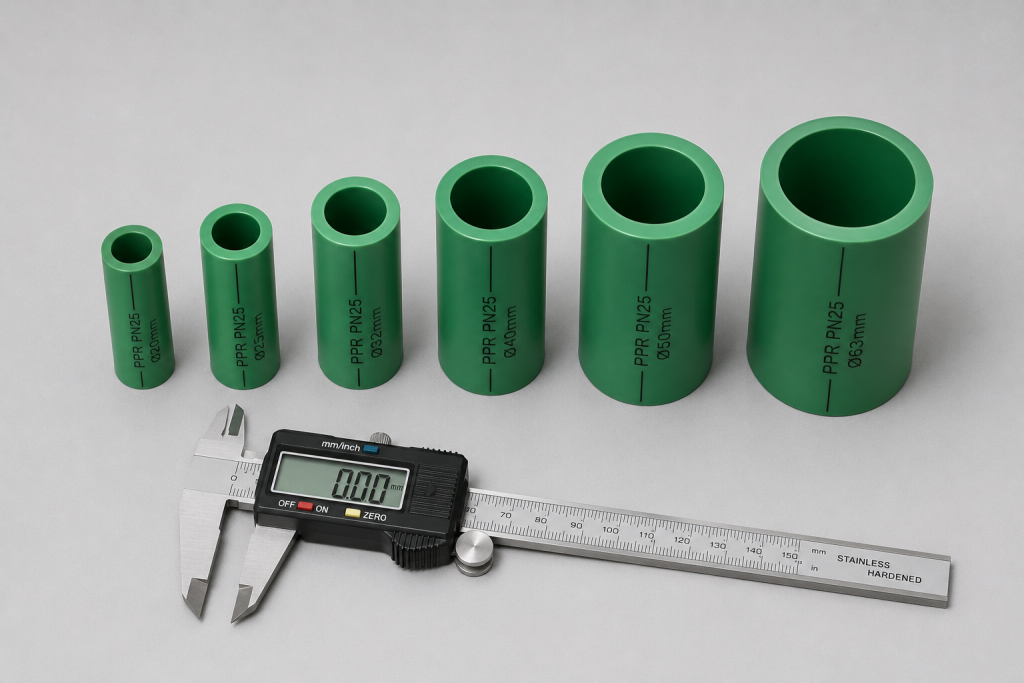
PPR pipe price in Dubai comes down to how much polypropylene is in the pipe, what grade it is, and who has certified it. Everything else is packaging. Here are the six drivers, in the order they move a quotation.
More diameter means more material per metre. Simple. But the jump isn’t linear: moving from 25mm to 32mm adds far more weight per metre than 20mm to 25mm, because wall thickness scales with diameter too.
This is also where oversizing quietly drains a budget. Contractors sometimes bump every branch up “for safety”. On a 60-villa community, that habit adds real weight to the order for no measurable pressure benefit. If you’re unsure, our guide on how to choose PPR pipe size walks through the sizing logic properly.
PN10, PN16, PN20, PN25. Each step up thickens the wall for the same outside diameter. More wall, more material, higher price per metre.
The mistake is treating PN as a “safety level” you can dial up freely. It isn’t. It’s an engineering class tied to temperature and design life. If you want the deeper breakdown, read the difference between PN10 and PN16 and our comparison of PN16 vs PN10 pipe pressure ratings.
Three constructions dominate the UAE market:
Composite pipe costs more per metre. On long hot-water risers it often saves more in brackets, loops and labour than it adds in material.
This is the invisible line item. A pipe with full third-party backing — Intertek, WRAS, Kiwa, BSI Kitemark, CE — has been paid for in the factory long before it reaches Al Quoz. A pipe without it hasn’t.
On Dubai projects, consultants increasingly ask for conformity documentation and, on potable water systems, evidence the material is accepted for the application. If your supplier can’t produce a datasheet and test certificate the same day, that’s your answer.
People price pipe and forget fittings. On a villa bathroom cluster, the fitting count per metre of pipe is far higher than on a straight riser — so the fittings can dominate the line. Elbows, tees, sockets, unions, brass-insert transitions and valves all carry different values.
Our breakdown of PPR pipe fitting types helps you build a realistic take-off instead of a rough guess.
Full-bundle quantities, scheduled deliveries and consolidated orders across PVC, HDPE and PPR usually land better than a single small drop. Site access, floor delivery and urgent same-week supply all move the number as well.
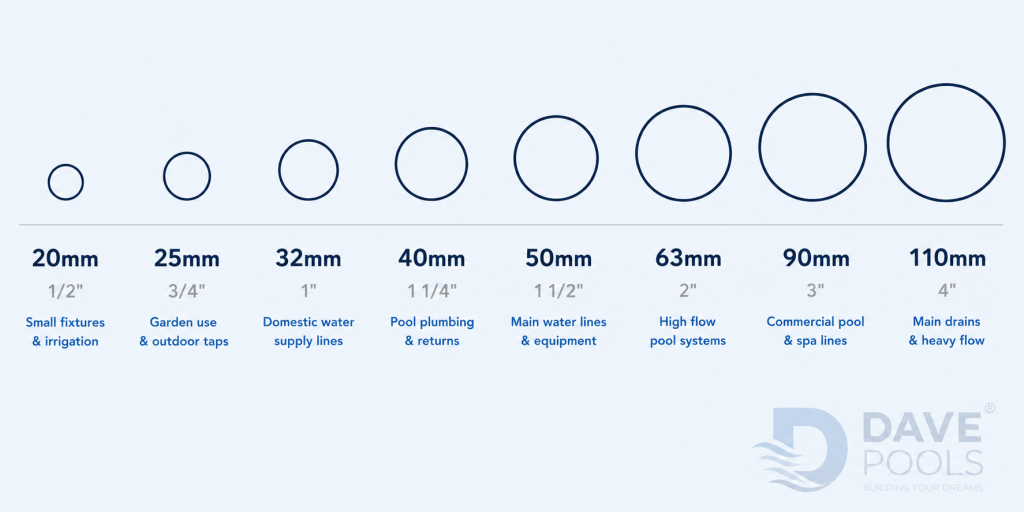
PPR is measured by outside diameter, not internal bore. A “25mm” PPR pipe is 25mm across the outside — the water passage inside is smaller, and how much smaller depends on the PN class.
| OD (mm) | Common trade reference | Where it’s typically used in UAE projects |
|---|---|---|
| 20 | ~½” | Single fixture branches — basin, WC, shower feed |
| 25 | ~¾” | Branch serving 2–3 fixtures, small apartment feeds |
| 32 | ~1″ | Apartment sub-main, villa bathroom cluster |
| 40 | ~1¼” | Floor distribution, small riser |
| 50 | ~1½” | Riser, villa main, booster discharge |
| 63 | ~2″ | Building main, plant room headers |
| 75 | ~2½” | Larger risers, chilled water branches |
| 90 | ~3″ | Main distribution in towers |
| 110 | ~4″ | Primary mains, larger chilled water lines |
| 125–160 | 5″–6″ | Heavy commercial and industrial distribution |
If you’re converting between systems or checking what’s already installed on site, how to measure pipe size covers the practical method — and it’s worth knowing that standard PVC pipe sizes follow a completely different logic.
PN stands for pressione nominale — nominal pressure. A PN20 PPR pipe is rated for 20 bar of continuous internal pressure at 20°C over a 50-year design life, as defined in DIN 8077/8078 and ISO 15874. Raise the temperature and that figure comes down.
That last sentence is the one that matters in Dubai.
| PN class | Typical SDR / S-series | Wall relative to OD | Where it fits |
|---|---|---|---|
| PN10 | SDR 11 (S5) | Thinnest | Cold water only, low-rise, some irrigation feeds |
| PN16 | SDR 7.4 (S3.2) | Medium | Cold water mains, warm water, general distribution |
| PN20 | SDR 6 (S2.5) | Thick | Hot water lines, risers, the UAE workhorse |
| PN25 | Fibre composite construction | Thick + reinforced | Hot water at higher duty, long runs, plant rooms |
Thermoplastics lose pressure capacity as they get hotter. A pipe rated 20 bar at 20°C is not carrying 20 bar at 70°C — the manufacturer’s derating table will show a much lower long-term working pressure.
Because Dubai hot water systems run continuously warm, and because “cold” lines here aren’t always cold, PN20 gives sensible headroom on any line that may see heat. It’s the reason most specifications in the Emirates land there.
Always ask for the manufacturer’s pressure/temperature derating chart. A supplier who hands it over without hesitating is a supplier who knows their product — the same principle we apply in how to check PVC pipe quality.
PN25 in PPR is usually achieved through a glass-fibre reinforced middle layer rather than simply piling on more wall. You get pressure capacity and roughly a four-to-five-fold reduction in thermal movement. On a long horizontal run in a plant room, that’s not a luxury.
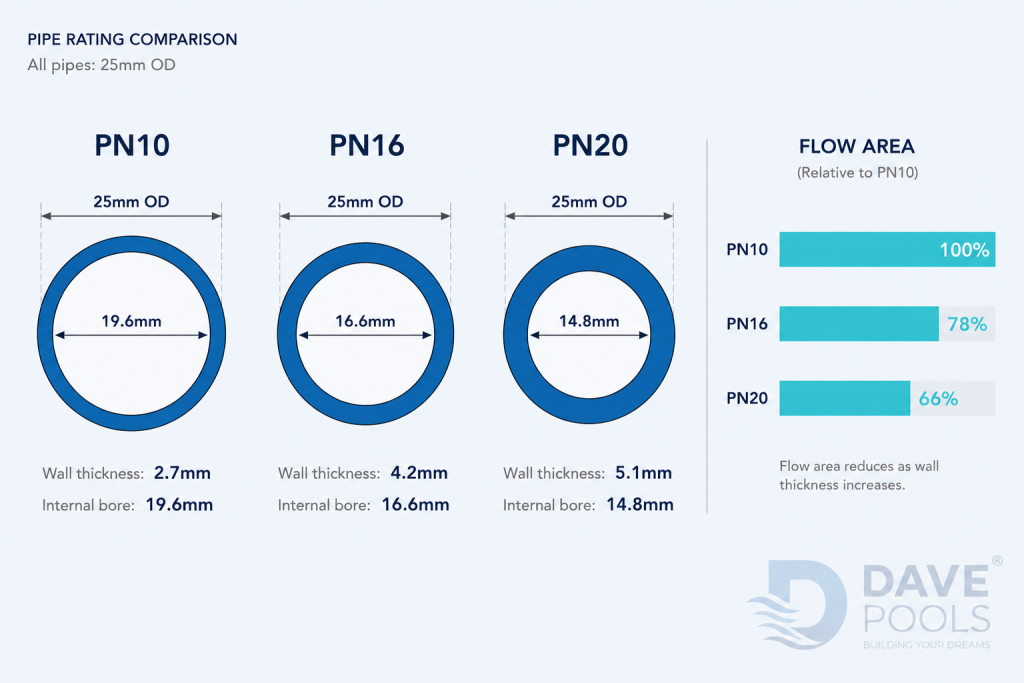
Here’s the practical consequence of PN class, using 25mm OD as the example. Wall thicknesses follow DIN 8077 for PP-R:
| 25mm OD PPR | Wall thickness | Internal bore | Flow area vs PN10 |
|---|---|---|---|
| PN10 (SDR 11) | 2.3mm | 20.4mm | 100% |
| PN16 (SDR 7.4) | 3.5mm | 18.0mm | ~78% |
| PN20 (SDR 6) | 4.2mm | 16.6mm | ~66% |
Read that last column again.
Moving from PN10 to PN20 at the same nominal size removes about a third of the flow area. So the contractor who “upgrades everything to PN20 for safety” without resizing has just built a pressure problem into the system — and paid more for the privilege.
The correct move: choose PN based on temperature and duty, then size the diameter around the bore you actually end up with. If pressure is already marginal on an existing system, our guide on how to increase water pressure in a pipe covers the realistic fixes.
Wall thickness by class also explains why SDR is worth understanding — it’s the same ratio logic used across plastic pipe systems, as covered in SDR 11 vs SDR 17.

Step 1 — Separate the lines by temperature. Hot water, warm return, cold water, chilled water and any solar-heated line all get assessed separately. Don’t apply one class across the whole drawing. If you’re unsure whether PPR suits a given line, start with is PPR pipe compatible with hot or cold water.
Step 2 — Set the PN class from the worst-case temperature and pressure. Worst case in the UAE usually means summer, mid-afternoon, with a booster running. Cross-check the value against the manufacturer’s derating table, not the number printed on the pipe.
Step 3 — Size the diameter from flow demand, using the real bore. Take the internal bore for that PN class, not the OD. Add up fixture units, apply your velocity limit, then pick the size.
Step 4 — Decide plain vs composite by run length. Short branches inside a bathroom: plain PP-R is fine. Long horizontal runs, risers, exposed plant room piping: fibre composite earns its place immediately.
Step 5 — Build the fittings take-off properly. Count elbows, tees, reducers, unions and every brass-insert transition. Then confirm the fusion tooling on site matches the sizes you’ve ordered — the method is covered in how to weld PPR pipe and how to connect PPR pipes.
Step 6 — Lock the specification, then request pricing. Send suppliers a spec, not a wish. Brand, standard, PN class, size list, quantities, delivery schedule. Now the numbers you get back mean something.
Rooftop and exposed water tanks in the UAE can push supply temperatures well above what a designer in a temperate climate would expect during peak summer. A line specified as cold water on paper may run warm for months of the year.
That’s a real derating issue. It’s one of the strongest arguments for specifying a higher PN class on cold lines than the drawing suggests.
Polypropylene degrades under sustained UV. Any PPR that will sit exposed on a roof, in an open plant area, or on a temporary works run needs a UV-protected grade or full physical covering. Ordinary green PPR left in Dubai sunlight is on a countdown.
Plain PP-R moves roughly 0.15mm per metre per degree Celsius. Run that across a 20-metre pipe seeing a 50°C swing and you’re looking at meaningful movement that has to go somewhere — into an expansion loop, a properly placed guide, or into your fittings.
Fibre composite cuts that figure by roughly four to five times. On long runs, that’s the whole reason the product exists.
Sustained high free-chlorine residual combined with high temperature accelerates ageing in every polyolefin system. If the project has aggressive dosing, ask for chlorine-resistance test data specifically — and consider how the wider water management solution is designed, not just the pipe.
Rigid piping in shafts transmits water noise. If the project is a premium villa or hotel, this becomes a snag-list item late in the job. Worth reading how to soundproof noisy pipes at design stage, and looking at dedicated soundproof pipes and fittings for waste stacks.
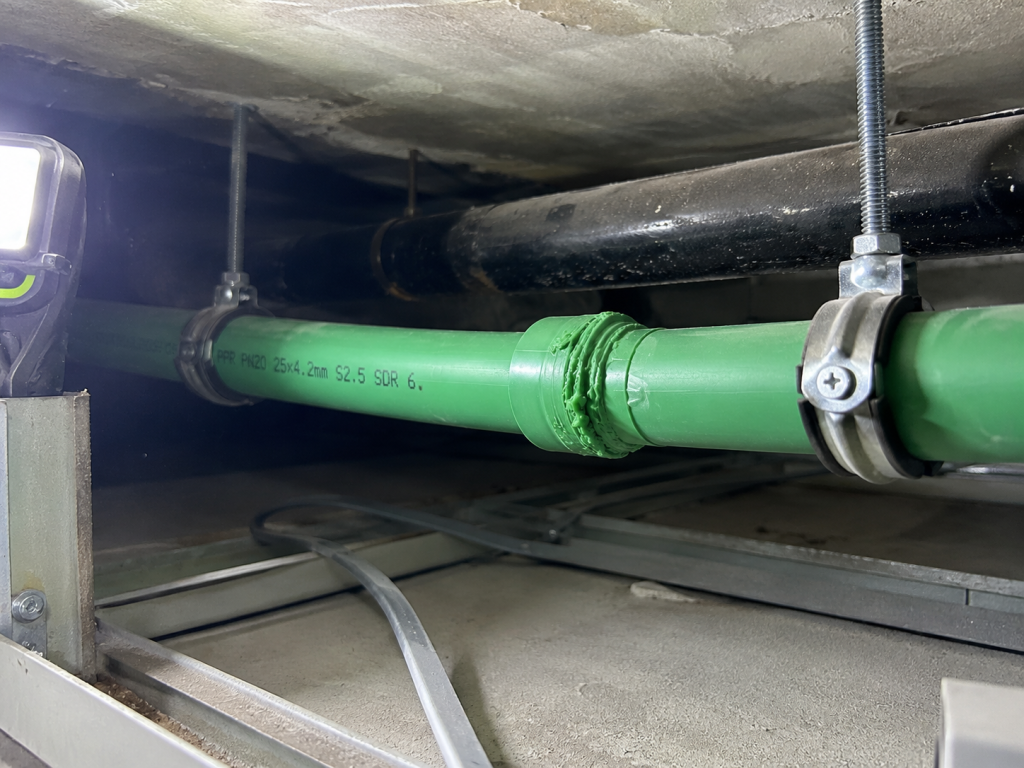
1. Specifying PN20 everywhere by default Why it hurts: You pay for wall you don’t need, and you shrink the bore on lines that were already tight. Fix: Class by line function. Hot gets PN20. Genuine cold-only lines can often sit lower — with UAE temperatures factored in.
2. Comparing quotes on price per metre alone Why it hurts: Different PN classes weigh different amounts. Per-metre is not per-metre unless the class matches. Fix: Compare on identical brand, standard, PN and size. Ask for weight per metre if you want the honest comparison.
3. Forgetting the fittings take-off Why it hurts: Fittings can carry a large share of a bathroom-heavy scope, and they arrive as a “surprise” mid-project. Fix: Take off fittings at tender stage. Use PPR pipe fitting types as your checklist.
4. Mixing brands mid-project Why it hurts: Socket dimensions and fusion behaviour vary between manufacturers. Mixed brands at a fusion joint is a leak waiting for a warm weekend. Fix: One brand family per system. Order a buffer. If you’re comparing brands, see RAKtherm and Cosmoplast.
5. Buying uncertified pipe to hit a number Why it hurts: It fails inspection, or it fails in year three. Both cost more than the saving. Fix: Ask for the certificate before the PO, not after the delivery.
6. Ignoring expansion until installation day Why it hurts: Loops and guides get value-engineered out, then the pipe finds its own way to move. Fix: Decide plain vs composite at design stage, using run length and temperature swing.
7. No pressure test protocol agreed upfront Why it hurts: Disputes over who caused a leak, and no baseline data. Fix: Agree the test regime in writing. Our guide on how to pressure test PVC pipe covers the same discipline that applies to fused systems.
Ask every supplier for the same eight things. If one can’t answer, you’ve learned something.
That list is the difference between buying a price and buying a piping system. The same logic applies when you choose a pipes manufacturer or supplier for any material.
Dave Pools Trading LLC has supplied pipes, fittings, irrigation and pool equipment across the UAE for over 20 years, operating from Al Quoz Industrial Area 1 in Dubai. Customers rate the service 4.7 out of 5.
What that means practically for a PPR enquiry:
More on our background: about Dave Pools and why Dave Pools is a trusted supplier in Dubai.
Outside diameter and PN class, because both control how much material is in each metre. After that: construction type (plain, fibre composite or aluminium composite), brand, certification, fittings ratio and order volume.
PN20 is the standard choice for hot water lines in UAE villas and towers. Pressure capacity drops as temperature rises, so PN20 provides sensible headroom. Always confirm against the manufacturer’s derating table for your working temperature.
No. PN20 has a thicker wall and a smaller internal bore, so it carries less flow at the same nominal size. It’s the right choice for hot lines. On cold lines it can create a pressure problem while adding cost.
Typically 20mm for individual fixture branches and 25–32mm for the cluster feed, depending on fixture count and available pressure. Size from flow demand using the internal bore of your chosen PN class, not the outside diameter.
For any project going through consultant or authority review, yes. Ask for manufacturer test certificates and conformity documentation before raising the purchase order, especially on potable water systems.
Only with a UV-protected grade or full physical covering. Standard polypropylene degrades under sustained sunlight, and UAE UV exposure is severe. Never leave PPR uncovered on a roof or in open plant areas.
PPR pipe pricing in Dubai looks confusing until you realise you’re usually comparing different products with the same name.
Get three things right and the rest follows. Set the PN class from real working temperature, not habit. Size the diameter from the actual internal bore, not the OD printed on the pipe. And insist on certification before you raise the PO, not after the delivery arrives.
Do that, and you’ll stop buying the cheapest quotation and start buying the right piping system — which, on a Dubai project running through August, is a very different thing.
Next step: send us your size list and line temperatures. We’ll help you set the PN class and come back with a specification you can put in front of a consultant.
Share your line temperatures, pressures and quantities. Our team will recommend the correct PPR grade, diameter and pressure class — then send a clear, comparable quotation with certification included.
20+ years supplying the UAE · Rated 4.7/5 · Al Quoz Industrial Area 1, Dubai · +971 4 393 4806 · sales@davepools.com