
A plumber recently replaced all the pipes in a three-storey building. The hot water pressure on the top floor was weak — barely enough for a shower. The diagnosis? Undersized main supply lines. The entire system had to be partially redone.
Choosing the wrong PPR pipe size doesn’t just reduce flow. It can cause pressure drop across your whole system, lead to noisy pipes from high-velocity water, and accelerate wear on fittings and valves. For guidance on pipe dimensions, PN ratings, and pricing in Dubai, read our PPR Pipe Price in Dubai: Size and PN Rating Guide.
PPR pipes are used in a wide range of applications — from small home plumbing to large commercial systems. Before we talk sizes, if you’re new to PPR, start with our post on what are PPR pipes and fittings and why PPR pipe is used.
Key Facts About PPR Pipe Sizing
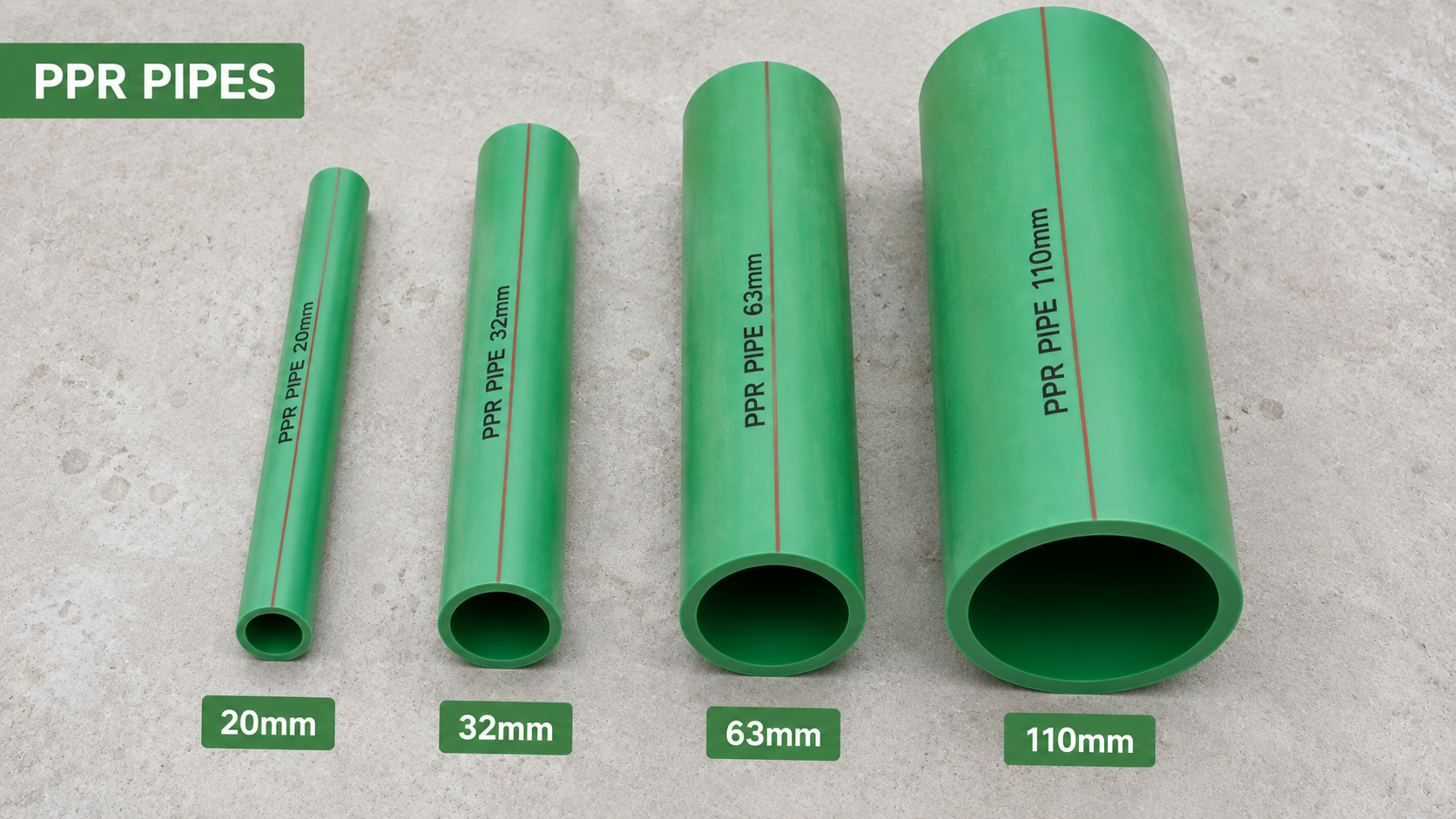
- PPR pipe sizes are measured by outer diameter (OD) in millimeters
- Common residential sizes: 20mm, 25mm, 32mm
- Common commercial/main line sizes: 40mm, 50mm, 63mm, 75mm, 90mm, 110mm
- Wall thickness depends on the pressure class (PN10, PN16, PN20, PN25)
- Smaller ID = more pressure drop; always size up for long runs
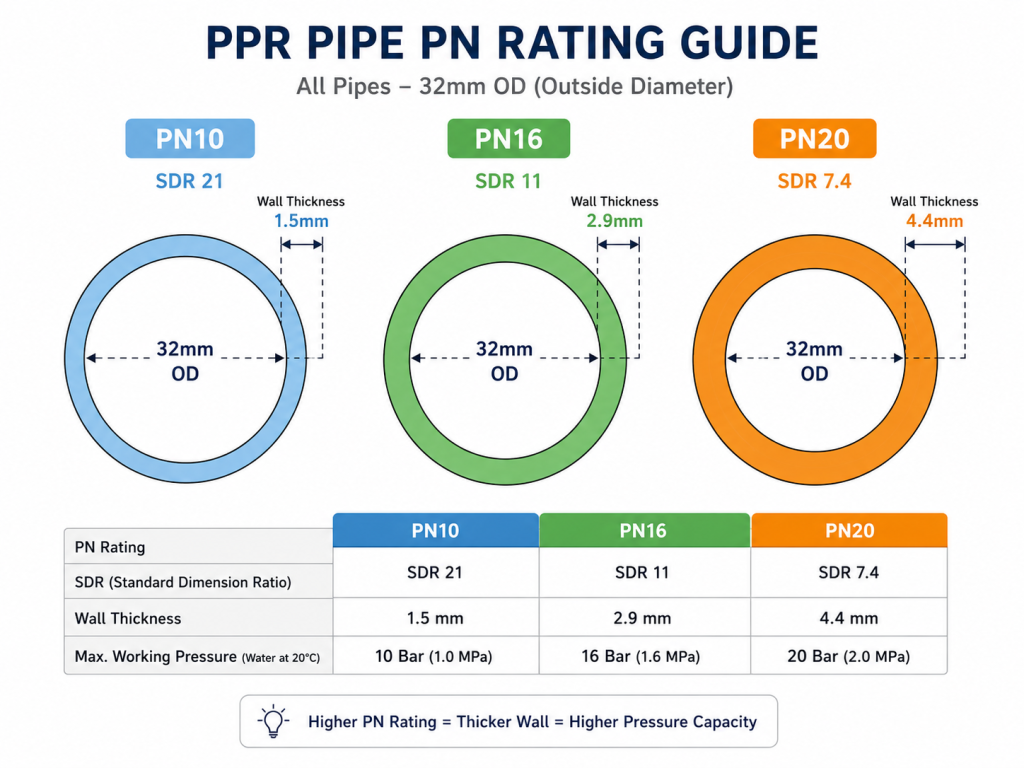
When you see a PPR pipe labeled as “25mm PN16”, here’s what it means:
The size number (e.g., 20mm, 32mm, 63mm) refers to the outside diameter of the pipe. This is the standard measurement used across the industry. The internal diameter (ID) — which controls how much water flows — depends on the wall thickness, which is set by the pressure class.
PN stands for Pressure Nominal — the maximum pressure the pipe handles at 20°C. Higher PN = thicker walls = smaller internal bore for the same OD. Learn more in our guide on the difference between PN10 and PN16.
For most residential hot water applications, PN20 is the standard. For cold water supply, PN16 is commonly used. See our post on is PPR pipe compatible with hot or cold water for more details.
PPR pipes are manufactured in standard sizes following ISO and DIN standards. Here are the most common sizes and their typical applications:
| Size (OD) | Typical Use | Flow Rate (approx.) | Common PN Rating |
|---|---|---|---|
| 20mm | Individual taps, showers | Low (1–2 fixtures) | PN20 |
| 25mm | Branch lines, small bathrooms | 2–4 fixtures | PN16 / PN20 |
| 32mm | Sub-mains, small floor distribution | 4–6 fixtures | PN16 / PN20 |
| 40mm | Floor mains in buildings | 6–10 fixtures | PN16 |
| 50mm | Riser pipes, medium commercial | 10–20 fixtures | PN16 |
| 63mm | Building main supply | 20–40 fixtures | PN10 / PN16 |
| 75mm | Large commercial buildings | 40–70 fixtures | PN10 / PN16 |
| 90mm | Main risers, apartment blocks | 70–120 fixtures | PN10 |
| 110mm | Large industrial / municipal | 120+ fixtures | PN10 |
For specific size availability, browse our high pressure pipe fittings by size or our full PPR pipes and fittings supplier page.
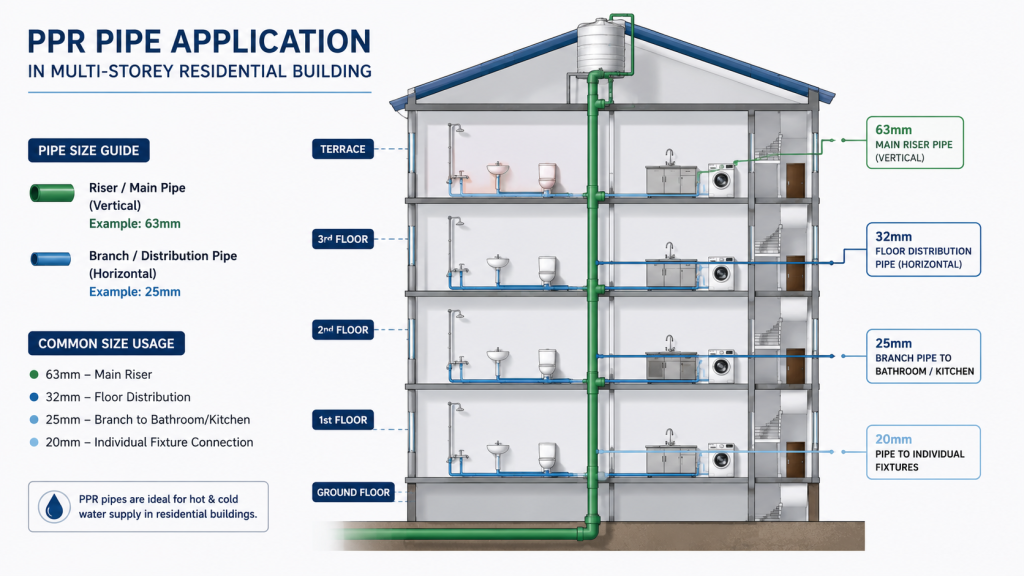
Here’s a simple step-by-step approach that works for most residential and light commercial projects:
Start by listing all the fixtures connected to the line — taps, showers, washing machines, water heaters, etc. Each fixture has a demand flow rate. The more fixtures on a line, the larger the pipe you need.
Add up the peak demand flow rate for your fixtures. For residential buildings in the UAE, a common rule of thumb is to use 25mm for branch lines serving 1–4 fixtures and 32mm for sub-mains serving up to 6.
Longer pipe runs increase friction and reduce pressure. For runs over 20–30 metres, size up by one step to compensate for friction losses.
If your supply pressure is low, undersized pipes make it worse. See our guide on how to increase water pressure in a pipe for practical solutions.
For hot water systems, use PN20 or PN25. For cold water, PN16 is typically sufficient. Higher temperature reduces the working pressure of PPR, so a higher PN rating compensates for this.
Also helpful: our guide on how to measure pipe size if you need to match existing pipes in a retrofit project.
For all fittings to match your chosen sizes, see our PPR pipe fitting types guide and our pipes and fittings supplier page in Dubai.
Here’s something most people miss: the PN rating affects the internal bore of the pipe. Two 32mm PPR pipes with different PN ratings will have different internal diameters.
| Pipe OD | PN Rating | Wall Thickness | Internal Diameter |
|---|---|---|---|
| 32mm | PN10 | 2.9mm | 26.2mm |
| 32mm | PN16 | 4.4mm | 23.2mm |
| 32mm | PN20 | 5.4mm | 21.2mm |
| 32mm | PN25 | 6.7mm | 18.6mm |
A PN25 pipe of 32mm has roughly 30% less internal area than a PN10 pipe of the same size. For hot water systems, always account for this when calculating flow requirements.
For a deeper look at SDR ratios (which define wall thickness), read our SDR 11 vs SDR 17 comparison.
Your main line should always be larger than your branch lines. Using 20mm throughout — from the header to every fixture — is a very common mistake in small buildings, and it kills pressure everywhere on the system.
PPR expands more than metal under heat. Long hot water runs need expansion loops or offsets. Our guide on how to connect PPR pipes covers this in detail.
Each fitting (elbow, tee, reducer) adds resistance equivalent to extra pipe length. Add 20–30% to your calculated pipe length when working out sizing to account for fitting losses.
Low-quality PPR can have inconsistent wall thickness that fails under pressure. Know how to check PVC pipe quality — the same visual checks apply to PPR. Always buy from a trusted pipes supplier in Dubai.
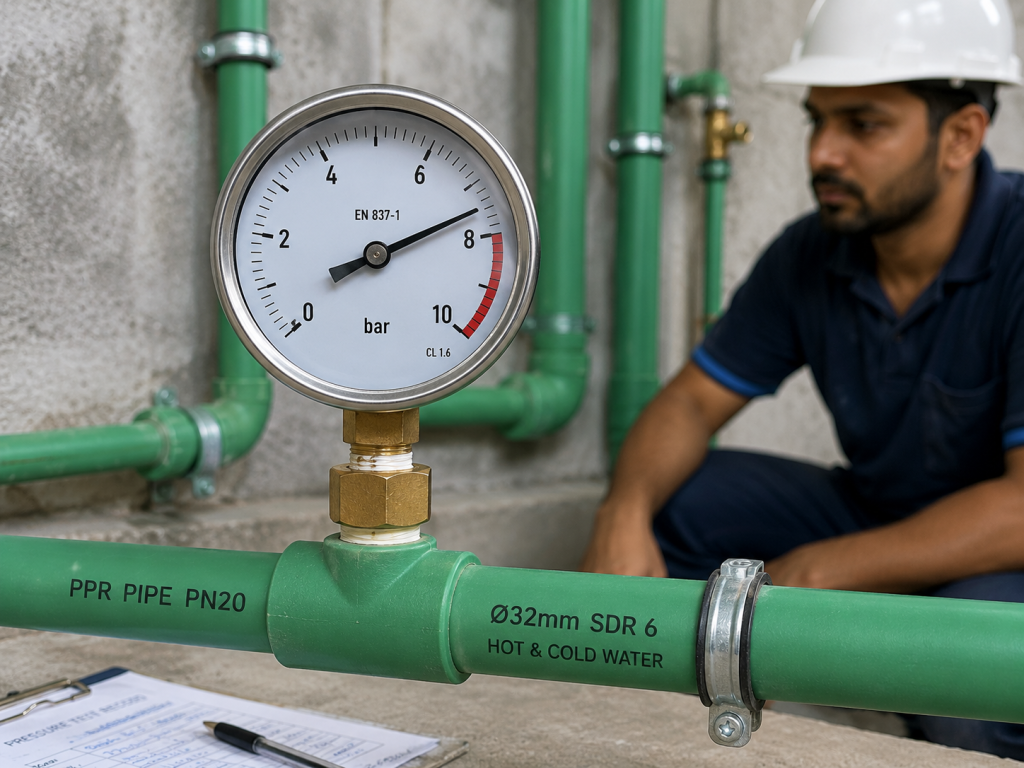
After installation, always pressure test your PPR system before closing walls or burying pipes. Read our guide on how to pressure test PVC pipe — the process is similar for PPR systems.
Choose PPR pipe size by counting fixtures, checking how long the run is and knowing your supply pressure. Then pick the PN rating for the water temperature. Mains must be larger than branches, so don’t use 20 mm throughout. Allow for thermal expansion on long hot runs, and pressure-test before covering the pipe.
For residential use, 20mm is used for individual fixture branches, 25mm for bathroom sub-mains, and 32mm for the main distribution line within the flat or villa.
PN16 is acceptable for hot water at lower temperatures, but PN20 is the standard recommendation for hot water lines in the UAE to maintain safe working pressure under heat.
Use a reducing socket or reducing tee fitting. These are available in all standard size combinations. See our guide on how to connect PPR pipes for step-by-step instructions.
Yes. A smaller internal diameter increases flow velocity and friction, which drops pressure — especially over long runs. Sizing up your main lines significantly improves end-pressure, particularly on upper floors.
Dave Pools stocks a full range of PPR pipe sizes. Visit our PPR pipes and fittings supplier page or browse by size in our pipe fittings size catalogue
Choosing the right PPR pipe size comes down to three things: how many fixtures you’re serving, how far the water needs to travel, and what temperature and pressure the system will run at.
Use the guidelines in this article as your starting point. For larger or more complex projects, always consult with a qualified plumber or pipe supplier who can review your full system design.
Dave Pools supplies PPR pipes and fittings across Dubai. Tell us about your project and we’ll help you choose the right pipe size and specification.
Explore our PPR pipes and fittings range, products, or learn more on our about page.