
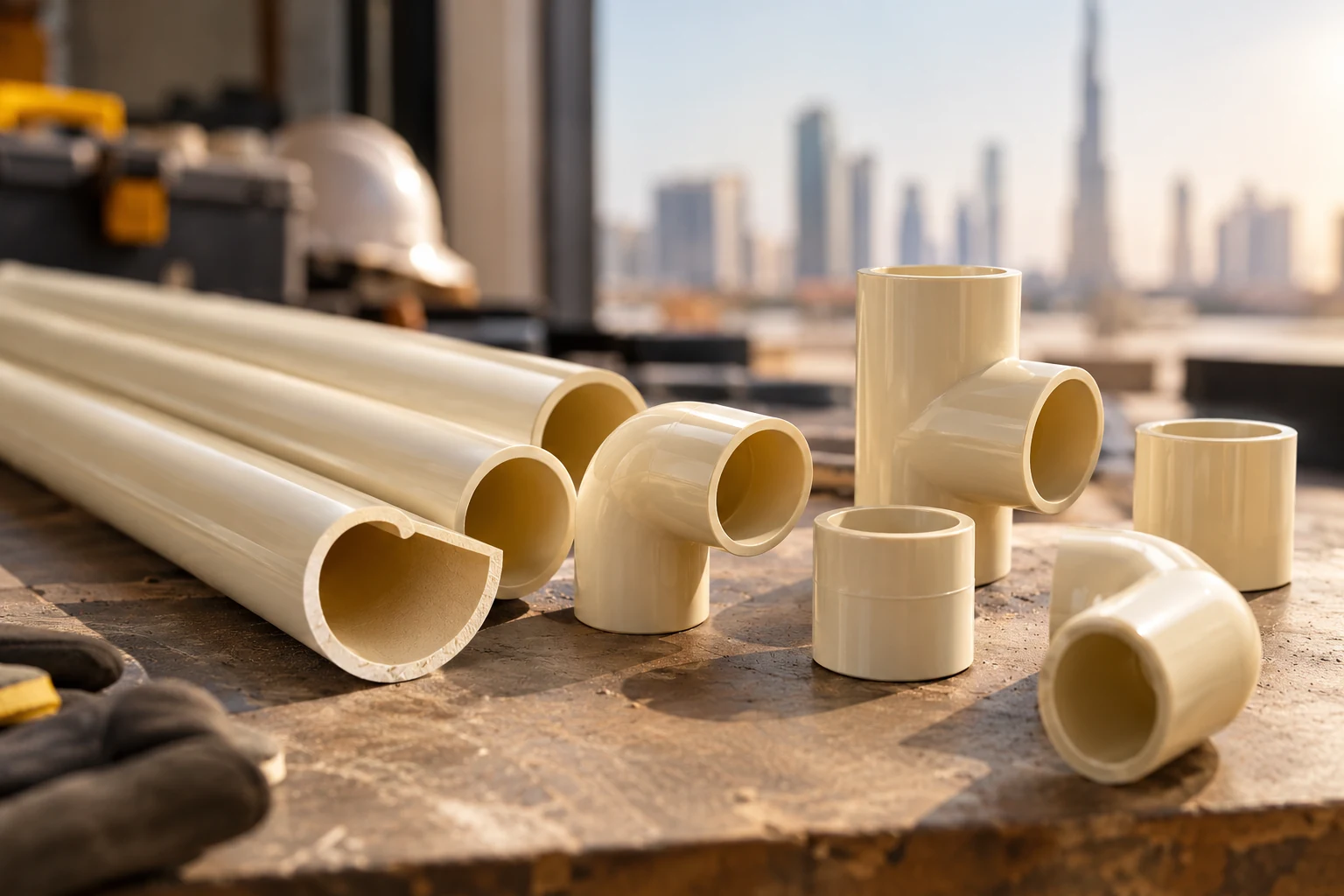
A hot water line that works on day one and fails in its second summer is almost always a sizing or temperature mistake. Someone picked a pipe on diameter alone, or trusted a room temperature pressure rating on a system that runs at 70°C. Understanding CPVC pipe sizes and temperature rating together is what prevents that call back to site.
This guide covers CPVC diameters from 15mm to 200mm, what the 93°C rating really means, how pressure capacity drops as water gets hotter, and how to match the right size and wall thickness to UAE villas, hotels, fire sprinkler systems and industrial lines. It is written for engineers, contractors and facility managers who need a number they can specify, not a brochure.
✅ CPVC Pipe at a Glance
📋 Table of Contents
CPVC stands for Chlorinated Polyvinyl Chloride. It starts as standard PVC and goes through a second chlorination step that lifts the chlorine content from about 57% to around 67%. That extra chlorine is what separates it from the white uPVC pipe used for cold water and drainage.
The change in the polymer gives CPVC better heat tolerance, stronger chemical resistance and more strength at elevated temperatures. In plain terms: a uPVC pipe starts to soften and lose pressure capacity above 60°C, while CPVC is designed for continuous service up to 93°C.
That gap matters in the UAE, where rooftop tanks, solar heated water and fire protection systems regularly push pipe materials harder than a temperate climate would. To see where each material belongs, read our breakdown of the difference between uPVC and CPVC pipes.
Dave Pools stocks CPVC pipes and fittings in Dubai from 15mm residential stub outs to 200mm industrial mains, with matching elbows, tees, couplings, reducers, ball valves and check valves.
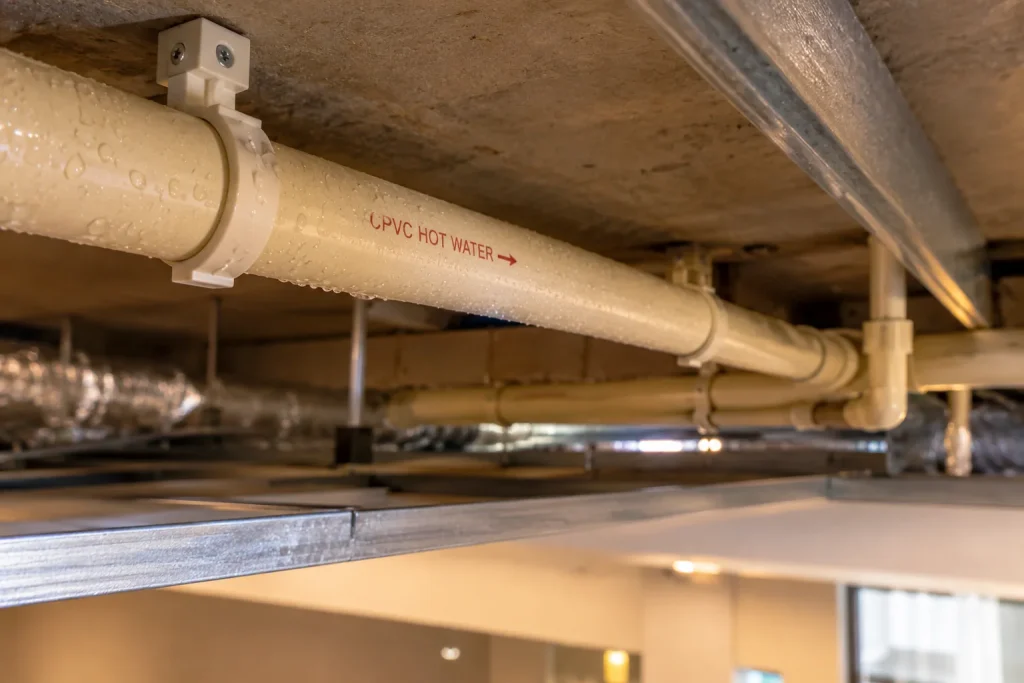
The 93°C figure is the maximum continuous operating temperature at which CPVC keeps its rated pressure capacity under sustained flow. It is not a melting point and it is not a spike tolerance. Treat it as the ceiling for normal service, then design well below it.
| Threshold | °C | °F | What It Means |
|---|---|---|---|
| Continuous maximum | 93°C | 200°F | ✅ Design limit for normal service. Pressure capacity is heavily derated at this point. |
| Above 93°C | >93°C | >200°F | ⚠️ Outside the rated range. Risk of deformation and joint failure under pressure. |
| uPVC continuous maximum | 60°C | 140°F | For comparison. Suited to cold water and drainage only. |
Important: The 93°C rating applies to the pipe material. Solvent welded joints must cure fully before pressure testing or exposure to heat. Joint failure at temperature is nearly always a cement or curing problem, not a material defect.
This is why CPVC is the usual choice for domestic hot water in UAE villas and apartment buildings, and why it appears in fire sprinkler systems where plastic pipe is allowed. Hot lines that regularly reach 70 to 80°C sit inside CPVC’s range but well beyond what standard PVC can handle.
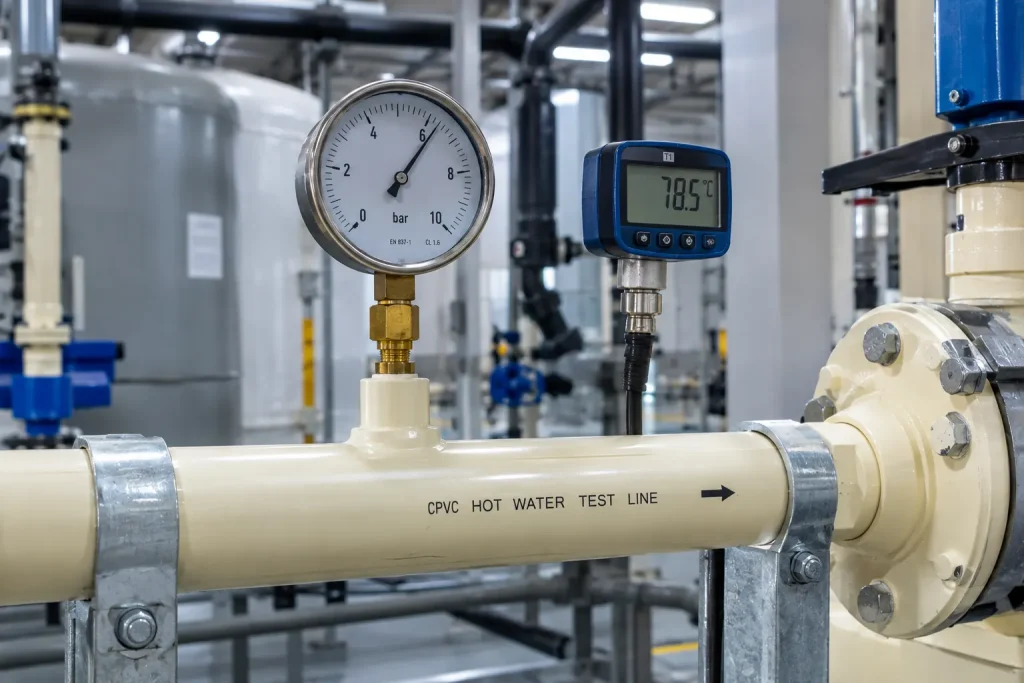
Every thermoplastic pipe loses pressure capacity as temperature rises. This is called pressure derating, and it is the single most overlooked factor when sizing a hot water system.
| Temperature | Approx. Pressure Retained | Practical Note |
|---|---|---|
| 23°C (73°F) | 100% | Baseline rating temperature |
| 38°C (100°F) | about 82% | Normal UAE ambient and warm cold water lines |
| 49°C (120°F) | about 65% | Typical domestic hot water supply |
| 60°C (140°F) | about 50% | uPVC limit. CPVC is still comfortable here. |
| 71°C (160°F) | about 40% | Solar tank discharge. Size up the wall. |
| 82°C (180°F) | about 25% | Use Schedule 80 or a higher pressure class |
| 93°C (200°F) | about 20% | Maximum continuous rating. Low pressure duty only. |
Quick example: a pipe rated 16 bar at 23°C keeps roughly 40% of that at 70°C, which is about 6.5 bar. If your riser sees 8 bar static pressure, that pipe is already undersized for the hot side even though the datasheet says 16 bar. Always size against the actual operating temperature, then confirm the exact derating factors in the manufacturer’s datasheet for the grade you buy.
UAE note: Roof mounted storage tanks can climb past 60°C in peak summer from solar gain alone, even with no solar heater fitted. If a rooftop tank feeds your distribution lines, check the real supply temperature before assuming uPVC is enough.
Most CPVC pipe supplied for building services and industrial work uses IPS (iron pipe size) outside diameters with Schedule 40 or Schedule 80 walls under ASTM F441. The table below shows the common sizes with their real outside diameters and wall thicknesses. Dave Pools stocks CPVC pipes and fittings from 15mm through 200mm, so confirm current availability for the larger diameters with the sales team.
| Size | OD (mm) | Sch 40 Wall (mm) | Sch 80 Wall (mm) | Typical Application |
|---|---|---|---|---|
| 15mm (½”) | 21.3 | 2.77 | 3.73 | Residential stub outs, basins, WC |
| 20mm (¾”) | 26.7 | 2.87 | 3.91 | Hot water branches, small risers |
| 25mm (1″) | 33.4 | 3.38 | 4.55 | Villa hot water main, small commercial |
| 32mm (1¼”) | 42.2 | 3.56 | 4.85 | Apartment supply branch |
| 40mm (1½”) | 48.3 | 3.68 | 5.08 | Riser mains, light commercial |
| 50mm (2″) | 60.3 | 3.91 | 5.54 | Hotel and apartment headers |
| 65mm (2½”) | 73.0 | 5.16 | 7.01 | Commercial hot water distribution |
| 80mm (3″) | 88.9 | 5.49 | 7.62 | Sprinkler mains (listed grade), process piping |
| 100mm (4″) | 114.3 | 6.02 | 8.56 | Industrial hot water, chemical lines |
| 125mm (5″) | 141.3 | 6.55 | 9.53 | Large commercial mains |
| 150mm (6″) | 168.3 | 7.11 | 10.97 | Light industrial mains |
| 200mm (8″) | 219.1 | 8.18 | 12.70 | Industrial plant, water treatment |
Always confirm exact dimensions against the manufacturer’s datasheet for the product you order, since tolerances and available schedules differ by brand.
To see how CPVC sizes relate to uPVC, read the PVC pipe standard sizes guide. If you need to identify an existing line on site, the pipe size measurement guide explains nominal, outside and inside diameter.
CPVC is specified in more than one sizing system, and mixing them up is one of the most common ordering errors on UAE projects.
| System | Standard | Where Used | How the Wall Works |
|---|---|---|---|
| IPS Schedule 40 / 80 | ASTM F441 | Industrial, process and many fire systems | Fixed wall per size. Schedule 80 is thicker and holds more pressure. |
| CTS (copper tube size) SDR 11 | ASTM D2846 | Building hot and cold water plumbing | Smaller outside diameters than IPS. ½” CTS is about 15.9mm OD. |
| Metric PN rated | BS 7291 / EN ISO 15877 | European and UK influenced specifications | Wall depends on the pressure class and the diameter ratio. |
The practical rule: never assume two pipes of the same nominal size will join. A ½” CTS pipe and a ½” IPS pipe have different outside diameters, so fittings are not interchangeable. If a project has both hot water and fire protection, confirm the standard for each system before ordering.
The same applies across materials. CPVC fittings are not interchangeable with PVC fittings, even when the outside diameter looks the same. Order fittings listed for the same material grade and standard as the pipe. For more on where the two materials differ, read our CPVC vs PVC pipe comparison. For help with pressure classes, see PN10 vs PN16.
Here is how the size range maps to the project types Dave Pools supplies across Dubai and the UAE.
For a standard UAE villa with a rooftop tank, 15mm to 25mm CPVC covers the branches to fixtures, and 32mm to 40mm handles the main riser. Most villa jobs never need more than 50mm at the header. Also review the best pipe for home plumbing and our guide to which pipe is used for hot water supply.
Multistorey buildings in Dubai typically use 50mm to 80mm CPVC for hot water risers and 15mm to 32mm for flat branches. Riser sizing depends on the number of outlets and the pressure drop per floor, so a proper hydraulic calculation is needed at this scale.
Listed CPVC fire pipe (often sold as BLAZEMASTER® or an equivalent FM listed product) is used in residential and light commercial sprinkler systems where the local authority and project specification allow it. Branch lines are usually ¾” to 1″ (20 to 25mm), with cross mains up to 3″ (80mm). Only use fire rated CPVC for sprinkler work. Standard plumbing grade CPVC is not FM listed. See our CPVC for fire sprinkler systems guide and the overview of which pipes are used in fire sprinkler systems.
CPVC resists many acids, bases and salts, which suits chlorinated water treatment lines, chemical dosing and some process applications. 50mm to 200mm is the usual range. Chemical compatibility is specific to each fluid and concentration, so ask the Dave Pools technical team for a resistance check before you specify CPVC for process piping.
Standard irrigation uses uPVC pressure pipe or HDPE, but some treated wastewater and greenhouse heating circuits run warm water and may need CPVC on the distribution sections. See the pipe material guide for UAE irrigation.
| Factor | CPVC | uPVC |
|---|---|---|
| Max continuous temperature | 93°C (200°F) | 60°C (140°F) |
| Hot water supply | ✅ Yes | ❌ Not suitable |
| Cold water supply | ✅ Yes | ✅ Yes |
| Drainage | Not standard | ✅ Yes |
| Fire sprinkler (FM listed grade) | ✅ Yes | ❌ Not approved |
| Chemical resistance | Excellent across many chemicals | Good at ambient temperature |
| Typical colour | Cream or light yellow | White or light grey |
| Solvent cement | CPVC cement only | PVC cement only |
| Rooftop tank lines in UAE summer | ✅ Safe choice | ⚠️ Risk above 60°C |
If a system stays below 60°C all year, uPVC is a sound choice for cold lines. If there is any scenario where it reaches 60°C or more, even seasonally, CPVC is the safer specification. In the UAE, rooftop storage and solar assisted systems cross that line in summer more often than people expect.
For a three way view that includes PPR, read PPR vs CPVC vs uPVC for Dubai’s climate. We also compare PPR vs PVC vs HDPE pipes for wider material context.
This is the most important rule: always use CPVC rated solvent cement, never standard PVC cement. PVC cement does not bond the CPVC surface properly, so the joint can look sound and still fail under heat or pressure, often with no warning. Check that the tin says CPVC, or that it is a dual rated PVC/CPVC product. Dave Pools supplies PVC glue and cleaners for thermoplastic pipe systems.
Dubai’s summer heat makes solvent cement set faster, but a quick set is not a full cure. Cure time depends on pipe size, joint fit, ambient temperature and humidity. A few rules hold on every site:
Our pipe pressure testing guide covers the test steps once joints have cured.
CPVC expands more than most people expect. A 10 metre hot water run heated from 25°C to 70°C grows by roughly 25 to 30mm. On long runs, build in expansion loops or offsets so the pipe has room to move, and never anchor both ends of a straight run rigidly. This matters most on roof level distribution exposed to direct sun.
Heat softens the pipe, so hot lines need closer supports than cold lines. Use the hanger spacing table from the pipe manufacturer for your actual operating temperature, not a standard PVC table. For wider installation guidance, see the underground pipe installation guide.
The UAE climate changes how CPVC should be specified and protected. Four things are worth planning for:
For more on how local conditions affect pipe choice across all materials, read PPR vs CPVC vs uPVC in Dubai’s climate and the thermoplastic polymers guide to plastic pipes.
“I’ve been working with Dave Pools for years, and they’ve consistently provided outstanding service. Their high-pressure pipes and fittings are top-notch, and the team is incredibly knowledgeable and helpful. Whether for a residential or commercial project, I trust Dave Pools for quality and reliability.”
Sarah A., Happy Client ★★★★★
“DAVE POOLS is my trusted partner for all my pool equipment and sanitaryware needs. Their wide range of high-quality products, including plumbing supplies and landscaping materials, is impressive. Their commitment to delivering on time and their knowledgeable team of professionals make them stand out.”
Ahmed S., Happy Client ★★★★★
Rated 4.7 / 5 by customers across residential, commercial, and contractor projects in the UAE.
📋 Case Study
See how we supply at scale in our commercial hotel pool equipment supply case study and the commercial irrigation landscaping project case study.
CPVC is rated for continuous service up to 93°C (200°F) under sustained pressure. Standard uPVC is rated to 60°C, so CPVC is the correct choice for any system that regularly runs above that, including domestic hot water lines in the UAE. Do not design to the limit, because pressure capacity drops sharply as temperature climbs.
CPVC is available from ½” to 8″ nominal in IPS Schedule 40 and Schedule 80, which matches roughly 15mm to 200mm. Dave Pools stocks CPVC from 15mm to 200mm in Dubai for residential, commercial and light industrial use. For large diameter orders, confirm stock with the team before you finalise your material take off.
Yes. CPVC suits hot water distribution in UAE villas, especially where water comes from a rooftop tank that can pass 60°C in summer. Branches to fixtures are usually 15mm to 25mm and the main riser is typically 32mm to 50mm depending on outlets. Use CPVC rated cement and allow full cure time. See the hot water pipe selection guide.
Yes. All thermoplastic pipes derate as temperature rises. At 23°C CPVC works at 100% of its rating, at about 70°C it keeps roughly 40%, and at 93°C only about 20%. Size hot systems against the real operating temperature and move to a heavier wall, such as Schedule 80, where pressure and temperature are both high.
Use CPVC rated solvent cement. Standard PVC cement does not bond CPVC properly and the joint can fail under heat or pressure without visible warning. Check the tin label for CPVC use, because some dual rated cements cover both materials. Dave Pools supplies PVC glue and cleaners for thermoplastic systems.
Listed fire grade CPVC, such as BLAZEMASTER® or an equivalent FM listed product, is used in residential and light commercial sprinkler systems where the authority and project specification allow it. Standard plumbing grade CPVC is not approved for this. The pipe, fittings and cement must all be listed. See the CPVC fire sprinkler guide.
Both share the same outside diameter for a given nominal size, but Schedule 80 has a thicker wall, so it carries more pressure and is stronger. For 1″ pipe, Schedule 40 has a 3.38mm wall and Schedule 80 has 4.55mm. Schedule 80 is preferred for industrial, hotter and higher pressure duty.
It can be buried for hot water supply, but HDPE PE100 is usually preferred for underground pressure mains because it handles ground movement and soil load better. If you do bury CPVC, bed it in sand, sleeve it at concrete or road crossings and protect it from point loads. For cold water mains, HDPE or uPVC are standard.
Only with protection. Long exposure to direct sun damages CPVC like other PVC based pipe. Paint it with a suitable coating, wrap it in UV resistant cladding or insulate it, especially on rooftop runs. Keep unused lengths covered in storage as well.
Neither wins in every case. CPVC is solvent welded, handles high temperature and chemicals well, and is common in fire and industrial work. PPR is heat fused and widely used for building hot and cold supply. Match the material to your temperature, pressure and specification. Our PPR vs CPVC vs uPVC guide compares them for Dubai.
Potable grade CPVC made for hot and cold water plumbing is certified to drinking water standards in many markets, for example NSF/ANSI 61. Not every CPVC product is potable rated, so always check the certification on the exact product, especially industrial grades, and ask for the documents needed for your technical submission.
CPVC’s 93°C rating, chemical resistance and pressure capacity make it the right material for any UAE system that runs above 60°C, from villa hot water and hotel risers to fire sprinklers and light industrial lines.
Choosing the right size is about more than diameter. Pressure class, schedule and operating temperature decide whether the pipe lasts. The tables above give you the framework. For a specific site, run a hydraulic calculation using the real operating temperature, flow rate and run length before you finalise the specification.
Dave Pools stocks CPVC pipes and fittings in Dubai from 15mm to 200mm, with matching solvent weld fittings, ball valves and reducers. Whether you are specifying one villa or a multistorey commercial project, our team can advise on size, schedule and fitting selection.
Further reading: PVC vs HDPE pipe · PN16 vs PN10 pressure ratings · SDR 11 vs SDR 17 · What is HDPE pipe?
Get the Right CPVC Pipe for Your Project
CPVC pipes and fittings from 15mm to 200mm, with technical support and fast delivery to site across the UAE.
→ View CPVC Pipes and Fittings in Dubai
→ Browse All Pipes and Fittings
📞 +971 04 393 4806 | +971 54 308 1083 | 📧 sales@davepools.com
Al Quoz Industrial Area 1, Street 5, Al Tayer Warehouse #18, Dubai, UAE