
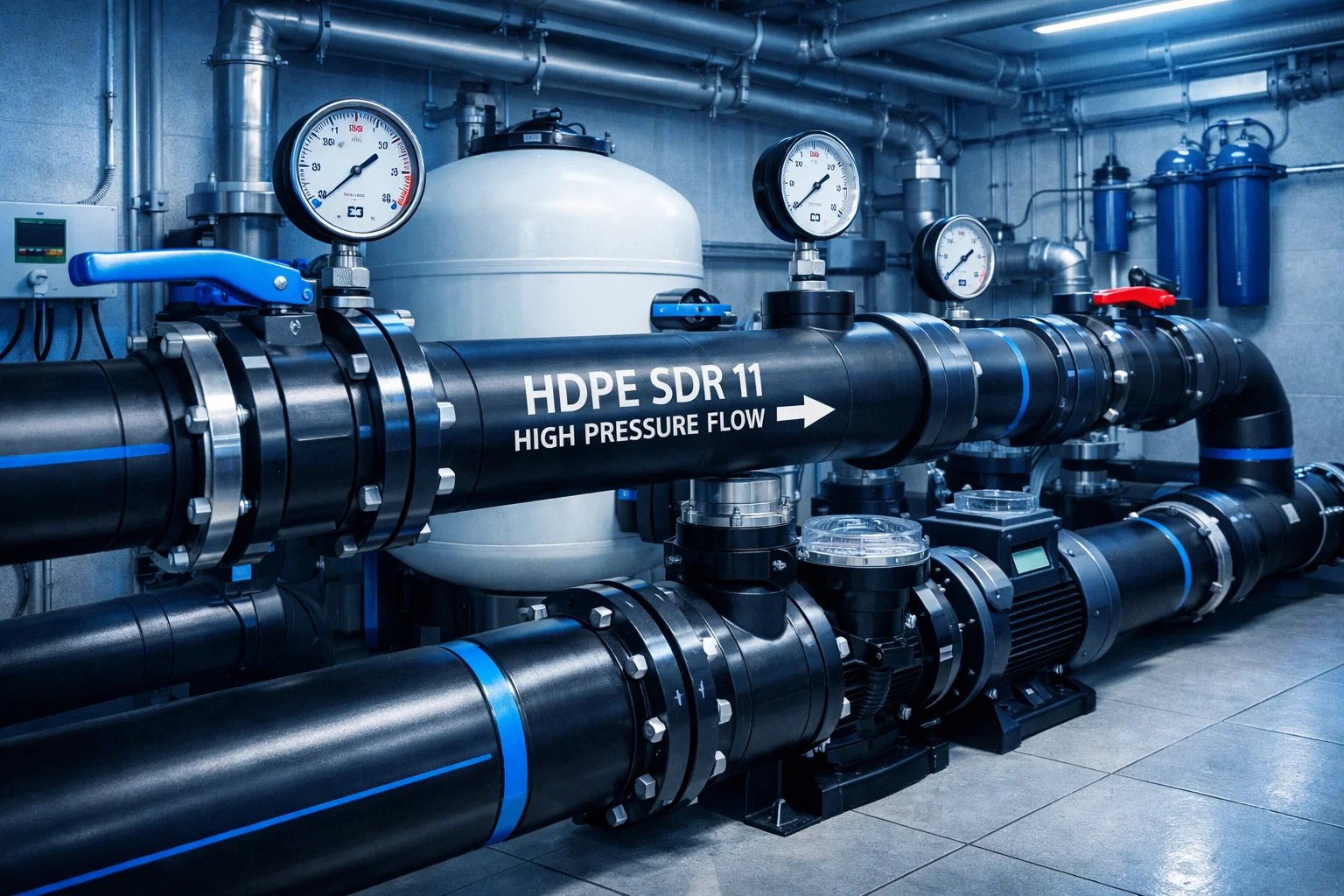
You need to lay a water supply line — and two pipes are sitting in front of you. They look identical. Same colour. Same material. But one is labelled SDR 11 and the other SDR 17. You know they’re different, but you’re not sure which one you actually need.
Pick the wrong one, and you could end up with a burst pipe, low pressure, wasted material, or a failed inspection. That’s not a small mistake — especially when the pipe is underground.
This guide breaks down the SDR 11 vs SDR 17 difference in plain language — what the numbers mean, which handles higher pressure, and which one fits your specific project. No jargon. Just clear, practical answers.
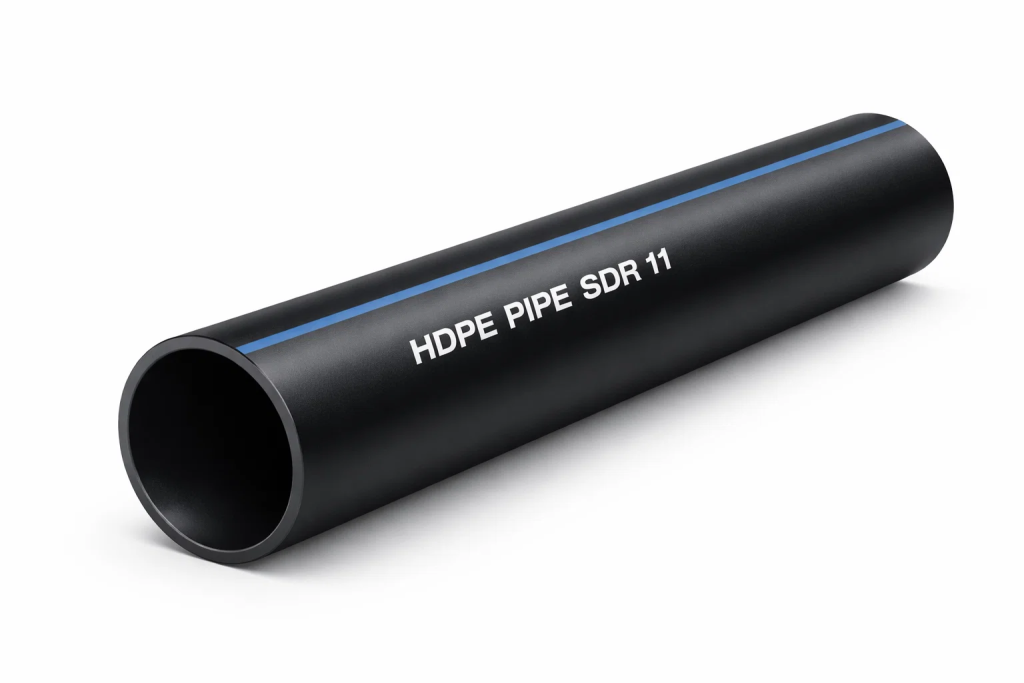
SDR stands for Standard Dimension Ratio. It’s a number that tells you the relationship between a pipe’s outer diameter and its wall thickness.
| SDR = Outer Diameter ÷ Wall Thickness A pipe with an outer diameter of 110mm and a wall thickness of 10mm has an SDR of 11.A pipe with the same outer diameter but a wall thickness of 6.5mm has an SDR of 17. |
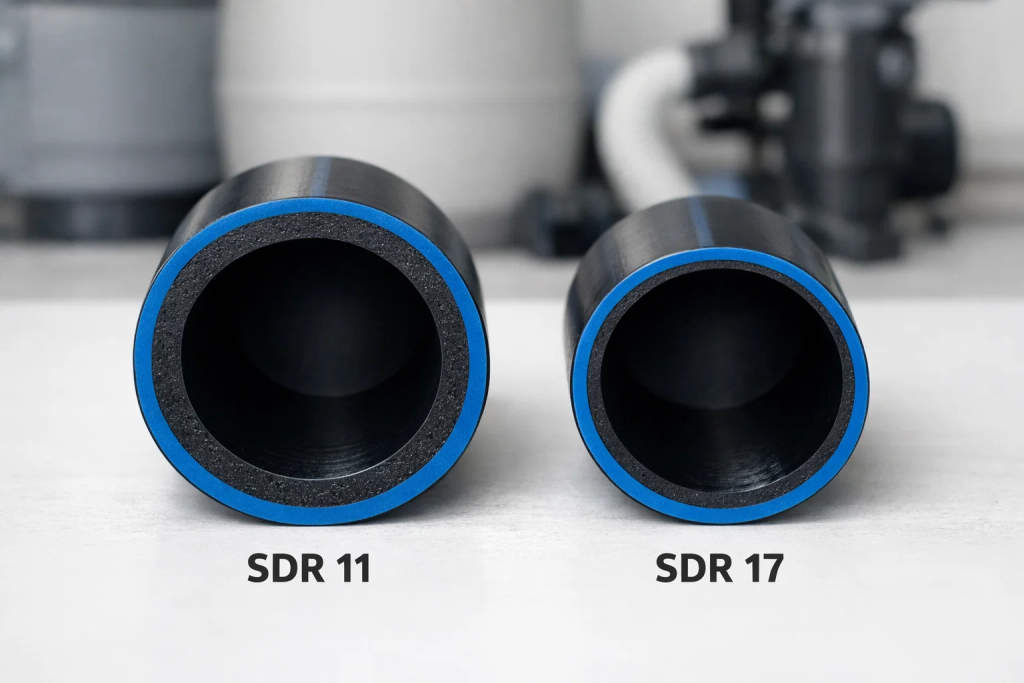
Here’s the key rule: the lower the SDR number, the thicker the wall, and the higher the pressure it can handle.
SDR ratings apply to many pipe materials — HDPE, PVC, PPR, CPVC — but they’re most commonly discussed with HDPE pipes and PPR pipes used in water supply, irrigation, and pool systems.
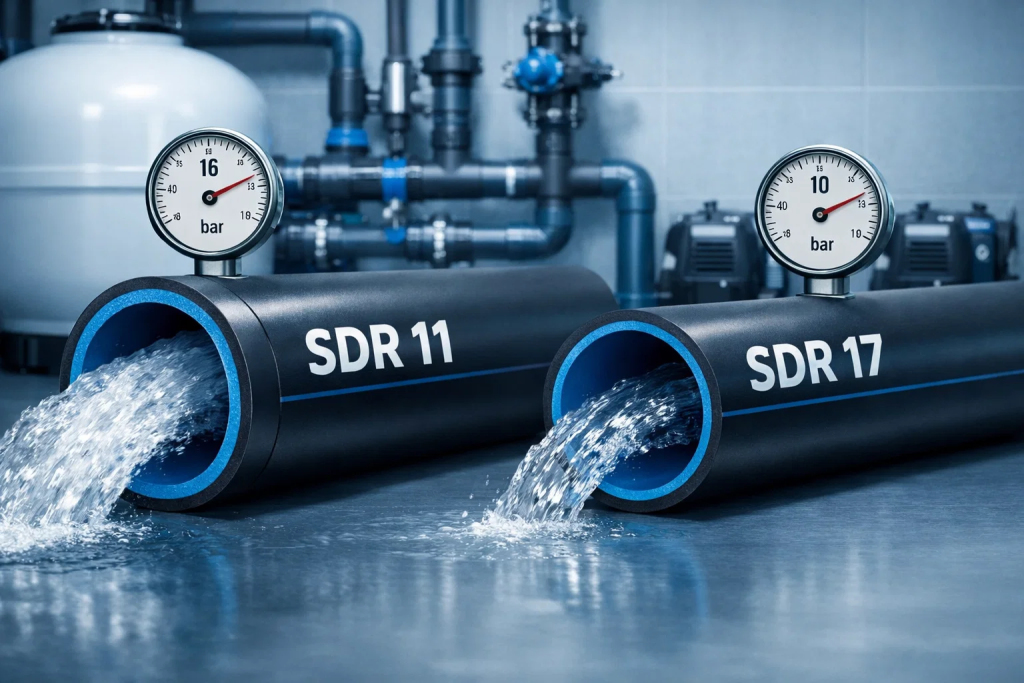
| SDR 11 Quick Facts• Thicker walls — roughly 9.1% of the outer diameter• Higher pressure rating — typically 16 bar for HDPE (PE100)• Heavier per metre• Ideal for mains water supply, buried pipelines, and high-pressure applicationsSDR 17 Quick Facts• Thinner walls — roughly 5.9% of the outer diameter• Lower pressure rating — typically 10 bar for HDPE (PE100)• Lighter per metre• Ideal for low-pressure irrigation, drainage, and landscape water supply |
SDR 11 is a thick-walled pipe designed to withstand high pressure. For every 11 units of outer diameter, the wall is 1 unit thick. That relatively thick wall is what gives it its strength.
In HDPE PE100, SDR 11 carries a pressure rating (PN) of 16 bar — which is why it’s the go-to choice for municipal water mains, industrial pipelines, and anywhere water travels under serious pressure over long distances.
For pool contractors and plumbers working with municipal-grade supply, SDR 11 is the standard. If you want to understand the broader material options, check out this complete guide to HDPE pipe and how it compares to other materials.
SDR 17 has thinner walls in proportion to its diameter. For every 17 units of outer diameter, the wall is 1 unit thick. That makes it lighter, easier to handle, and less expensive per metre — but it comes at the cost of pressure capacity.
In HDPE PE100, SDR 17 carries a pressure rating of 10 bar. That’s perfectly adequate for irrigation lines, low-pressure water distribution, landscape supply, and drainage systems where water isn’t moving at full mains pressure.
SDR 17 is also common in smart irrigation systems in UAE landscapes, where the pressure requirements are modest but the pipe length can be considerable.
| Feature | SDR 11 | SDR 17 |
| Wall Thickness | Thicker (stronger) | Thinner (lighter) |
| Pressure Rating (PN) | Higher (e.g. 16 bar) | Lower (e.g. 10 bar) |
| Weight | Heavier | Lighter |
| Flexibility | Less flexible | More flexible |
| Best For | High-pressure mains, buried supply | Low-pressure irrigation, drainage |
| UV / Chemical Resistance | Excellent | Good |
| Lifespan | 50+ years | 30–50 years |
| Typical Use | Municipal water, pools, fire supply | Landscape, drip irrigation, agriculture |
The pressure a pipe can safely handle is called its nominal pressure (PN) rating. This is measured in bar (1 bar ≈ 14.5 PSI).
The formula that links SDR to pressure is:
| PN = (2 × MRS) / (SDR – 1) × CMRS = Minimum Required Strength (material-specific)C = Design coefficient (safety factor) |
What this means in practice:
For context: typical household mains water pressure runs between 2–4 bar. Municipal supply mains often operate at 6–12 bar. Industrial water supply can push higher.
This is closely related to the difference between PN10 and PN16 pipe ratings — a topic worth reading if you’re specifying pipe for a pressurised system.
If you need to verify your system can handle the required load, this guide on how to pressure test PVC pipe gives you the practical steps.
The wall thickness isn’t just about pressure. It also affects:
For reference, if you’re working with PVC instead of HDPE, the same principle applies. Read about standard sizes of PVC pipe and PVC pipe temperature ratings to understand how wall dimensions affect performance across materials.
The honest answer: it depends on the pressure and the application. Here’s how to think it through.
A real-world example: A contractor building a commercial pool in Dubai will typically use SDR 11 HDPE pipe for the supply line from the mains to the plant room — then switch to SDR 17 or scheduled PVC for the low-pressure return circuits around the pool.
This mirrors the pipe selection principles discussed in the guide to PPR vs PVC vs HDPE pipes, where pressure rating is the first filter for any pipe selection decision.
Pool plumbing and irrigation are two areas where SDR selection comes up constantly — and where mistakes are common.
Pool supply lines running from the mains typically require SDR 11 — especially in UAE and GCC projects where water supply pressure can be higher than European standards.
Low-pressure return circuits (from the pump to the pool return jets) can use SDR 17 or standard PVC pipe. The key is matching the pipe’s pressure rating to the pump’s output.
For a full view of pool plumbing, see how to install pool equipment correctly — pipe selection is one of the first steps.
For landscape irrigation, SDR 17 is often sufficient. Drip and sprinkler systems in residential and commercial landscapes typically operate at 2–6 bar — well within SDR 17’s range.
However, main supply runs to an irrigation controller may need SDR 11 if fed directly from a high-pressure municipal source. Check the different types of irrigation systems to understand how pressure varies across irrigation designs.
For tips on keeping pressure consistent, see how to increase water pressure in a pipe — pressure drops across long runs often determine SDR choice.
Why it’s bad: The pipe may hold initially, but repeated pressure surges cause fatigue failure. You get a burst underground pipe — expensive and disruptive to fix.
Fix: Always check the maximum operating pressure of the system, add a safety margin, then choose the appropriate SDR. When in doubt, go thicker.
Why it’s bad: You spend more and use heavier pipe than the application needs. SDR 17 does the job at lower cost and with easier handling.
Fix: Map out your system’s actual pressure at each section. High-pressure supply mains get SDR 11. Low-pressure distribution branches get SDR 17.
Why it’s bad: SDR and schedule are different classification systems. Mixing them up leads to mismatched fittings and joints that don’t hold.
Fix: Confirm whether your supplier specs pipes by SDR or by schedule. The guide to checking PVC pipe quality covers what markings to look for when verifying pipe specifications.
Why it’s bad: Pipe pressure ratings are given at 20°C. At higher temperatures, the pressure rating drops. HDPE SDR 11 rated at PN16 at 20°C might only handle PN10 at 40°C.
Fix: Always check the manufacturer’s derating curve for temperature. For hot water lines, review which pipes are used for hot water supply to avoid specifying the wrong material.
See: which pipe is used for hot water supply
SDR 11 has thicker walls relative to its diameter, giving it a higher pressure rating (PN16). SDR 17 has thinner walls, a lower pressure rating (PN10), and is lighter. Choose SDR 11 for high-pressure applications and SDR 17 for low-pressure systems like irrigation.
Yes, if the system pressure stays within PN10 (10 bar). SDR 17 HDPE pipes made from food-grade material are approved for potable water. But for mains-pressure supply or buried municipal lines, SDR 11 is the safer and more commonly specified option.
Not necessarily. SDR 11 is stronger but heavier and uses more material. SDR 17 is perfectly suitable for low-pressure systems. Over-specifying SDR 11 everywhere adds unnecessary cost. The right choice depends on your system’s actual pressure requirements.
PN stands for Pressure Nominal — the pipe’s rated continuous working pressure in bar at 20°C. PN16 means the pipe is rated for 16 bar. PN10 means it’s rated for 10 bar. See our guide on the difference between PN10 and PN16 for more detail.
Main supply lines from mains pressure typically use SDR 11. Low-pressure pool circulation circuits can use SDR 17 or scheduled PVC. The correct choice depends on operating pressure at each section. Read how to install pool equipment for practical guidance.
Yes, but it has less crush resistance than SDR 11. For shallow burial in light-traffic areas, SDR 17 can work. For deep burial or under roads and heavy loads, SDR 11 is the standard recommendation to prevent deformation under soil pressure.
SDR applies to any thermoplastic pipe — HDPE, PVC, CPVC, PPR. The pressure rating will differ by material even at the same SDR, because each material has a different minimum required strength. See thermoplastic polymers guide for a full overview.
Dave Pools supplies both SDR 11 and SDR 17 HDPE pipes in Dubai and across the UAE. Browse the HDPE pipes and fittings supplier in Dubai page or contact us directly for project-specific recommendations.
SDR 11 vs SDR 17 is not really a competition — it’s a specification decision. Both pipes have their place.
SDR 11 is the right pick when you need strength, high pressure capacity, and long-term reliability in demanding environments. SDR 17 is the smart choice when pressure requirements are modest, weight matters, and you want a more manageable installation.
The biggest mistake most buyers make is defaulting to one or the other without checking the actual pressure in their system. Spend five minutes confirming that number — and the rest of the decision follows naturally.
Dave Pools supplies SDR 11 and SDR 17 HDPE pipes across Dubai and the UAE. Browse our polyethylene pipe range or our high-pressure pipes. Get expert advice on pipe selection, sizing, and supply.
Visit: davepools.com