
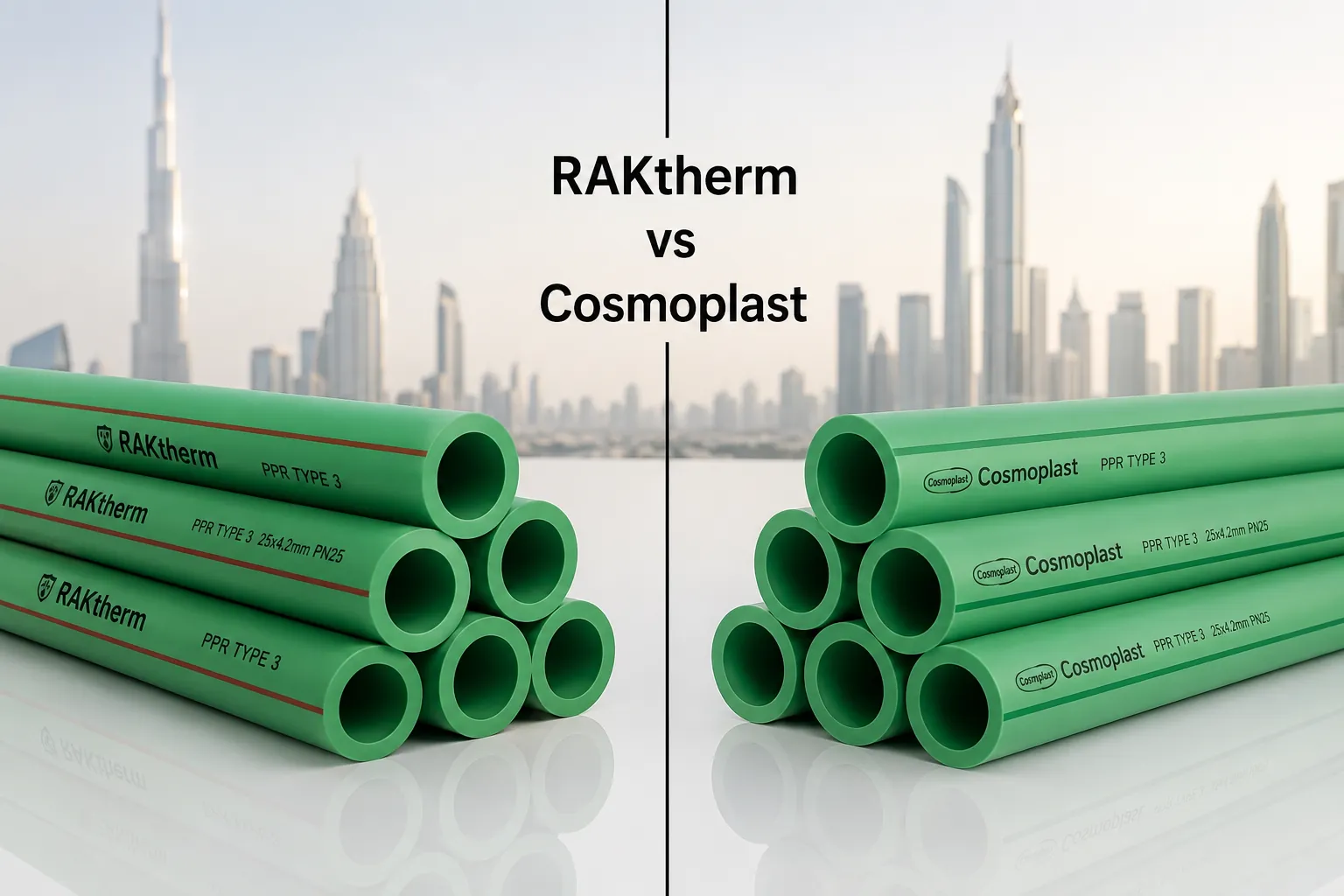
If you’ve been specifying or sourcing PPR pipes in Dubai, you’ve almost certainly encountered these two names: RAKtherm and Cosmoplast. Both are UAE-manufactured, both are widely distributed across the Emirates, and both claim to be the better choice for hot and cold water plumbing systems. So which one is actually better- and more importantly, RAKtherm vs Cosmoplast PPR pipes which one is right for your specific project ?
This isn’t a manufacturer’s brochure. We’ve looked at the specs, the certifications, the product range, the applications, and how each brand performs in real Dubai project conditions — the extreme heat, high mineral content water, and construction demands that make the UAE one of the most demanding environments for piping systems in the world. By the end of this guide, you’ll know exactly which brand suits which application, and where to source whichever one you need.
📋 Table of Contents
⚡ Quick Facts: RAKtherm & Cosmoplast PPR Pipes in UAE
PPR stands for Polypropylene Random Copolymer — a thermoplastic material used to manufacture pipes for hot and cold water supply systems. It’s become the dominant choice for building plumbing in the UAE and across the wider GCC for good reason: it handles the conditions here better than metal or standard PVC alternatives.
Here’s why PPR is the default specification for most Dubai plumbing projects:
To understand how PPR sits within the broader range of piping materials for Dubai projects, our detailed guide on PPR vs PVC vs HDPE pipes gives you the full comparison across materials. And if you’re deciding between PPR and PVC for a specific application, our PPR vs PVC pipe comparison covers the key differences in detail.
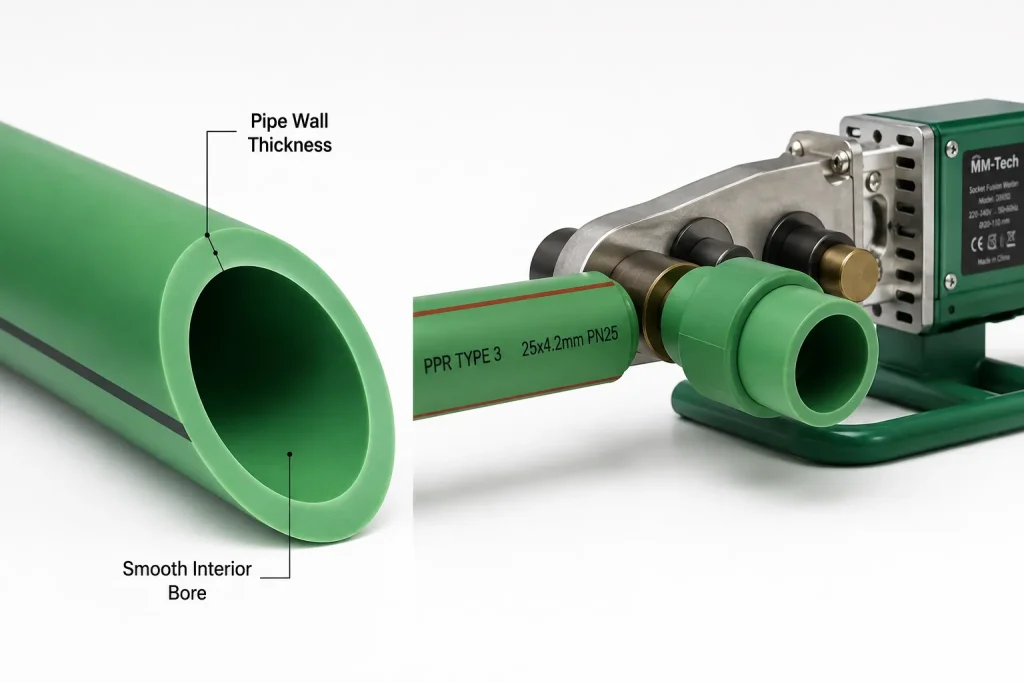
RAKtherm is a division of Hashim Industry, established in 1963 and headquartered in Ras Al Khaimah. It is widely regarded as the premier manufacturer of integrated PPR and PEX piping systems in the Middle East and North Africa. The company manufactures on a 40,000 m² production complex using advanced German manufacturing technology, with tight dimensional tolerances and rigorous quality control at every stage.
| Specification | RAKtherm PPR Detail |
|---|---|
| Material Grade | PP-RCT (Polypropylene Random Copolymer Type 3) — next-generation formulation |
| Manufacturing Standards | DIN 8077/8078, ISO 15874, EN 15874 |
| Temperature Rating | –10°C to 95°C continuous working temperature |
| Pressure Rating | PN10 / PN16 / PN20 / PN25 — up to 25 Bar |
| Available Sizes | 20mm to 110mm (PPR); larger in multilayer variants |
| Pipe Length | 4 metres standard |
| Certifications | UL 6039, FM 90, WRAS, Intertek, BSI |
| Special Features | Flame-retardant formulation; lifetime warranty available; aluminum foil variant for UV/external use |
| Colour | Green (standard PPR); Grey (fire-rated variants) |
| Manufacturing Location | Ras Al Khaimah, UAE |
RAKtherm’s key differentiation is its use of PP-RCT (Type 3) material — the next generation of PPR raw material that delivers up to 25% higher pressure resistance at elevated temperatures compared to standard PP-R. In Dubai’s climate, where water temperatures in roof tanks and sun-exposed risers regularly push past 60°C, that additional thermal pressure performance is a genuine advantage — particularly on high-rise residential buildings and commercial developments where long hot water runs experience significant temperature at pressure.
The aluminum foil variant of RAKtherm PPR is also worth noting: it adds UV protection and reduces thermal expansion for above-ground or external applications — directly relevant for UAE construction where some pipe runs are exposed or semi-exposed before final wall finishes are applied.
For more on the RAKtherm brand, Dave Pools provides a dedicated RAKtherm brand page with the full product overview.
Cosmoplast is part of the Harwal Group — one of the UAE’s largest manufacturing conglomerates — and holds the distinction of being the largest thermoplastic pipe manufacturer in the GCC region. With over 60 years of regional manufacturing experience and production facilities in Sharjah, Dubai, Abu Dhabi, Saudi Arabia, and Russia, Cosmoplast has a supply depth and regional presence that few competitors can match.
| Specification | Cosmoplast PPR Detail |
|---|---|
| Material Grade | PP-R Polypropylene Random Copolymerized (RAL 6017 green) |
| Manufacturing Standards | German DIN 8077/8078, ISO 15874, BS, ASTM, ISO 9001:2000 |
| Temperature Rating | Up to 95°C continuous working temperature |
| Pressure Rating | PN10 / PN16 / PN20 / PN25 / PN30 — up to 25 Bar (PN30 available on some sizes) |
| Available Sizes | 20mm to 160mm |
| Pipe Length | 4 metres standard |
| Certifications | DIN, BS, ASTM, ISO 9001, WRAS, Intertek, Kiwa, BSI |
| Special Features | Fibre-reinforced variants; PPR-AL-PPR composite pipes; widest size range in UAE market (up to 160mm) |
| Colour | Green (standard PPR) |
| Manufacturing Location | Sharjah, Dubai & Abu Dhabi, UAE |
Cosmoplast’s primary advantage is breadth. The widest size range in the UAE market (up to 160mm) means it covers applications that RAKtherm’s standard PPR range doesn’t reach — large-diameter risers, building main headers, and industrial distribution runs. The Pipeline System Division is ISO 9001:2000 accredited and holds multiple international certifications across BS, DIN, and ASTM standards, giving consultants and engineers the documentation depth needed for project technical submissions and municipality approvals.
Cosmoplast’s PPR-AL-PPR composite and fibre-reinforced range also specifically addresses one of PPR’s known weaknesses in UAE conditions: thermal expansion. Reinforced pipes expand significantly less than standard PPR at high temperatures, which reduces the frequency of expansion loops and compensators needed in long hot water runs — simplifying system design on large projects.
Dave Pools provides a dedicated Cosmoplast brand overview page with the full product profile.
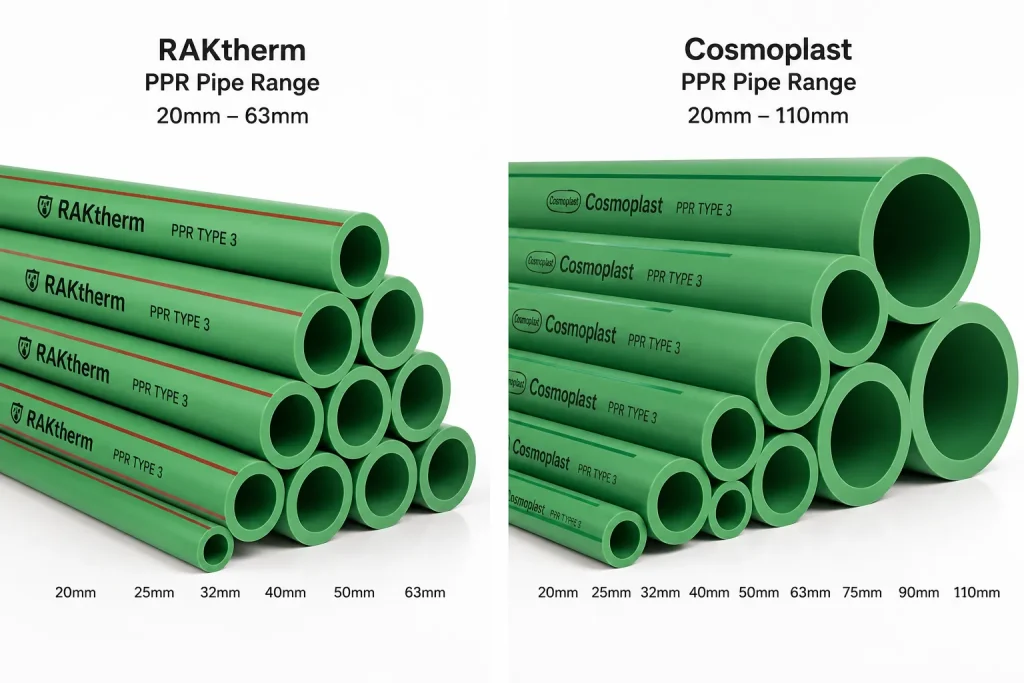
Here’s the direct, side-by-side breakdown across every factor that matters on a Dubai construction or fitout project:
| Factor | RAKtherm | Cosmoplast |
|---|---|---|
| Material Grade | PP-RCT (Type 3) — next-gen | PP-R (Standard grade) |
| Temperature Rating | –10°C to 95°C | Up to 95°C |
| Max Pressure Rating | PN25 | PN25 / PN30 (select sizes) |
| Size Range | 20mm–110mm (standard PPR) | 20mm–160mm ✅ Wider range |
| Thermal Expansion Control | Good (aluminum foil variant) | Excellent (fibre & PPR-AL-PPR) |
| Pressure at High Temp | Higher (PP-RCT advantage) ✅ | Standard PP-R performance |
| Certifications | DIN, ISO, UL, FM, WRAS, Intertek, BSI | DIN, BS, ASTM, ISO 9001, WRAS, Intertek, Kiwa, BSI |
| Fibre-Reinforced Range | Yes (aluminum foil multilayer) | Yes (fibre + PPR-AL-PPR) ✅ |
| UV-Resistant Variant | Yes — aluminum foil PPR | Yes — UV-rated products available |
| Manufacturing Heritage | Since 1963 (Hashim Industry) | 60+ years (Harwal Group) |
| Consultant Approval | Strong — widely accepted UAE | Strong — widely accepted UAE ✅ |
| Drinking Water Safe | Yes — food grade PPRc | Yes — food grade certified |
| Available from Dave Pools | ✅ Yes | ✅ Yes |
Overall summary: RAKtherm edges ahead on thermal-pressure performance at elevated temperatures thanks to PP-RCT material. Cosmoplast leads on size range, reinforced pipe variants, and breadth of certifications — making it the stronger specification for large-diameter or structurally demanding applications. For most standard Dubai villa and commercial plumbing projects, both are excellent — the decision often comes down to consultant specification, project budget, and which PN rating and pipe type best fits the application.
Neither RAKtherm nor Cosmoplast supply a single product — both offer a range of PPR pipe types suited to different applications. Understanding what’s in each range helps you match the right product to the right part of your system.
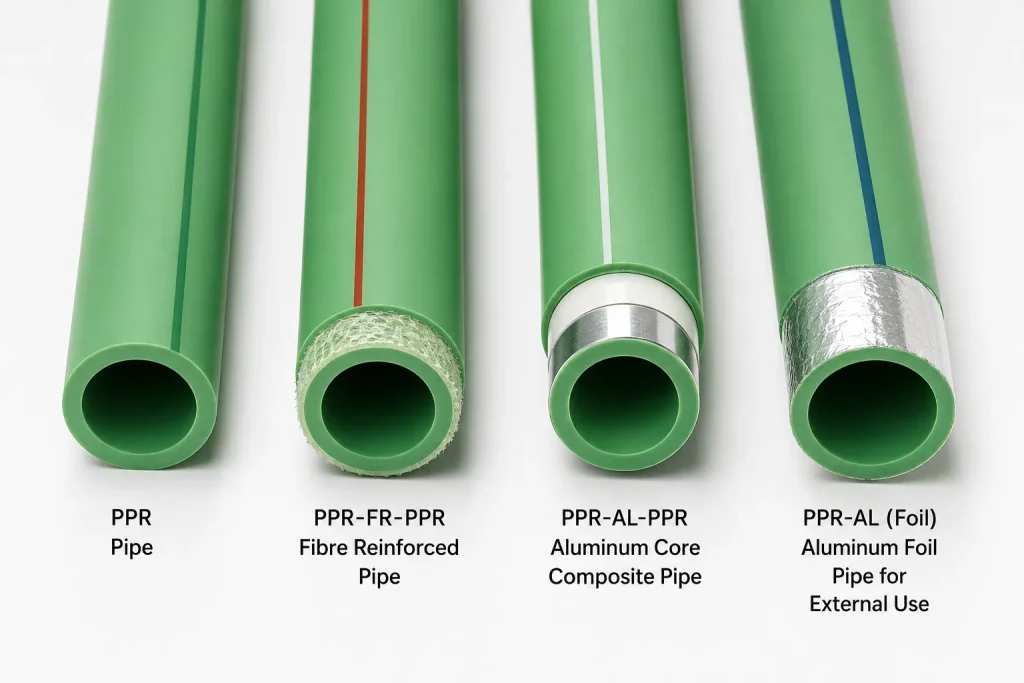
The core product in both ranges. Green polypropylene pipe in PN10, PN16, PN20, and PN25 pressure classes, suitable for hot and cold water distribution inside buildings. This is the workhorse of UAE residential and commercial plumbing. For most internal water supply applications — bathroom risers, kitchen supplies, and flat distribution networks — standard PPR from either brand performs identically well.
Both brands offer fibre-reinforced variants. The fibre layer (typically fibreglass) reduces the coefficient of thermal expansion significantly. Standard PPR expands and contracts with temperature changes — relevant in UAE buildings where hot water can fluctuate from 20°C to 80°C through the day. Fibre-reinforced pipe reduces this movement by up to 50%, cutting the number of expansion loops and compensators needed. Cosmoplast’s fibre-reinforced range is particularly strong in this area.
A three-layer system: inner PPR layer, bonded aluminium core, outer PPR layer. The aluminium core makes these pipes virtually non-expanding under temperature change — making them ideal for long horizontal runs and exposed installations where thermal expansion loops are impractical. Also oxygen-barrier rated, making them suitable for underfloor heating systems in UAE villas and hospitality projects.
RAKtherm’s external-grade PPR variant wraps the pipe in an aluminium foil layer that provides UV protection and reduces thermal expansion. Suitable for above-ground or semi-exposed pipe runs on UAE construction sites — particularly useful during the construction phase before wall finishes are applied, or for permanent external applications. To understand how PPR pipe types are categorised and what fittings work with each, read our guide on PPR pipe fitting types.
Both RAKtherm and Cosmoplast supply matching fittings for their pipe ranges — elbows, tees, reducers, unions, end caps, male and female threaded adapters, and more. It’s best practice to use matching brand fittings with your chosen pipe brand for guaranteed dimensional compatibility and fusion weld integrity. For an overview of how PPR pipes and fittings are connected, see our guide on how to connect PPR pipes, and our overview of what PPR pipes and fittings are.
Here’s a practical, direct guide to matching brand to project type — based on the specs, certifications, and UAE construction realities:
Either brand works well. For standard hot and cold water supply in residential buildings — the vast majority of UAE plumbing projects — both RAKtherm and Cosmoplast standard PPR in PN16 or PN20 is the correct specification. The choice here often comes down to consultant specification, what the main contractor has standardised on, or availability at time of order. Dave Pools stocks both. For villa-specific system design considerations, read our guide on planning pipework for UAE villas.
RAKtherm PP-RCT advantage. For tall buildings where water pressure at lower floors is significantly higher, and where hot water at pressure is sustained over longer runs, RAKtherm’s PP-RCT material delivering 25% higher pressure resistance at elevated temperatures gives it a meaningful edge. PN25 RAKtherm is a strong specification for lower-floor connections in high-rise projects.
Cosmoplast PPR-AL-PPR composite — strong choice. Large hotel developments have very long hot water distribution runs across multiple floors. The PPR-AL-PPR composite’s near-zero thermal expansion performance significantly reduces the engineering complexity of managing expansion in these long runs. Cosmoplast’s breadth of certifications also supports consultant submission and municipality sign-off on hospitality projects.
Cosmoplast — larger diameter advantage. For industrial applications requiring pipe diameters above 110mm — large chilled water systems, process water distribution, infrastructure headers — Cosmoplast’s size range up to 160mm (and beyond in other materials) covers ground that RAKtherm standard PPR doesn’t reach. The company’s ISO 9001 accreditation and multi-standard certifications also match the documentation requirements of large infrastructure tenders.
RAKtherm aluminum foil PPR or HDPE — depending on spec. For exposed outdoor pipe runs in UAE conditions, PPR with UV protection (RAKtherm’s aluminum foil variant) is the right choice if the system requires PPR. However, for main outdoor irrigation supply lines, HDPE generally remains the preferred material for its flexibility and UV resilience. See our guide to choosing the best pipe material for irrigation systems for a full comparison.
PN (Pressure Nominale) rating is one of the most important specifications to get right when ordering PPR pipes for a Dubai project. The wrong PN selection is one of the most common causes of premature pipe system failure in UAE buildings. Here’s what each rating means and when to use it:
| PN Rating | Max Working Pressure | Wall Thickness | Best For (UAE) |
|---|---|---|---|
| PN10 | 10 Bar | Thinnest wall | Cold water only; low-pressure residential circuits; garden supply lines |
| PN16 | 16 Bar | Medium wall | Standard UAE residential hot & cold water supply — most common specification for villas & apartments |
| PN20 | 20 Bar | Thicker wall | Mid-rise buildings; hot water at pressure; commercial plumbing |
| PN25 | 25 Bar | Thickest wall | High-rise lower floors; direct boiler connections; high-pressure industrial applications |
A higher PN rating means a thicker pipe wall — more material, greater weight, and a higher unit price. Specifying PN25 across an entire system where PN16 is sufficient wastes budget. Specifying PN10 in a hot water circuit is a code violation and a system failure waiting to happen. Always confirm operating temperature and pressure requirements before specifying PN rating. Our post on the difference between PN10 and PN16 pipes goes deeper on this.
Also note: PPR pipe’s pressure capacity decreases as temperature increases. A PN16 pipe rated at 16 Bar at 20°C may only support 6–8 Bar at 70°C. This is why RAKtherm’s PP-RCT material is significant — it retains more pressure capacity at elevated temperatures than standard PP-R, which directly matters in UAE hot water systems. Our detailed PN16 vs PN10 pipe pressure rating guide explains how to calculate the right rating for your working conditions.
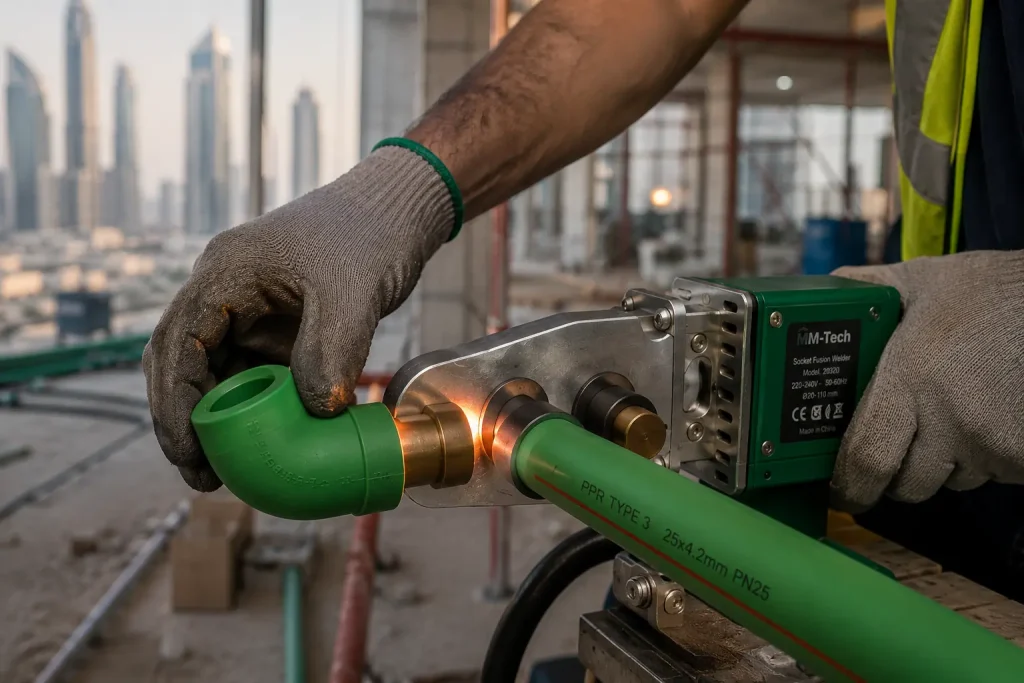
Both RAKtherm and Cosmoplast PPR are joined by socket fusion welding — the same process, the same tools, the same fundamental technique regardless of brand. A calibrated heat fusion tool heats both the pipe end and the fitting socket simultaneously to 260°C, then the two are pushed together and held for a set cooling time to form a permanent, monolithic joint.
Step 1 — Cut Square: Use a dedicated PPR pipe cutter or fine-tooth hacksaw to cut the pipe perfectly square. Any angled cut will result in an uneven fusion zone and a weak joint. For guidance on getting clean cuts, see our post on how to cut pipe correctly.
Step 2 — Mark Insertion Depth: Mark the pipe at the correct insertion depth before welding. Over-insertion reduces the bore; under-insertion leaves an unwelded gap.
Step 3 — Heat Fusion Weld: Insert the pipe and fitting simultaneously into the correct-sized die on the heat fusion tool. Hold for the manufacturer-specified heating time (typically 5–30 seconds depending on pipe diameter). Remove and push firmly together. Hold without movement for the specified cooling time. Read our full guide on how to weld PPR pipe correctly.
Step 4 — Allow Full Cooling: Don’t apply water pressure until all joints have fully cooled. In UAE summer heat, ambient temperatures accelerate the surface cooling but the joint core takes longer — waiting the full recommended cool-down period is critical.
These errors show up regularly on UAE construction and fitout projects — and they’re entirely avoidable with the right knowledge:
Mistake 1 — Wrong PN Rating for Hot Water
Using PN10 on a hot water circuit because it’s cheaper. At 70°C operating temperature, a PN10 pipe may only safely handle 4–5 Bar — far below what a hot water riser in a multi-storey building sees.
Fix: Always check temperature-derated pressure capacity, not just the cold-water PN rating. Use PN16 minimum for hot water; PN20 or PN25 for high-rise or high-pressure applications.
Mistake 2 — Mixing Brand Fittings with Different Brand Pipes
RAKtherm pipes with Cosmoplast fittings (or vice versa). While both comply with DIN dimensional standards, slight manufacturing tolerances between brands can result in imperfect fusion zones.
Fix: Use matching brand fittings with matching brand pipe throughout each system. If you need to understand what different fitting types are available, our PPR pipe fitting types guide has the full breakdown.
Mistake 3 — No Expansion Allowance on Long Runs
Running 10+ metres of hot water PPR horizontally without expansion loops or sliding supports. The pipe buckles or pulls joints under thermal cycling.
Fix: Install expansion loops or use fibre-reinforced/PPR-AL-PPR pipe which has significantly lower thermal expansion. This is especially important in UAE buildings where hot water temperature swings are large.
Mistake 4 — Insufficient Fusion Heating Time
Rushing the heat fusion weld — removing the pipe from the die before the correct heating time has elapsed. The result is a cold joint that looks fused but has inadequate bond strength.
Fix: Always follow the manufacturer’s fusion time table, which varies by pipe diameter. Refer to our full guide on how to weld PPR pipe for correct heating times across sizes.
Mistake 5 — Using Standard PPR for External or UV-Exposed Runs
Standard green PPR exposed to direct UAE sunlight degrades — becoming brittle and prone to cracking. This is particularly common on external wall runs, roof-mounted pipe work, and semi-exposed plant rooms.
Fix: Specify RAKtherm aluminum foil PPR or Cosmoplast UV-rated products for any exposed installation. Alternatively, provide UV-resistant insulation or pipe casing for external runs.
Both are excellent brands and both are widely accepted on Dubai projects. RAKtherm’s PP-RCT (Type 3) material gives it a performance edge for high-temperature, high-pressure applications — particularly useful in high-rise buildings and direct boiler connections. Cosmoplast leads on size range (up to 160mm), reinforced pipe variants, and depth of certifications for large infrastructure and hospitality projects. For most standard villa and apartment plumbing, either brand in the appropriate PN rating performs equally well. Dave Pools stocks both — visit our PPR pipes and fittings supplier page to discuss your project requirements.
For most UAE villa hot water supply, PN16 is the standard specification and is appropriate for typical residential operating pressures. If you’re on a high floor, have long hot water runs, or are connecting close to a boiler, PN20 gives you additional safety margin. PN25 is generally reserved for high-rise lower floors and high-pressure commercial applications. Our guide on PN10 vs PN16 pipe pressure ratings explains the selection criteria in detail.
Yes. Both RAKtherm and Cosmoplast PPR pipes are manufactured from food-grade polypropylene and are approved for potable water distribution. Both carry WRAS and international certifications confirming they are safe for drinking water contact. This is a standard requirement for UAE building projects and municipality approvals.
Standard green PPR is not recommended for prolonged UV exposure — it degrades in the UAE sun. For outdoor applications, use RAKtherm’s aluminum foil PPR (UV protected) or Cosmoplast’s UV-rated variants. For main outdoor irrigation supply lines, HDPE pipe is typically the more practical and cost-effective choice. Read our comparison of PPR vs PVC vs HDPE for outdoor and irrigation applications.
Yes. Dave Pools is a stocked supplier of both RAKtherm and Cosmoplast PPR pipes and fittings in Dubai, covering the full range of pipe types, sizes, and PN pressure ratings for both brands. We can advise on the right product selection for your specific project. Visit our PPR pipes and fittings supplier page or contact us directly at sales@davepools.com or +971 04 393 4806.
PP-RCT (Polypropylene Random Copolymer Type 3) is the next-generation raw material used in RAKtherm’s PPR pipes. It delivers up to 25% higher pressure resistance at elevated temperatures compared to standard PP-R. In UAE conditions — where hot water in roof tanks and sun-exposed risers can reach 60–70°C — this additional thermal-pressure performance gives PP-RCT pipes a meaningful safety margin over standard PP-R, particularly on high-rise buildings and in direct boiler connection applications. Learn more about what PPR pipes and fittings are and how they’re classified.
Both RAKtherm and Cosmoplast are genuinely strong PPR pipe brands — UAE-manufactured, internationally certified, and widely proven across thousands of Dubai construction projects. The real question isn’t which brand is “better” in the abstract — it’s which brand and which product type best fits your specific project conditions.
Here’s the practical summary:
Dave Pools stocks both brands across the full range of pipe types, sizes, and PN ratings — all certified, all locally available in Dubai. Our team can advise on the right product for your project before you order.
Source RAKtherm & Cosmoplast PPR Pipes in Dubai
Dave Pools supplies both brands across the full range — PN10 through PN25, 20mm to 160mm, standard PPR, fibre-reinforced, and composite variants. Stocked in Al Quoz, Dubai. Delivered across the UAE.
→ Browse PPR Pipes & Fittings Supply in Dubai
→ Contact Dave Pools — Get a Quote
📞 +971 04 393 4806 | +971 54 308 1083 | 📧 sales@davepools.com
Al Quoz Industrial Area 1, Street 5, Al Tayer Warehouse #18, Dubai, UAE