
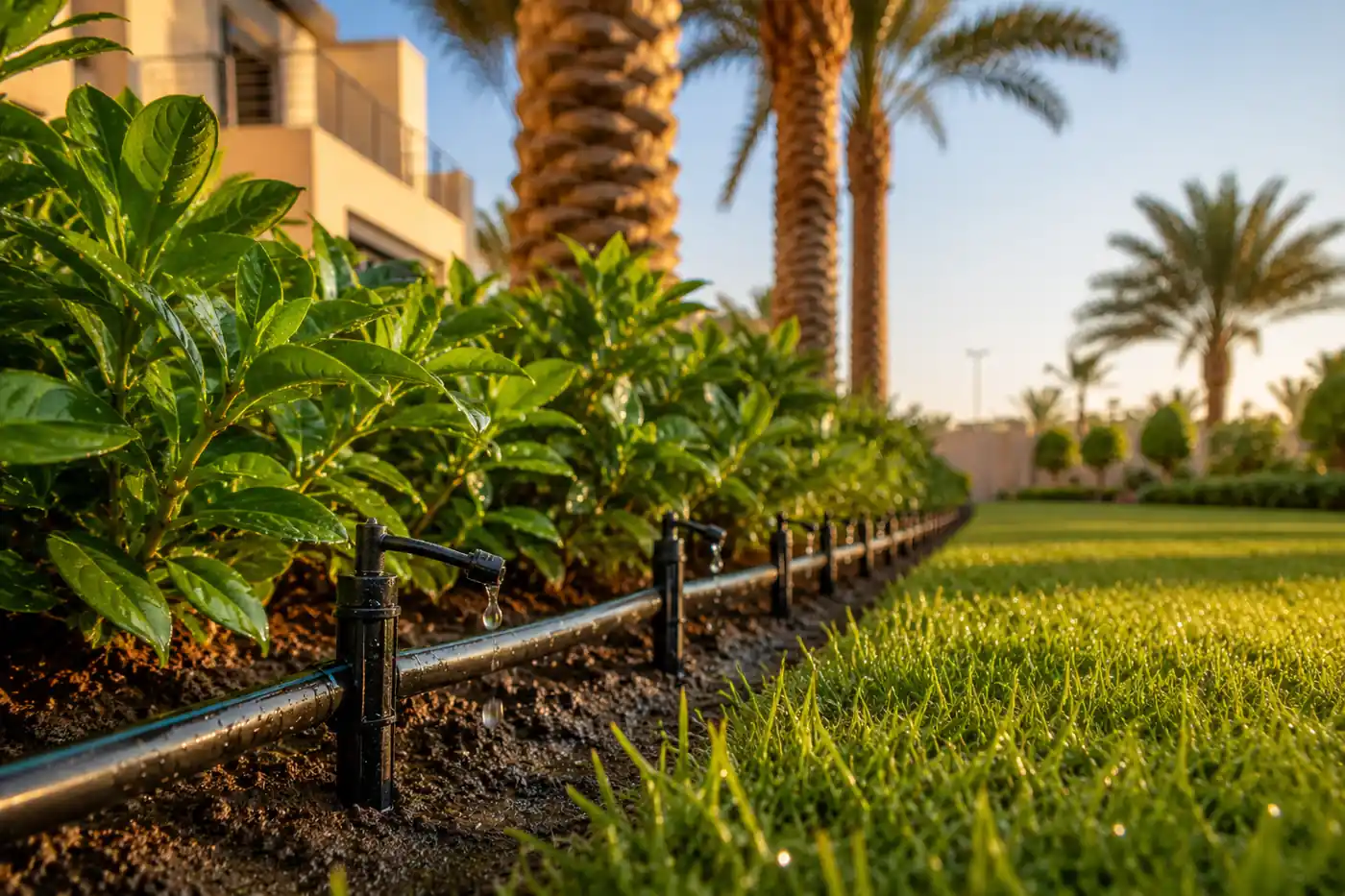
Most gardens in the UAE don’t die because of poor soil or bad plants. They die because of the wrong irrigation system — or no system at all. When temperatures push past 45°C and water is one of the most precious resources in the region, watering by hand or using a basic sprinkler just doesn’t cut it anymore.
Whether you manage a residential garden in Dubai, a commercial landscape in Abu Dhabi, or a large outdoor space across the UAE, choosing the right irrigation setup can be the difference between a thriving landscape and one that wilts within a season. This guide breaks down every major irrigation system type, compares them honestly, and helps you decide what works best for your specific project — no fluff, just what you need to know.
📋 Table of Contents
⚡ Quick Facts: Irrigation in the UAE
The UAE’s climate is one of the most demanding in the world for landscaping. Summers are long, intensely hot, and almost entirely rainless. Even in winter, humidity and salt-laden air create conditions that stress plants and degrade piping infrastructure. This means the stakes of choosing the wrong irrigation system are far higher here than they would be in a more temperate country.
Here’s the reality: most landscaping failures in Dubai and across the UAE aren’t caused by poor plant selection — they’re caused by irrigation systems that are either unsuitable for the climate, poorly installed, or not maintained. Overwatering causes root rot. Underwatering causes dehydration stress. Poorly sealed joints cause water loss underground. And systems that don’t account for evaporation waste thousands of litres a month.
Getting this right has a direct impact on:
Before choosing your system, it helps to understand the full landscape of different types of irrigation systems available — each designed for different plant types, soil conditions, and project scales.
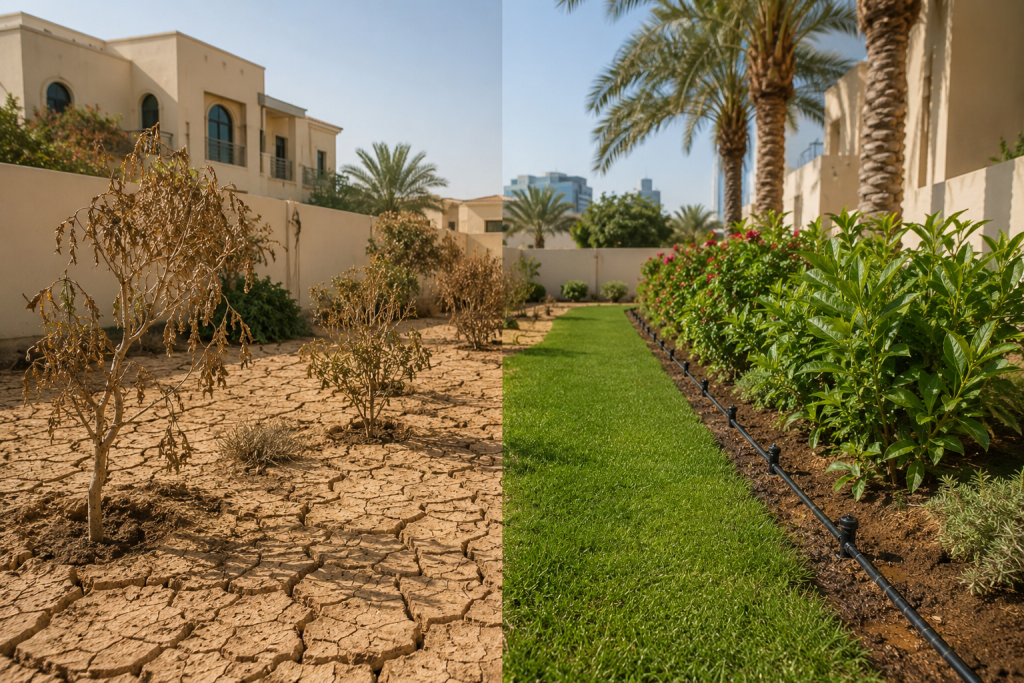
Not all irrigation systems are built the same — and not all of them are suitable for the UAE’s extreme conditions. Here’s a straightforward breakdown of the main options you’ll encounter:
Water is delivered directly to the root zone through a network of tubes and emitters. Minimal evaporation, maximum efficiency. Best for gardens, shrubs, trees, and agricultural applications. This is the most widely recommended system for the UAE climate.
Water is sprayed over a defined area using fixed or rotating sprinkler heads. Works well for lawns and large grass areas. However, significant water is lost to evaporation in the UAE heat — especially if operated during the day.
Drip lines are buried underground, delivering water directly below the surface. Virtually eliminates evaporation loss. Higher upfront installation complexity, but excellent for sports fields, golf courses, and high-end residential landscapes.
Timer-controlled systems that operate on a schedule without manual intervention. Can be combined with drip or sprinkler delivery methods. Removes human error from the watering equation and ensures consistency even when no one is present.
App or sensor-controlled systems that adjust watering schedules based on weather data, soil moisture, and plant requirements. The most advanced and water-efficient option. Increasingly popular for both residential and commercial landscaping projects in Dubai.
For a more detailed breakdown of each system and when to use them, read our full guide on different types of irrigation systems for UAE landscapes.
If you ask any experienced landscaper in Dubai which irrigation system they’d recommend first, the answer is almost always the same: drip irrigation. And there’s a good reason for that.
A drip irrigation system works by slowly releasing water at low pressure directly to the base of each plant through small emitters or drip tubes. Instead of spraying water into hot, dry air where much of it evaporates before reaching the soil, drip systems put water exactly where it’s needed — at the roots.
Step 1: Water Source & Main Supply Line
Water enters from a main supply — usually a tap, tank, or pump. A filter is fitted at the source to prevent debris from clogging the emitters. A pressure regulator is also recommended, especially in UAE properties where mains pressure can be high.
Step 2: Main Distribution Pipe
A larger diameter pipe (typically HDPE or PVC) carries water from the source to the planting zones. For UAE conditions, UV-resistant piping is essential. Learn more about HDPE pipes and why they’re ideal for outdoor use in the UAE.
Step 3: Lateral Lines & Emitters
Smaller-diameter tubing branches off the main line and runs alongside or around each plant. Emitters — small devices that release water at a controlled flow rate (measured in litres per hour) — are placed at each plant’s root zone.
Step 4: Timing & Control
A timer or controller manages when and how long the system runs. For best results in the UAE, watering is typically done early morning (before 7am) or late evening to further reduce evaporation.
Understanding exactly how drip irrigation works helps you design a system that won’t underperform or waste water.
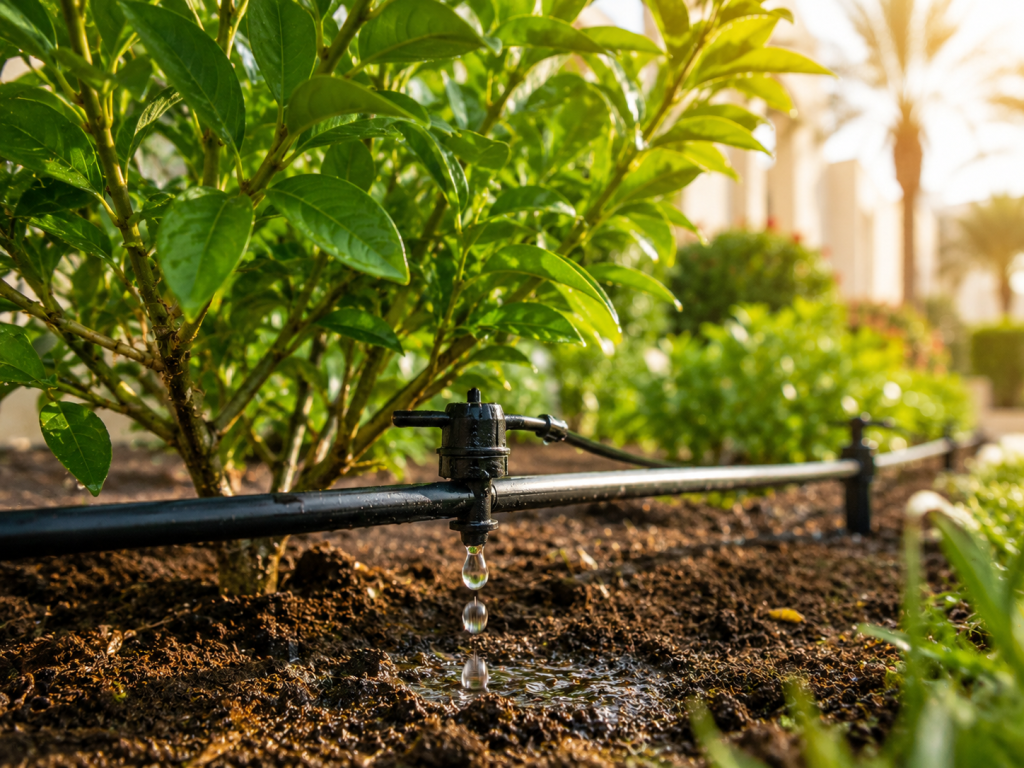
An automatic irrigation system solves one of the most common problems in UAE landscaping: inconsistency. Gardens that rely on manual watering get over-watered when someone is diligent and starved when the person responsible is travelling, busy, or simply forgets. In a climate as unforgiving as the UAE’s, inconsistency kills plants fast.
An automatic system removes the human variable entirely. You programme a controller once — specifying which zones water, for how long, and on which days — and the system handles the rest. Solenoid valves open and close automatically on schedule, and the water flows without anyone having to think about it.
For larger UAE properties — hotels, apartment communities, commercial parks — automatic systems with multiple zones are standard. They give facilities managers control over every area of a property’s landscaping from a single control panel.
A smart irrigation system takes automation one step further. Instead of just running on a fixed schedule, it responds to real-world conditions — weather, temperature, soil moisture, plant type, and even local evapotranspiration rates. It only waters when the plants actually need it.
This matters enormously in the UAE, where weather can shift dramatically. A scheduled automatic system might water at full rate the morning after a rare rainfall event, wasting water and waterlogging plants. A smart system detects the rain or reads the soil moisture data and skips the cycle automatically.
Weather-Based Controllers (ET Controllers)
These connect to local weather stations or pull real-time data online. They calculate evapotranspiration — how much moisture the landscape is losing to heat and wind — and adjust watering duration accordingly. Ideal for large commercial landscapes and community parks.
Soil Moisture Sensor Systems
Sensors buried in the soil measure moisture levels at the root zone. When levels drop below a set threshold, the system activates. When moisture is adequate, the system stays off. Precise and waste-free.
App-Controlled Systems
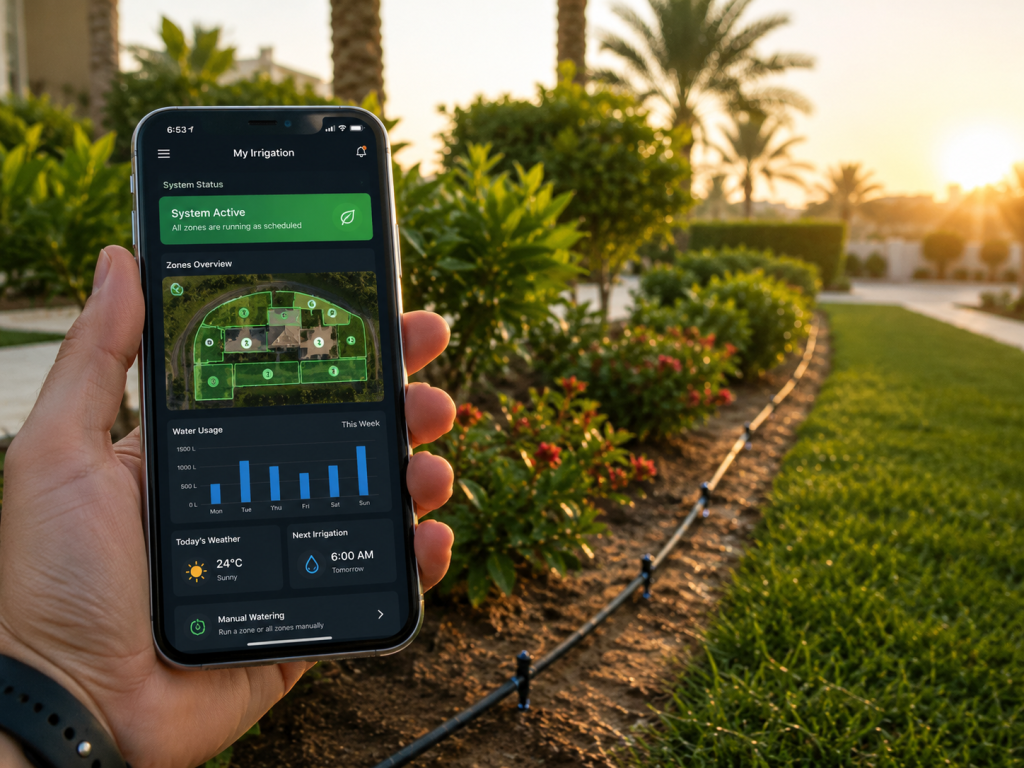
Modern smart controllers connect via WiFi and can be managed from a smartphone app from anywhere in the world. You can monitor water usage, adjust schedules, and receive alerts about faults or leaks in real time. For property owners managing UAE homes from abroad, this is a significant benefit.
For a full breakdown of how these systems are being used across Dubai and the wider UAE, read our detailed post on smart irrigation systems for UAE landscapes.
For most residential and commercial projects in the UAE — yes. The water savings alone typically offset the higher upfront investment within 12 to 24 months. Dubai Municipality and DEWA have sustainability initiatives that actively encourage smart water management, and some green-certified developments require it.
For smaller garden projects where budgets are constrained, a combination of drip irrigation with a basic automatic timer still delivers excellent results without the premium smart system cost.
Choosing between irrigation systems comes down to your property type, budget, water efficiency goals, and how hands-on you want to be with management. Here’s a clear side-by-side view:
| Feature | Drip Irrigation | Automatic Sprinkler | Smart Irrigation |
|---|---|---|---|
| Water Efficiency | Very High | Medium | Highest |
| Best For | Gardens, shrubs, trees | Lawns & grass areas | All types |
| Manual Effort | Low (with timer) | Very Low | Minimal |
| Evaporation Loss | Very Low | High (in UAE heat) | Very Low |
| Upfront Investment | Low–Medium | Medium | Medium–High |
| UAE Climate Suitability | Excellent | Good (early morning only) | Excellent |
| Remote Management | With smart add-on | With smart add-on | Yes — built in |
| Maintenance Needs | Low | Medium | Low |
Bottom line: For most UAE landscaping projects, a drip irrigation system with an automatic or smart controller is the optimal combination. If you’re managing a large-scale commercial or community property, a full smart irrigation setup is the most effective long-term solution. For lawn-heavy properties, automatic sprinklers scheduled for early morning remain a practical choice when paired with efficient pressure management.
Not sure which is right for your project? Browse our full range of irrigation systems and equipment available in Dubai.
An irrigation system is only as good as the pipes and fittings holding it together. In the UAE, extreme heat, UV radiation, and saline-heavy groundwater put serious pressure on piping infrastructure. Using the wrong material leads to degradation, leaks, and premature failure — often underground where you won’t notice until the damage is done.
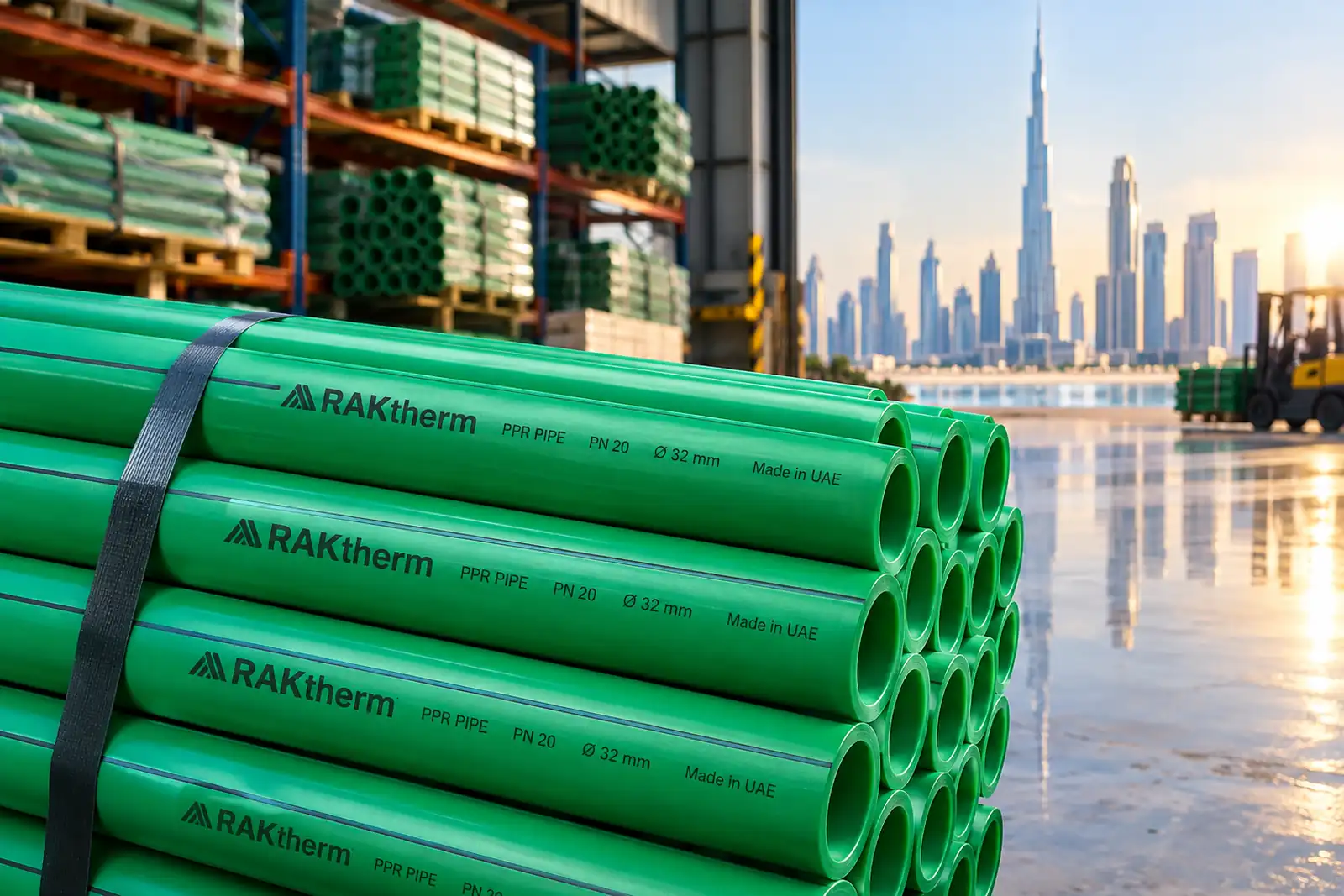
High-Density Polyethylene (HDPE) pipes are the most widely used material for main irrigation supply lines in the UAE. They’re flexible, highly resistant to UV radiation, and able to withstand the thermal expansion caused by extreme temperature swings. They don’t corrode, and they handle high water pressure reliably.
Read the full HDPE pipe guide to understand why this material outperforms most alternatives for UAE outdoor applications. If you’re sourcing material locally, Dave Pools is a trusted HDPE pipes and fittings supplier in Dubai and the UAE.
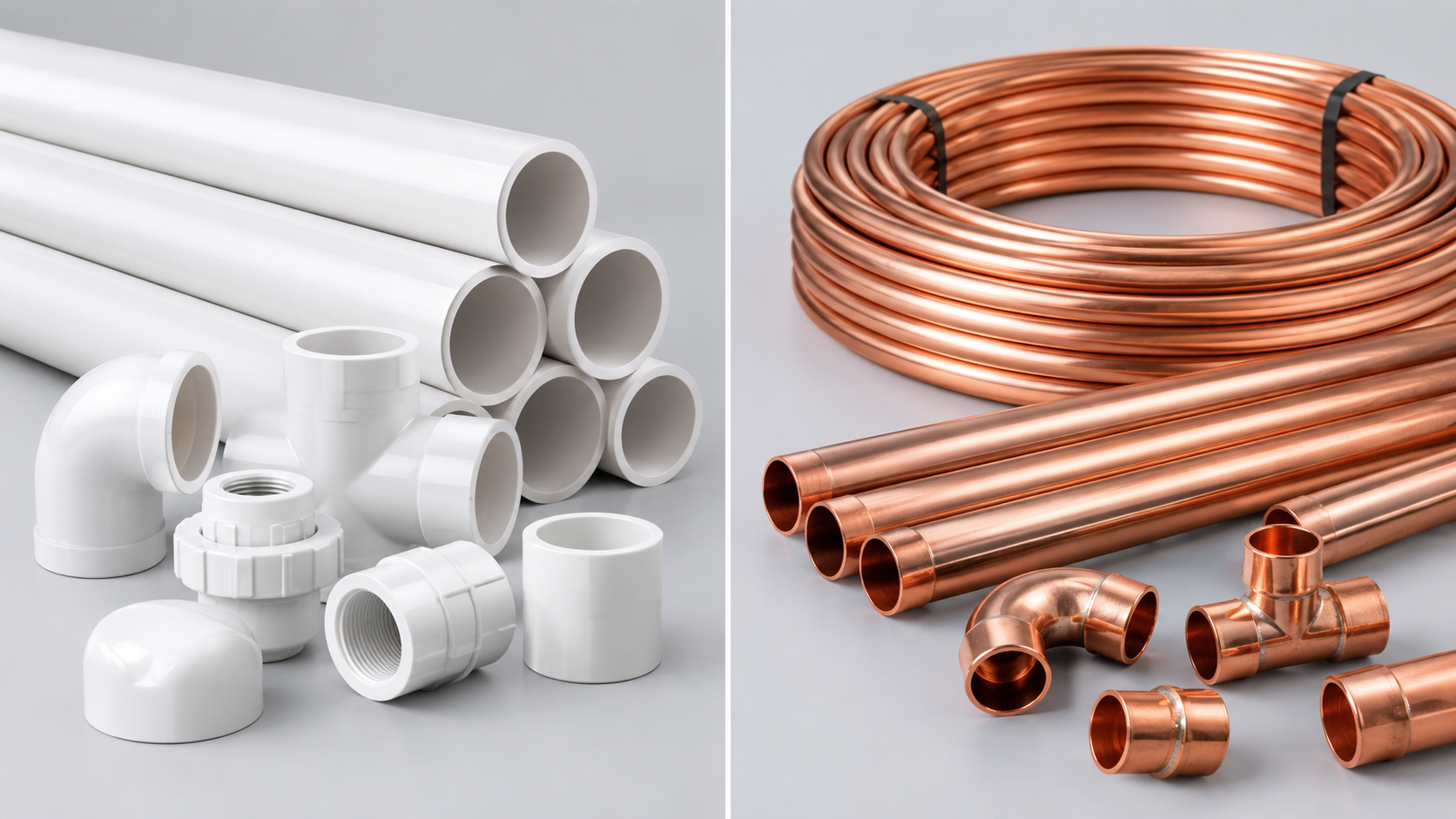
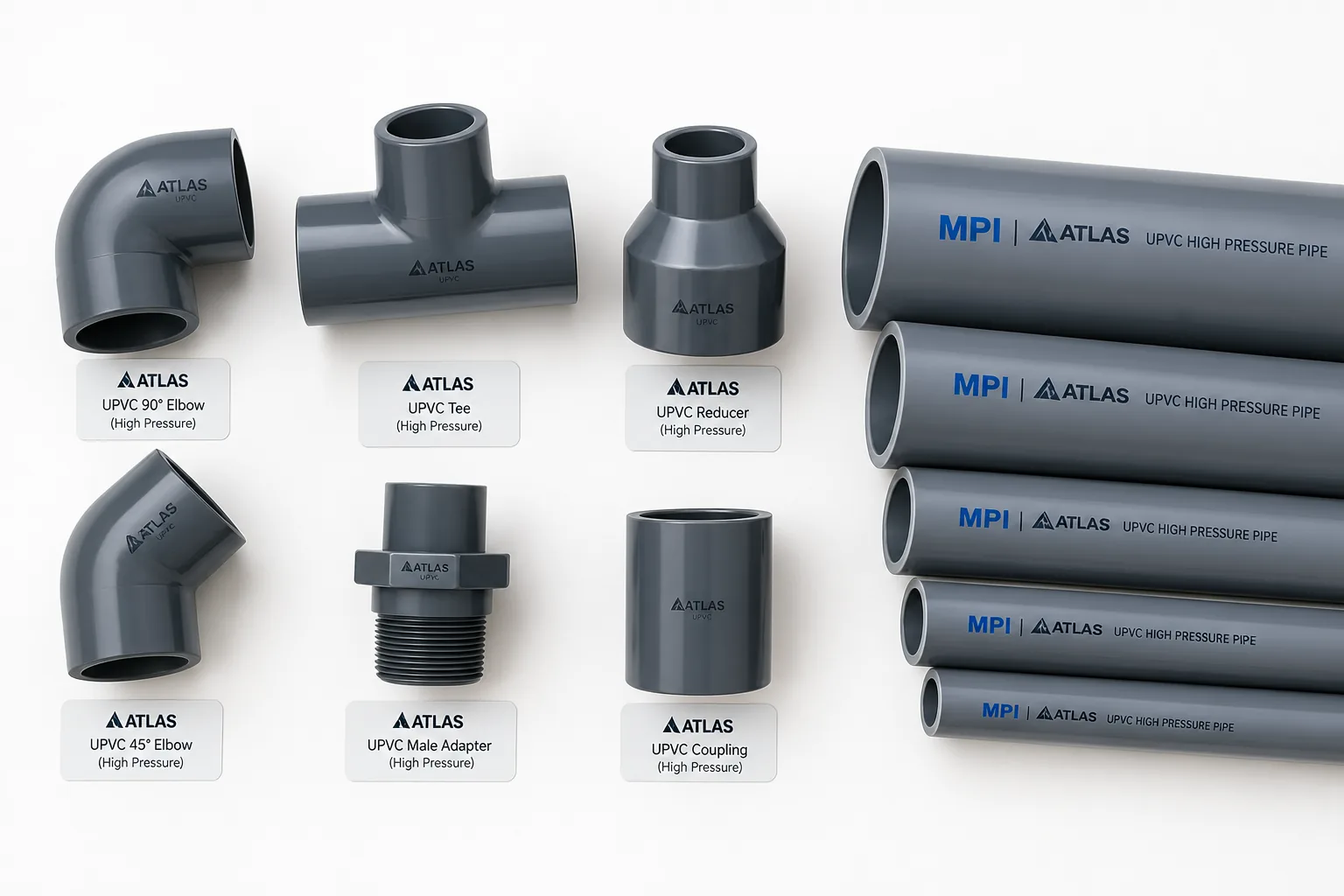
PVC (Polyvinyl Chloride) pipes are commonly used for the secondary distribution network within irrigation systems — especially for underground runs where UV exposure is not a factor. They’re rigid, smooth-bore (meaning excellent flow characteristics), and well-priced for larger volume projects.
When selecting PVC for irrigation, the pressure rating matters. Learn the difference between PN10 and PN16 rated pipes to make sure your system handles the operating pressure correctly. For a broader understanding of the material, see our comprehensive PVC pipe guide. You can also source pipes and fittings in Dubai directly from Dave Pools.
In UAE climates, some irrigation setups — particularly those serving rooftop gardens or sun-exposed terraces — may benefit from PPR piping on feed lines that experience extreme heat gain. PPR (Polypropylene Random Copolymer) handles high temperatures better than standard PVC, making it the right choice for above-ground hot supply sections. Explore our PPR pipes and fittings supply in Dubai.
Still unsure which material to use for your project? Our detailed guide on choosing the best pipe material for an irrigation system walks through every option with pros, cons, and real-world application guidance. You can also compare materials in our PPR vs PVC vs HDPE pipe comparison.
Valves control water flow to each irrigation zone. For most residential and commercial systems in the UAE, PVC ball valves or solenoid-operated valves are the standard choice. You can explore the full comparison of PVC ball valves vs gate valves to understand the trade-offs. If your system runs at higher pressures, understanding PVC high-pressure valves is also worthwhile. Dave Pools also supplies PVC high-pressure valves in Dubai.
A good irrigation system doesn’t just depend on picking the right type — the installation matters just as much. In the UAE’s harsh environment, a few specific considerations can make the difference between a system that lasts 10+ years and one that needs repairs within 12 months.
Any main supply piping exposed to direct sunlight will degrade faster than underground runs, even with UV-resistant materials. Burying lines at 20–30cm depth also protects them from physical damage. Our guide on how to install PVC pipes underground covers the correct techniques for UAE soil conditions.
For any exposed sections — typically lateral drip lines on the surface — use UV-stabilised polyethylene tubing or ensure lines are covered with mulch to reduce direct sun exposure and slow UV degradation.
UAE water often carries fine particulates and mineral deposits. A mesh or disc filter at the source protects emitters from clogging — one of the most common causes of drip irrigation failure. Check and clean filters every 2–3 months.
Running your system between 5am and 7am minimises evaporation loss significantly. Avoid watering at midday or early afternoon when UAE temperatures are at their peak. This simple scheduling adjustment can reduce water consumption by 15–25% on its own.
UAE mains pressure can fluctuate. Pressure that’s too high damages drip emitters and causes uneven water distribution. Fit a pressure regulator at each zone valve. If you ever face low-pressure issues, our guide on how to increase water pressure in a pipe offers practical solutions.
Poor-quality fittings are among the leading causes of underground leaks. A leaking joint that goes undetected can waste enormous amounts of water and undermine plant health. If you’re working with PVC, ensure all glued connections are done correctly — our guide on how to glue PVC pipe provides step-by-step guidance. For ongoing maintenance, knowing how to find a broken pipe underground is an important skill for any UAE property manager.
Even well-intentioned irrigation setups fail when these avoidable mistakes are made. Here’s what to watch for:
Mistake 1: Using the Wrong Pipe Material
Why it’s bad: Standard pipes not rated for UV or high temperatures degrade quickly in UAE conditions, leading to cracks, leaks, and system failure.
Fix: Always specify UV-stabilised or buried-grade materials. Read our guide on choosing the best pipe material for irrigation before specifying.
Mistake 2: No Pressure Regulation
Why it’s bad: High pressure damages emitters, causes misting instead of dripping, and wastes water.
Fix: Install a pressure regulator at every zone valve. Understand which valve types work best for pressure management in irrigation setups.
Mistake 3: Watering in the Middle of the Day
Why it’s bad: Up to 50% of water evaporates before reaching roots when operating during peak UAE heat.
Fix: Programme all automatic or smart controllers to water between 5am–7am.
Mistake 4: Ignoring the Filter
Why it’s bad: Clogged emitters deliver uneven or no water, causing plant stress and system failure.
Fix: Check and clean the inlet filter every 2–3 months. Replace blocked emitters promptly.
Mistake 5: Single-Zone Design for Mixed Plant Types
Why it’s bad: Grass, trees, and shrubs all have different water requirements. Running them on a single zone overwatering some and underwatering others.
Fix: Design multi-zone systems with separate controllers for different plant areas. Understand the full range of irrigation system types to design zones correctly.
Mistake 6: Not Upgrading an Outdated System
Why it’s bad: Old, inefficient systems waste water and money month after month.
Fix: There are at least 5 good reasons to upgrade your irrigation system if it’s more than 5 years old or underperforming.
For most residential gardens in Dubai, a drip irrigation system paired with an automatic timer is the best choice. It delivers water directly to the root zone, minimises evaporation in the heat, and requires minimal daily management. For larger properties or those managed remotely, upgrading to a smart irrigation system adds weather-responsive automation. Learn more about smart irrigation systems for UAE landscapes.
In UAE conditions, a well-designed drip irrigation system typically uses 30–50% less water than a comparable sprinkler setup. The main reason is that sprinklers lose significant water to evaporation during the day — a major issue in a climate where temperatures frequently exceed 40°C. Drip systems deliver water at root level, where it’s absorbed before it can evaporate.
Basic drip irrigation setups can be DIY-installed for small residential gardens. However, for larger systems with multiple zones, underground piping, solenoid valves, and smart controllers, professional installation is strongly recommended. Incorrect installation in UAE conditions can lead to underground leaks and system failure. If you want to understand the pipe work involved, our guide on installing PVC pipes underground is a useful starting point.
For underground main supply lines, HDPE pipes are the preferred choice — they’re flexible, corrosion-resistant, and handle thermal expansion well. For rigid underground distribution networks, pressure-rated PVC (PN10 or PN16) is a reliable and cost-effective option. See our full comparison of PPR vs PVC vs HDPE pipes to compare specifications.
At minimum, irrigation systems in the UAE should be inspected and serviced twice a year — once before summer and once before winter. Key checks include: filter cleaning, emitter inspection, valve testing, pressure verification, and controller schedule review. Regular maintenance prevents costly failures and keeps water consumption in check. Our water management resources at water management solutions in Dubai can help guide your maintenance approach.
The UAE’s climate leaves very little room for error when it comes to irrigation. Water is scarce, temperatures are extreme, and the consequences of getting it wrong — dead plants, wasted resources, expensive repairs — are real and costly.
The good news is that the technology available today makes it easier than ever to build an irrigation system that works reliably, conserves water, and keeps any landscape healthy through every season. Whether you go with a simple drip setup, a fully automated multi-zone system, or a smart water management solution, the key is matching the system to your specific landscape, plant types, and management capacity.
What matters most:
Dave Pools supplies a full range of irrigation systems and equipment in Dubai, from HDPE and PVC pipes through to valves, fittings, and complete landscape irrigation setups — all suited to UAE conditions.
Ready to Build or Upgrade Your Irrigation System?
Get the right pipes, fittings, valves, and irrigation equipment — all suited to UAE conditions and delivered across Dubai and the wider UAE.