
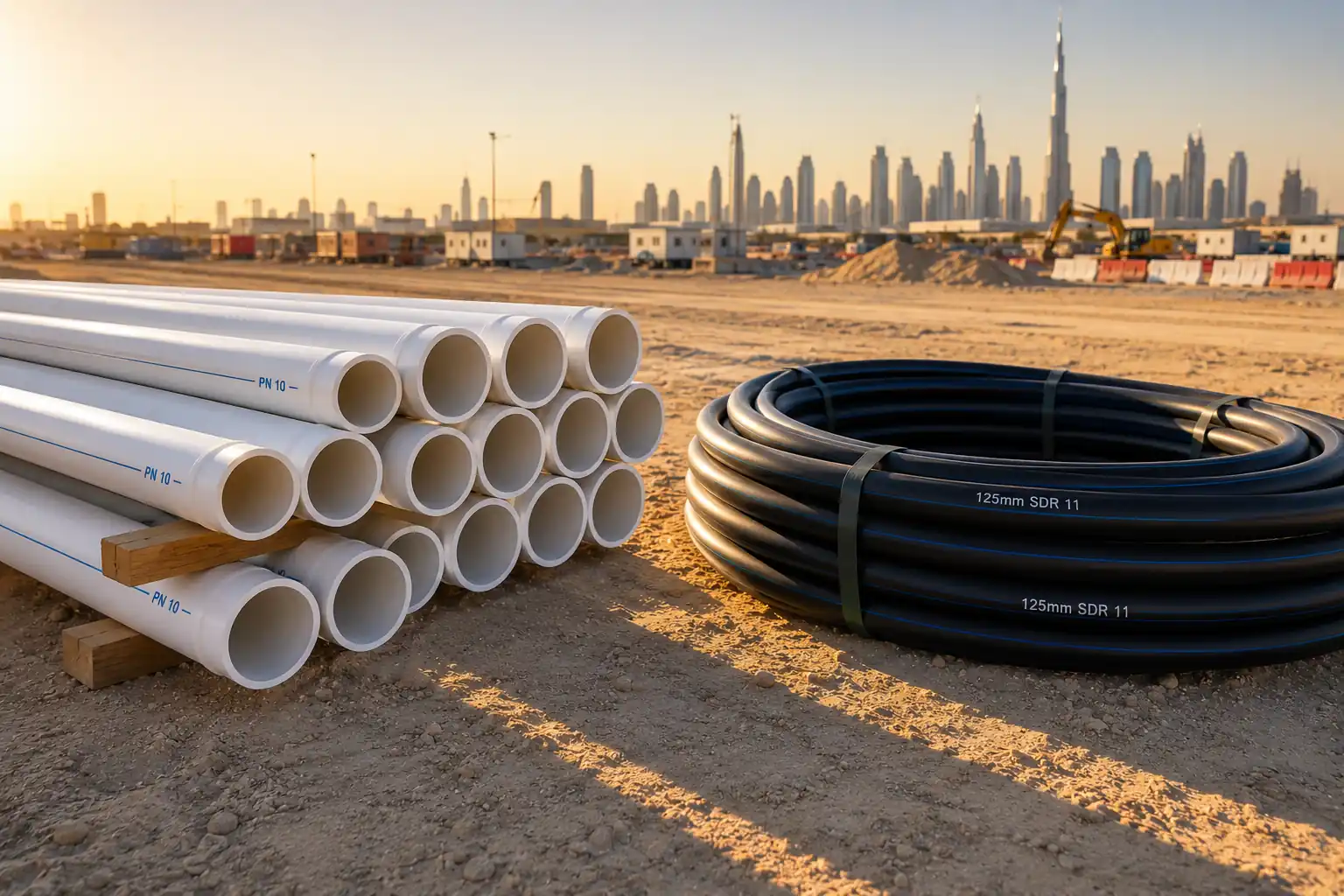
You’re sourcing pipe for a project — maybe it’s an underground irrigation main, a drainage network, a pool plumbing system, or a municipal water supply line. The spec says plastic pipe, and you’re looking at two options: PVC vs HDPE pipe. They’re both plastic. They’re both widely used. But they behave very differently in the ground, in the heat, under pressure, and over time. This post skips the general overview and gets straight to the comparison — so you can make the right call for your specific application in UAE conditions.
Table of Contents
Understanding why these two materials behave differently starts with what they’re made of at a molecular level — and it explains almost every performance difference between them.
Polyvinyl Chloride (PVC) is a rigid thermoplastic — its polymer chains are tightly structured and don’t flex easily under load. This rigidity is a design feature, not a weakness: it makes PVC dimensionally stable, easy to cut and join precisely, and excellent at maintaining its shape under soil load in trenched applications.
uPVC (unplasticised PVC) is the standard outdoor and structural grade — no plasticisers are added, keeping it rigid and chemically stable. This is what you’ll find in most UAE irrigation mainlines, drainage networks, and pool plumbing systems. For a complete understanding, see our guide on what PVC pipe is and how it’s used and standard PVC pipe sizes available in UAE.
High-Density Polyethylene (HDPE) is a semi-crystalline thermoplastic. Its molecular chains are more linear and tightly packed than standard polyethylene, giving it high tensile strength while retaining significant flexibility. You can bend an HDPE pipe into a curve without cracking it — something PVC simply cannot do.
This flexibility is HDPE’s core advantage. It allows the pipe to move with ground settlement, absorb vibration from traffic or nearby construction, and accommodate directional changes without fittings. In UAE’s expansive sandy soils where ground movement is a reality in new development areas, this matters enormously. For a full introduction, read our complete HDPE pipe guide and our SDR 11 vs SDR 17 comparison for HDPE pressure rating guidance.
| Factor | PVC / uPVC | HDPE |
|---|---|---|
| Flexibility | Rigid — cannot be bent on site | Highly flexible — can bend around obstacles |
| Joining method | Solvent cement / rubber ring push-fit / threaded | Butt fusion / electrofusion / mechanical couplings |
| Joint type | Discrete joints at each fitting/pipe end | Fully fused — monolithic pipe with no joint seams |
| Max temperature (water) | Up to 60°C (cold water applications only) | Up to 60°C (similar for standard grades) |
| Pressure rating system | PN (PN6, PN10, PN16) | SDR (SDR 17 ≈ PN10, SDR 11 ≈ PN16) |
| Impact resistance | Moderate — can crack under sharp impact, especially cold | Excellent — absorbs impact without cracking |
| Ground movement tolerance | Low — rigid pipes can crack under soil movement | High — flexibility accommodates settlement and movement |
| Chemical resistance | Good — not suitable for all solvents and hydrocarbons | Excellent — resistant to a very wide range of chemicals |
| UV resistance | Good in UV-stabilised uPVC grade | Poor — degrades in prolonged direct sunlight |
| Thermal expansion | Lower — more dimensionally stable in temperature swings | Higher — needs expansion allowance in above-ground runs |
| Availability in long coils | Rigid lengths only (typically 6m) | Available in coils (50m, 100m, 200m) — fewer joints |
| Installation ease (surface) | Easy — solvent cement, widely understood by teams | Requires fusion equipment — more skilled installation |
| Trenchless installation | ❌ Not suitable — too rigid | ✅ Ideal — standard for HDD (directional drilling) |
| Pool plumbing | ✅ Industry standard | ⚠️ Possible but non-standard |
| Large diameter availability | Up to 630mm in standard ranges | Up to 1600mm+ for infrastructure |
| Service life | 50+ years when correctly installed | 50+ years when correctly installed |
For above-ground installations, PVC’s rigidity is an advantage — the pipe holds its shape, supports itself between brackets, and makes for a clean, structured installation. For underground installations in UAE, the picture is more nuanced.
PVC performs well in well-compacted, stable trenches. The rigid pipe distributes soil load across its length and maintains its circular profile when properly bedded and backfilled. Where PVC underground struggles is in:
HDPE’s flexibility means it adapts to ground movement rather than resisting it. As UAE sandy soil settles around a buried HDPE pipe, the pipe flexes slightly to accommodate — redistributing load rather than concentrating it at joints. Since HDPE’s butt-fused joints are as strong as the pipe itself, there are no vulnerable seam points.
This is why HDPE is the preferred material for long-distance buried water mains in UAE infrastructure projects, and why it dominates in areas of active development where ground conditions are unpredictable. The UAE’s major utility projects — DEWA water mains, Emicool district cooling, agricultural irrigation networks in the Northern Emirates — predominantly specify HDPE for buried mainlines.
For guidance on HDPE testing after installation, see our guide on HDPE pipe testing methods and how to fix leaks in HDPE pipes when they do occur.
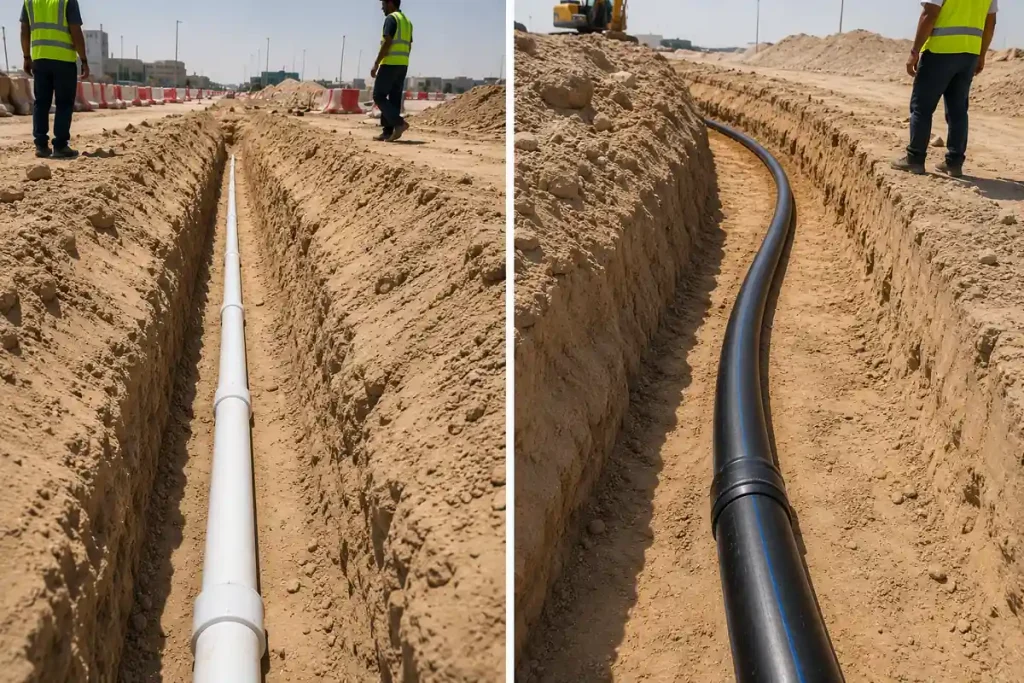
The joining method difference between PVC and HDPE is more significant than most people realise — it affects installation speed, joint reliability, the skills required on site, and what happens when a joint fails years later.
PVC pipe is joined with solvent cement — a chemical process where the cement softens both surfaces, which then fuse as the solvent evaporates. The technique is well understood and requires no specialist equipment beyond the primer, cement, and standard tools. Most UAE civil contractors and plumbing teams can install PVC competently.
The limitation is that each solvent-cemented joint is a potential weak point. Joints can fail due to: incorrect priming, using the wrong cement grade, not holding the joint during assembly, pressurising before full cure, or thermal stress cycling over time. In a long buried pipeline with many joints, even a low joint failure rate creates significant maintenance events. See our guide on how to glue PVC pipe correctly and how to pressure test PVC pipe after installation.
HDPE uses thermal jointing — either butt fusion (the pipe ends are heated on a hot plate and pressed together to form a monolithic weld) or electrofusion (a fitting with embedded heating elements fuses the pipe from the inside outward when electric current is applied). Both methods require specialist equipment and trained operators.
The advantage: a correctly made HDPE fusion joint is as strong as the pipe itself. There is no seam, no adhesive layer, no chemical dependency. Over a 50-year buried pipeline lifespan, HDPE fusion joints simply do not fail from joint-specific mechanisms the way solvent-cemented PVC joints can.
The disadvantage is access to the equipment and a trained operator. For large infrastructure projects this is standard practice. For a small residential irrigation system with 10 joints, it may be overkill — and the additional complexity of sourcing fusion equipment for a small job is a genuine practical barrier.
There is also the option of HDPE mechanical couplings (push-fit or compression fittings) for smaller diameter applications where fusion equipment is not available — but these are not suitable for pressurised buried mains where full fusion is the correct specification.
UAE’s climate presents specific challenges for both materials that differ from what most international product specifications assume.
uPVC outperforms HDPE significantly in direct UV exposure. Standard-grade HDPE is black — the carbon black pigment provides moderate UV resistance, but prolonged UAE sun exposure on above-ground HDPE still causes surface chalking and brittleness over 5–10 years. Specialised UV-stabilised HDPE grades are available but less commonly stocked in UAE.
uPVC pipe in UV-stabilised grade handles UAE sunlight well for above-ground applications — grey or cream-coloured uPVC with UV stabiliser added maintains its properties for 20+ years of direct sun exposure when used within its temperature rating. For outdoor UAE irrigation mainlines that run above ground between manifold boxes and below-ground sections, uPVC is almost always the better choice over HDPE.
Both PVC and HDPE have a maximum service temperature of approximately 60°C for water applications. In UAE summers, the top 10–20cm of soil can reach 50–55°C. At burial depths of 500mm and below, soil temperatures stay in the 30–40°C range even in peak summer — within safe operating range for both materials in pressurised water service.
However, HDPE has a higher thermal expansion coefficient than PVC — it expands and contracts more with temperature changes. For long above-ground HDPE runs in UAE, expansion loops or anchor points must be designed into the system to prevent buckling or joint stress. PVC, being more rigid with lower thermal expansion, is more dimensionally stable in above-ground temperature-cycling conditions. Refer to our guide on PVC pipe temperature ratings for detailed operating parameters.
HDPE’s chemical resistance profile is broader than PVC’s — it handles a wider range of acids, alkalis, and organic compounds without degradation. This makes HDPE the default specification for chemical process piping, industrial drainage, and any application where the fluid composition is aggressive or uncertain.
PVC’s chemical resistance is good for standard water applications — potable water, irrigation, pool water (in chlorinated concentrations typical of domestic pools), and most drainage fluids. Where PVC underperforms versus HDPE:
For standard UAE water supply, irrigation, and pool applications, both materials perform adequately. The chemical resistance edge matters in industrial, infrastructure, or specialised applications. See our guide on choosing the best pipe material for irrigation for application-specific guidance.
| Application | Best Choice | Why |
|---|---|---|
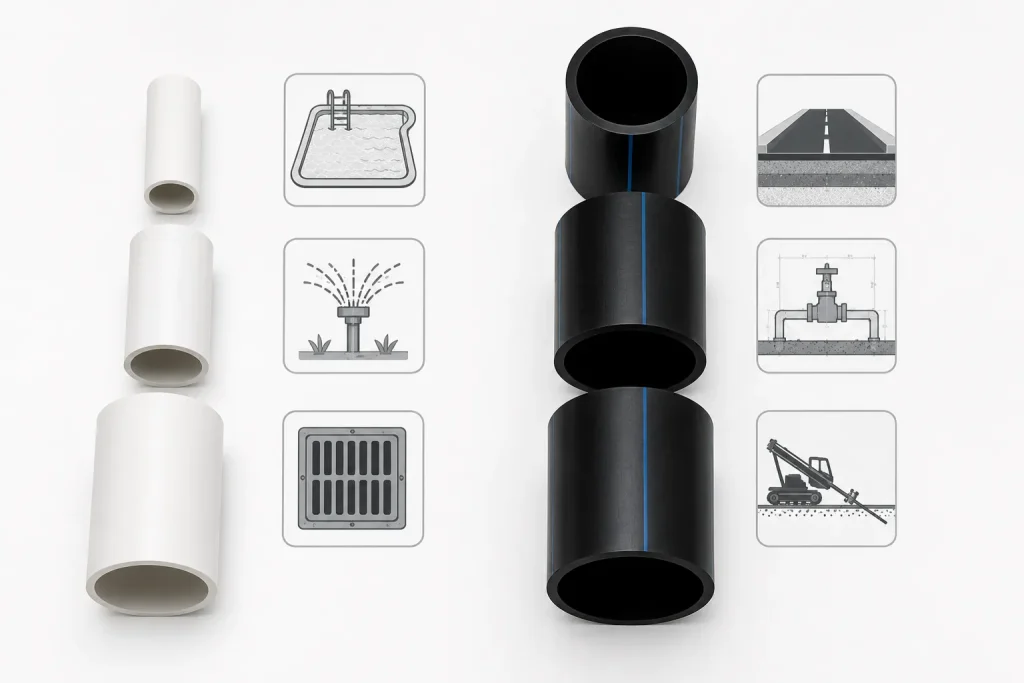
| Swimming pool circulation plumbing | uPVC | Industry standard — chemical resistant to pool water, easy to fabricate, wide range of fittings and valves available |
| Irrigation mainline (buried, UAE villa) | uPVC or HDPE | uPVC for structured systems with multiple fittings; HDPE for longer runs where fewer joints and flexibility are priorities |
| Irrigation mainline (large commercial, buried) | HDPE | Long coil lengths mean fewer buried joints; flexibility handles ground movement in large-scale UAE landscape projects |
| Above-ground irrigation supply line (UAE, exposed to sun) | uPVC | Better UV resistance in stabilised grade; lower thermal expansion — more dimensionally stable in UAE sun |
| Municipal water supply main (UAE infrastructure) | HDPE | Standard specification for UAE water mains — flexibility, leak-free fusion joints, large diameter availability |
| Gravity drainage (residential/commercial) | uPVC | Rigid pipe maintains correct gradient; wide range of drainage fittings; easier to install in structured drainage networks |
| Pressurised sewer force main | HDPE | Pressurised sewage mains need leak-free joints and flexibility; HDPE’s fused joints and chemical resistance make it the standard specification |
| Trenchless / directional drilling (HDD) | HDPE only | The flexibility to be pulled through a drilled bore is unique to HDPE — PVC is completely unsuitable for HDD applications |
| Fire sprinkler supply (building) | CPVC (neither) | Neither PVC nor HDPE is listed for fire suppression. CPVC is the correct material — see our guide on CPVC for fire sprinkler systems |
| Industrial chemical drainage | HDPE | Broader chemical resistance profile; fusion-welded joints eliminate leak risk in aggressive fluid applications |
| Gas distribution (buried) | HDPE only | PVC is not approved for gas distribution. HDPE is the global standard for buried gas mains |
Theory is useful. But here’s how the PVC vs HDPE decision plays out in the types of projects common across Dubai and the wider UAE.
A 200-villa community in Dubai needs a master irrigation system: one central pump station, buried mainlines running 800m across the community, with branch lines feeding each villa’s garden zone valve manifolds.
Specification decision: HDPE for the main distribution trunk lines buried along the roads (fewer joints over long distances, handles ground movement in UAE sandy soil, available in large coils). uPVC for the branch lines feeding each villa manifold (shorter runs, more fittings, easier for the landscaping team to work with at villa level). This hybrid approach — HDPE for mains, uPVC for laterals — is standard practice on large UAE landscape projects.
A residential pool needs its pump-filter-chlorinator circuit plumbed with appropriate pipe.
Specification decision: uPVC throughout, PN16 on the pressure side of the pump, PN10 acceptable for return lines. HDPE has no advantage here — uPVC’s rigidity, wide range of pool-specific fittings, and chemical resistance to chlorinated water make it the correct and conventional choice. Refer to our PN rating guide for pump-side vs return-line specifications.
A 160mm water supply main needs to cross under a busy road without open-cut trenching — a horizontal directional drill (HDD) is required.
Specification decision: HDPE SDR 11 (PN16 equivalent) without question. PVC cannot be pulled through a directional drill bore — it would crack immediately. HDPE’s flexibility and fused joints make it the only viable material for this application. This is a non-negotiable material selection.
A four-storey commercial building needs its horizontal drainage network — from floor drains and WC outlets to the main drainage chamber.
Specification decision: uPVC throughout. Gravity drainage needs rigid pipe to maintain precise gradient — HDPE’s flexibility actually works against you here, as it can sag between support points and disrupt the gradient. uPVC in 110mm and 160mm standard drainage grades is the correct and conventional specification for building drainage across the UAE.
Why it happens: PVC is what the team knows. The decision to go trenchless is made late in the project.
Why it’s a problem: PVC will crack and fail when pulled through a drilled bore. This is not a marginal risk — it’s a certainty.
Fix: Identify trenchless sections at the design stage and specify HDPE from the outset.
Why it happens: HDPE is specified for a buried system and the above-ground connection sections use the same material for simplicity.
Why it’s a problem: Standard black HDPE degrades in prolonged UAE UV exposure — surface chalking, brittleness, and eventual cracking within 5–8 years of above-ground exposure.
Fix: Use UV-stabilised HDPE for any above-ground sections, or transition to uPVC at grade level.
Why it happens: PVC is cheaper and more familiar. The pressurised sewer main is buried and assumed to be stable.
Why it’s a problem: UAE new development areas have frequent nearby construction vibration, heavy vehicle crossings, and ground settlement in sandy soil. PVC joints in force mains fail under these conditions — HDPE’s fused joints and flexibility handle them reliably.
Fix: Specify HDPE SDR 17 or SDR 11 for all pressurised force mains in active UAE development areas.
Why it happens: The design copies buried HDPE practice for an above-ground section without modification.
Why it’s a problem: HDPE expands significantly with temperature change — a 100m above-ground run in UAE can see 60mm+ of longitudinal movement between summer and winter temperatures. Without expansion loops or slide anchors, the pipe buckles or stresses at fittings.
Fix: Always design expansion allowances into above-ground HDPE runs in UAE. This is a standard engineering requirement, not an optional extra.
Why it happens: Available stock mixes SDR 11 and SDR 17 HDPE and they’re used interchangeably.
Why it’s a problem: SDR 17 (PN10 equivalent) used in a pressure zone designed for SDR 11 (PN16) creates a weak section that fails first under pressure. See our SDR 11 vs SDR 17 guide for the full explanation.
Fix: Maintain consistent SDR rating throughout each pressure zone. Never downgrade within a zone.
Yes — using mechanical transition couplings or flanged adapters. Direct solvent cement or fusion jointing between PVC and HDPE is not possible as they use incompatible jointing methods. Transition couplings allow the two systems to connect where needed, such as where a buried HDPE mainline connects to an above-ground uPVC manifold or pool equipment.
For long buried water supply mains in UAE’s sandy, expansive soil — HDPE. Its flexibility accommodates ground movement, its fused joints eliminate leak points over long distances, and it’s available in coil lengths that minimise the number of buried joints needed. For shorter buried supply lines at villa or building level, uPVC is perfectly adequate and simpler to install.
It depends on scale and installation type. For villa garden irrigation with a structured manifold layout, uPVC is simpler and better for the many fittings involved. For large commercial landscape irrigation with long trunk mains buried across wide areas, HDPE’s fewer joints and flexibility make it the better specification. Many large UAE irrigation systems use both — HDPE for trunk mains, uPVC for branch laterals and surface manifolds.
Pool plumbing requires a wide variety of fittings — elbows, tees, reducers, unions, valves — in a compact equipment room. The entire fitting ecosystem for pool systems has been developed around uPVC: solvent-cemented connections, threaded unions for equipment removal, and chemical-resistant fittings designed for chlorinated pool water. HDPE has no equivalent fitting ecosystem at the small diameters used in residential pool systems, and fusion equipment is impractical in a tight equipment room.
Both materials have documented service lives of 50+ years when correctly installed. In challenging underground conditions — ground movement, vibration, saline or chemically aggressive soil — HDPE’s fusion-welded joints and impact resistance give it a practical durability advantage. In stable, well-bedded conditions with controlled chemistry, uPVC performs equally well over the same lifespan.
Supplying PVC and HDPE Pipes Across Dubai and the UAE
Dave Pools stocks a comprehensive range of uPVC and HDPE pipes and fittings in all pressure ratings and sizes — from small villa irrigation and pool plumbing through to large-diameter infrastructure supply. Our team can help you specify the right material and pressure rating for every section of your project.
→ Browse uPVC Pipes & Fittings
→ Browse HDPE Pipes & Fittings