
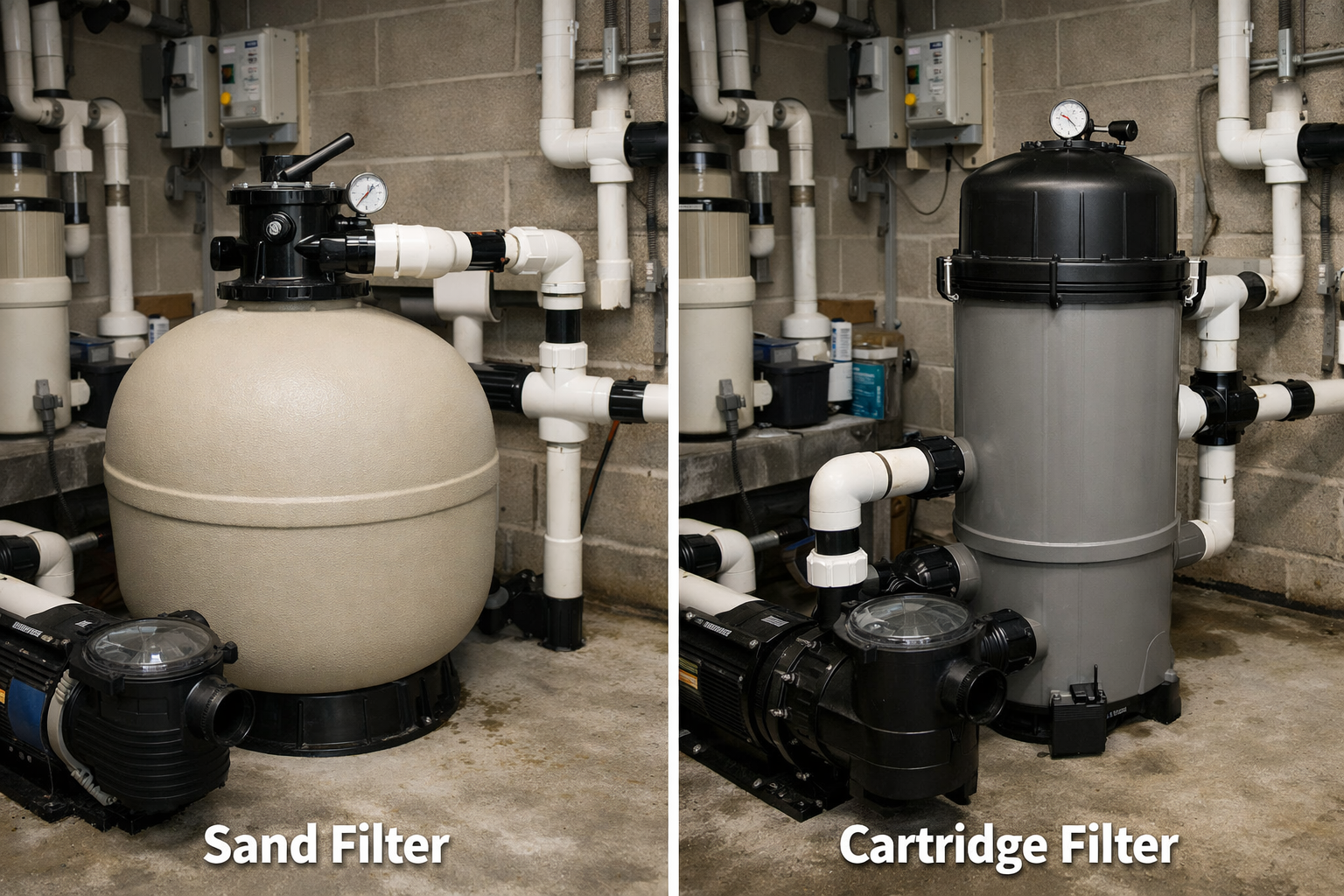
Choosing between sand and cartridge pool filters leaves many pool owners confused and overwhelmed by conflicting information. Making the wrong choice means dealing with cloudy water, spending excessive time on maintenance, and potentially damaging your pool equipment. This comprehensive guide breaks down everything you need to know about sand vs cartridge pool filters, helping you select the perfect filtration system that minimizes maintenance time, maximizes water quality, and keeps your pool crystal clear throughout the swimming season.
Pool filtration stands as the cornerstone of water quality maintenance in any swimming pool. Your pool filter removes debris, contaminants, bacteria, and microscopic particles that cloud your water and create potential health hazards. Without proper filtration, even the most advanced swimming pool equipment cannot maintain safe, inviting water conditions.
Modern residential pools rely on three primary filter types: sand filters, cartridge filters, and diatomaceous earth (DE) filters. Sand and cartridge filters dominate the market because they balance performance, reliability, and user friendliness better than more complex DE systems. The choice between these two filtration methods directly impacts your maintenance schedule, water clarity, and overall pool ownership experience.
Understanding how different filtration systems work helps you make informed decisions aligned with your specific pool size, usage patterns, and maintenance preferences. Professional pool equipment suppliers emphasize that selecting the right filter from the start prevents costly replacements and ensures years of trouble free operation.
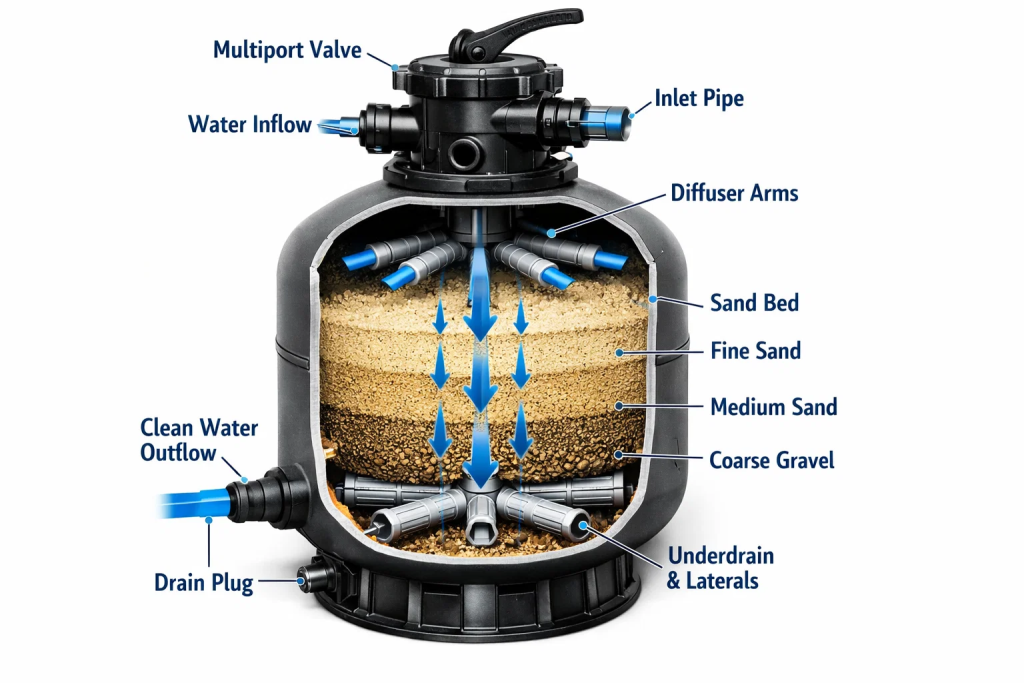
Sand pool filters represent the traditional, time tested approach to pool water filtration that has served pool owners effectively for decades. These robust systems use specially graded silica sand as the filtering medium, typically sized between 0.45 and 0.55 millimeters in diameter. The sand bed creates a natural barrier that catches and traps debris as water passes through multiple layers.
The filter assembly consists of a large, pressure rated tank filled with filtering sand, a multi port valve for operation control, internal laterals that distribute water, and a pressure gauge for monitoring system performance. The straightforward design makes sand filters incredibly durable and forgiving of operational mistakes, which explains their popularity among first time pool owners and those seeking minimal complexity.
Sand filters have proven their reliability since the mid 20th century, with many original installations still functioning properly today after appropriate maintenance. Their mechanical simplicity means fewer components that can fail, and repairs typically involve simple valve replacements or sand media changes rather than complex technical troubleshooting. Much like PVC pipe systems, sand filters benefit from straightforward construction that stands the test of time.
The sand filtration process follows proven mechanical filtration principles that have remained largely unchanged for generations. Pool water enters the filter tank through the multi port valve, flows downward through the sand bed under pressure, and exits through lateral pipes positioned at the tank bottom. The sand grains create a complex maze like barrier with millions of tiny spaces that physically trap particles.
As water flows through this dense sand matrix, particles ranging from visible debris to microscopic contaminants become lodged between sand grains. Larger particles get caught in the upper sand layers, while progressively smaller particles become trapped in deeper sections of the bed. This depth filtration mechanism provides effective water cleaning across multiple particle sizes.
Interestingly, as debris accumulates in the sand bed, the filter efficiency actually improves temporarily. The trapped particles create additional filtering surfaces, allowing the sand to catch even smaller contaminants than a freshly cleaned filter. However, this accumulation also increases internal pressure as water struggles to flow through the increasingly clogged pathways.
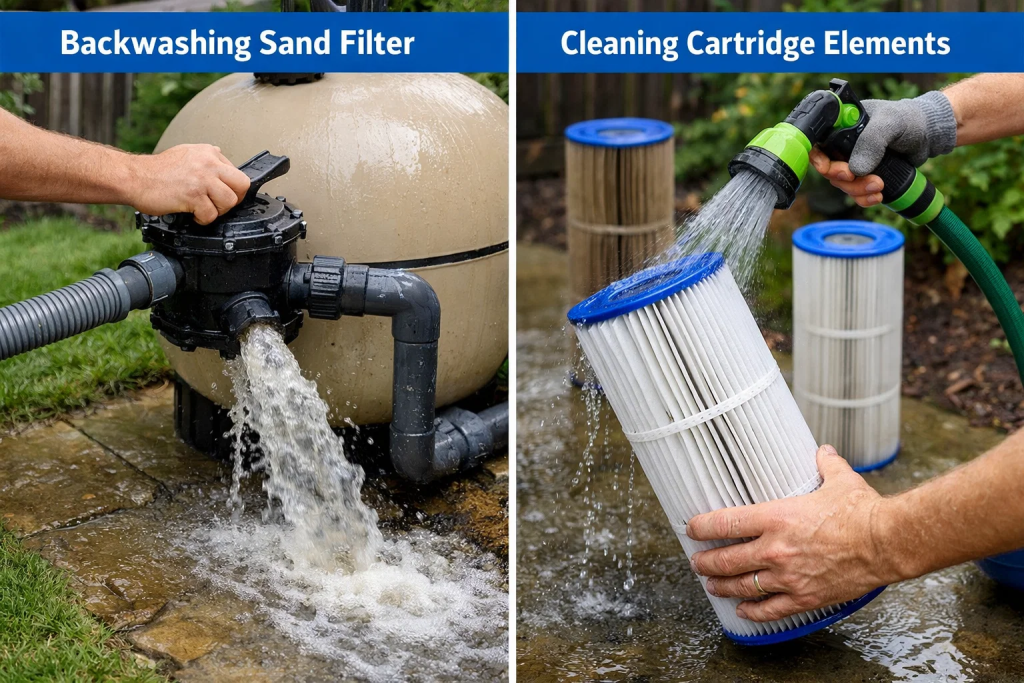
When the pressure gauge shows 8 to 10 PSI above the clean filter baseline, the system requires backwashing to restore performance. Backwashing reverses water flow direction, lifting and agitating the sand while flushing trapped debris through the waste line. This regeneration process typically takes 3 to 5 minutes and returns the filter to optimal operating condition. Similar to pressure testing procedures for pipes, monitoring pressure indicators prevents equipment damage from excessive buildup.
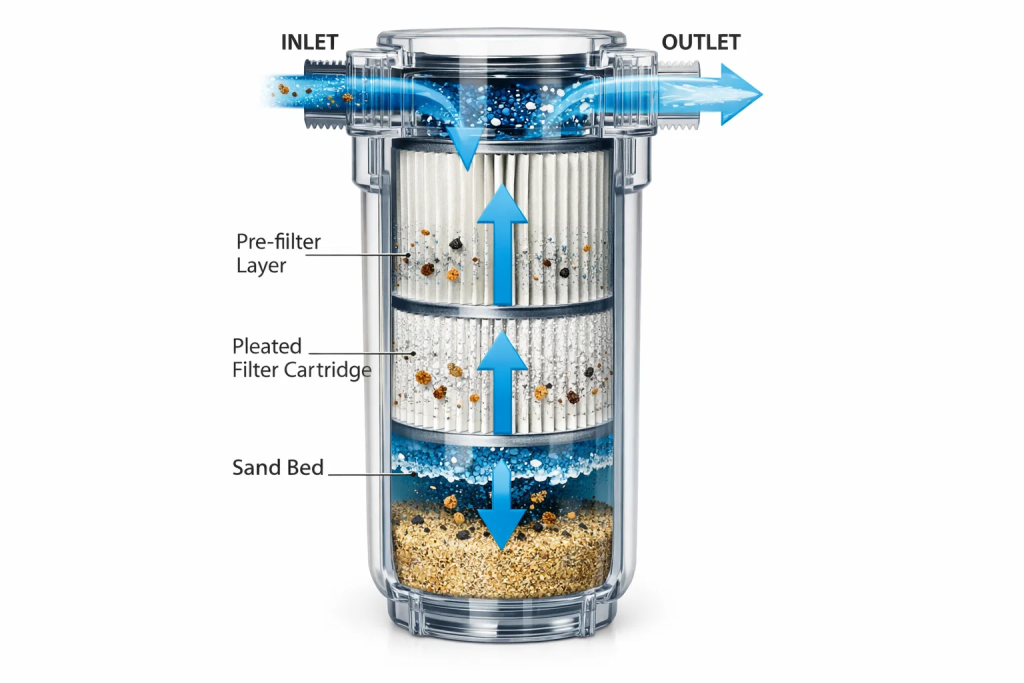
Cartridge pool filters represent modern filtration technology that uses pleated polyester fabric or specialized paper elements to trap contaminants. These cylindrical cartridges feature accordion style pleats that dramatically maximize filtering surface area within a compact housing. The increased surface area allows cartridge filters to capture significantly smaller particles than sand filters while occupying less equipment space.
Modern cartridge filter systems typically contain one to four individual cartridge elements, with the number depending on pool volume, circulation rate, and desired filtration capacity. The pleated cartridge material filters particles as small as 10 to 15 microns, which represents a significant performance advantage over sand filtration that typically captures particles only down to 20 to 40 microns.
These filters eliminate the need for backwashing equipment and complex multi port valves, which simplifies the overall system design considerably. The streamlined construction reduces potential failure points and makes cartridge filters particularly appealing for pool owners seeking minimal mechanical complexity in their equipment setup. The absence of backwashing also eliminates the need for dedicated waste lines, which simplifies installation similar to how PVC plumbing systems benefit from simplified connections.
Quality water management solutions increasingly incorporate cartridge filtration for superior water clarity combined with reduced water consumption.
Cartridge filtration relies on surface filtration principles rather than the depth filtration used by sand systems. Water flows through the pleated fabric material under pressure, which physically blocks particles on the cartridge surface while allowing clean water to pass through the media. The pleated design creates hundreds of square feet of filtering surface compressed into a relatively small cylindrical package.
The polyester or paper fibers in cartridge media form a tight mesh that captures particles mechanically. Unlike sand filters where particles become embedded throughout the media depth, cartridge filters trap contaminants on the surface layer where they remain visible and accessible for cleaning. This surface filtration allows for easier monitoring of filter cleanliness.
As debris accumulates on the cartridge surface, the filter continues functioning effectively until the material becomes sufficiently loaded with contaminants. Unlike sand filters where trapped particles temporarily improve filtration, heavily loaded cartridge filters experience reduced efficiency as surface accumulation restricts water flow. The pressure gauge indicates when cleaning becomes necessary, typically showing a 8 to 10 PSI increase above baseline.
Cleaning cartridge filters involves shutting down the pump, releasing pressure, opening the filter housing, removing the cartridge elements, and thoroughly rinsing them with a garden hose. The process takes more hands on effort than backwashing but provides visual confirmation that cleaning is complete. Deep cleaning periodically requires soaking cartridges in specialized solutions to remove oils, minerals, and organic buildup that simple rinsing cannot eliminate.
Learn proper cleaning techniques in our detailed guide on how to clean a pool cartridge filter to maximize element life and maintain peak performance.
Cartridge filters capture particles as small as 10 to 15 microns, while sand filters typically trap particles only down to 20 to 40 microns. This substantial difference in filtration capacity creates noticeable differences in water clarity. Cartridge filtered pools exhibit sparkling, highly polished water that appears almost glass like in clarity.
For pool owners prioritizing crystal clear water and minimal haziness, cartridge filtration delivers consistently superior results. The finer filtration removes suspended particles, algae spores, pollen, and fine debris that pass straight through sand filter media. This enhanced particle removal becomes especially important for pools in dusty environments or areas with heavy pollen counts.
The water quality difference becomes most apparent when comparing pools side by side. Cartridge filtered water typically shows better light transmission, reduced cloudiness, and improved overall appearance compared to sand filtered pools under identical chemical conditions. This superior clarity makes cartridge filters popular for showcase pools, commercial installations, and properties where aesthetics matter.
Sand filters require higher operating pressures to force water through the dense, tightly packed sand bed. Most sand filter systems operate at 15 to 25 PSI during normal filtration cycles, while cartridge filters function efficiently at just 5 to 15 PSI. The lower operating pressure reduces mechanical stress on pool pumps and can significantly extend pump service life.
The reduced pressure requirements of cartridge filters allow for energy efficient variable speed pumps to operate at lower, more economical speeds while maintaining adequate filtration turnover. This compatibility makes cartridge filters attractive for environmentally conscious pool owners focused on reducing electricity consumption and operating expenses.
Lower operating pressures also reduce strain on plumbing connections and fittings, which can extend the service life of your entire circulation system. Understanding proper water pressure management throughout your pool system helps optimize overall performance regardless of filter type.
Sand filters incorporate more complex valve systems, require backwash plumbing, and need sight glasses for monitoring backwash clarity. The multi port valve represents the most common failure point, with internal seals and springs requiring periodic replacement to prevent leaks and maintain proper function.
Cartridge filters feature simpler construction with fewer moving parts and no backwash valves. The straightforward design consists primarily of the filter housing, cartridge elements, and inlet/outlet plumbing. This simplicity translates to fewer maintenance issues and easier troubleshooting when problems arise.
The mechanical simplicity of cartridge systems appeals to DIY oriented pool owners comfortable performing their own maintenance. Fewer specialized components mean lower likelihood of unexpected failures and easier access to replacement parts when needed.
Sand filters require more physical space due to their larger tank diameter and multi port valve configuration. Equipment pads must accommodate the filter tank, provide clearance for backwash hose connection, allow access to the multi port valve, and include space for the sight glass.
Cartridge filters feature compact designs that fit in significantly tighter spaces, making them ideal for pools with limited equipment areas. The smaller footprint simplifies installation in urban settings, properties with space constraints, or situations where the equipment pad must share space with other utilities. This space efficiency resembles how HDPE pipes offer flexibility in tight installations.
Regular sand filter maintenance involves monitoring pool chemistry, performing routine backwashing, and conducting annual system inspections. Backwashing typically occurs every 4 to 6 weeks during swimming season, depending on pool usage, debris load, bather load, and environmental factors. Each backwash cycle takes 5 to 10 minutes of active attention but wastes substantial water volumes that require replacement and rebalancing.
The backwash process itself is remarkably simple: rotate the multi port valve to “backwash,” run the pump for 3 to 5 minutes while monitoring the sight glass, switch to “rinse” for 30 seconds, then return to normal filtration. This simplicity makes sand filters popular among pool owners who prefer quick, straightforward maintenance procedures.
However, sand filters demand periodic media replacement to maintain performance. Sand replacement becomes necessary every 5 to 7 years as the filtering media degrades, becomes contaminated with oils and minerals, and develops channels that reduce filtration effectiveness. The replacement process involves draining the filter, removing old sand, cleaning internal components, and refilling with fresh media. This procedure takes 2 to 3 hours but remains manageable for mechanically inclined pool owners.
Sand filters also benefit from occasional sand bed stirring to prevent channeling, where water flows through preferred pathways rather than distributing evenly. Proper maintenance of PVC plumbing connections ensures leak free operation and optimal filter performance throughout the system.
Cartridge maintenance centers on regular element cleaning and timely replacement when performance degrades. Removing cartridges, hosing them down thoroughly, and reinstalling them takes 30 to 45 minutes per cleaning cycle. This hands on process requires more physical effort than backwashing but provides visual confirmation of cleaning effectiveness.
Cleaning frequency depends on pool conditions but typically ranges from every 4 to 8 weeks during active swimming season. Pools with heavy debris loads, frequent usage, or challenging environmental conditions may require more frequent cleaning. The ability to visually inspect cartridge condition helps pool owners optimize cleaning schedules.
Deep cleaning becomes necessary several times per season to remove embedded oils, sunscreen residue, body oils, and mineral deposits. This process involves soaking cartridges overnight in specialized cleaning solutions or diluted muriatic acid, followed by thorough rinsing before reinstallation. Deep cleaning restores cartridge performance and extends element service life.
Cartridge elements eventually wear out from repeated cleaning cycles, compression from water pressure, and degradation of the filtering media. Replacement becomes necessary every 2 to 3 years, or sooner if elements show tears, compressed pleats, or persistent staining that doesn’t respond to cleaning. Understanding proper pipe sizing and flow rates helps maximize cartridge element life by preventing excessive pressure and flow velocity.
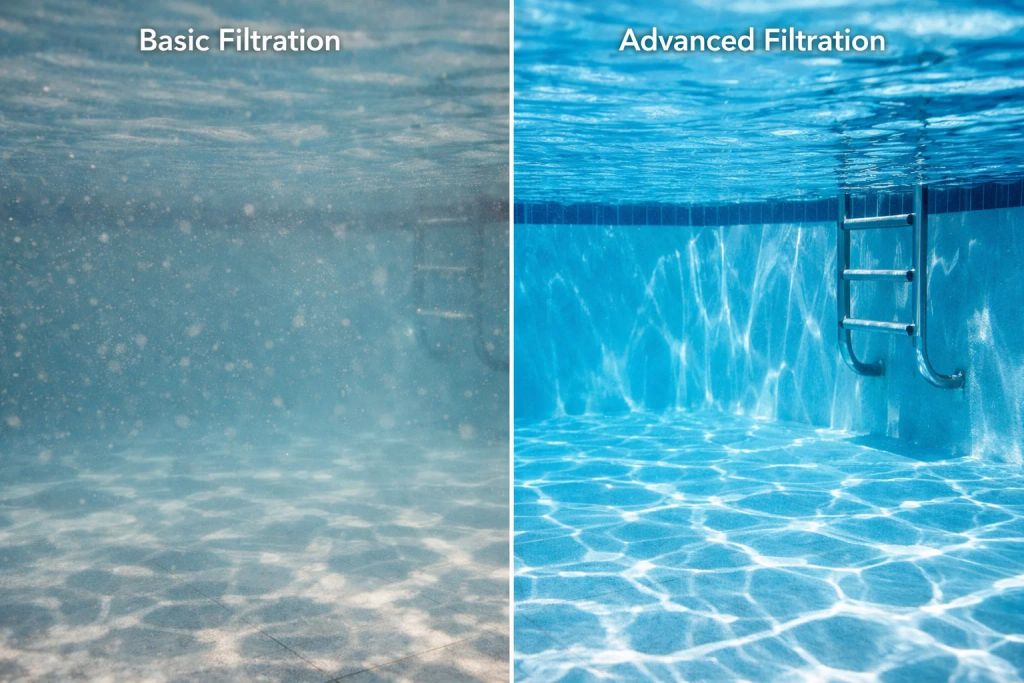
Cartridge filters consistently deliver superior water clarity due to their significantly finer filtration capability. The 10 to 15 micron filtration removes particles invisible to the naked eye but responsible for water haziness, reduced clarity, and that slightly cloudy appearance many pool owners struggle to eliminate.
This enhanced filtration becomes especially noticeable when dealing with fine suspended particles. Cartridge filters excel at removing pollen, fine dust, dead algae particles, and other contaminants that create persistent cloudiness in sand filtered pools. The result is water that sparkles brilliantly in sunlight and appears almost crystalline in clarity.
Sand filters provide adequate water quality for most recreational applications but cannot match the polished appearance cartridge filtered water achieves. Pool owners hosting events, operating rental properties, maintaining showcase pools, or simply prioritizing aesthetics often prefer cartridge filtration for its superior clarity advantages.
Both filter types work effectively when paired with proper chemical balance, adequate circulation, and regular maintenance. The filtration system works alongside chlorination, pH control, alkalinity management, and calcium hardness adjustment to create safe, inviting pool water. Consider integrating advanced systems like salt chlorination for enhanced water quality and reduced chemical handling.
Maintaining optimal water quality requires attention to multiple factors beyond filtration alone. Learn comprehensive techniques in our guide on how to maintain crystal clear pool water that addresses chemistry, circulation, and cleaning practices.
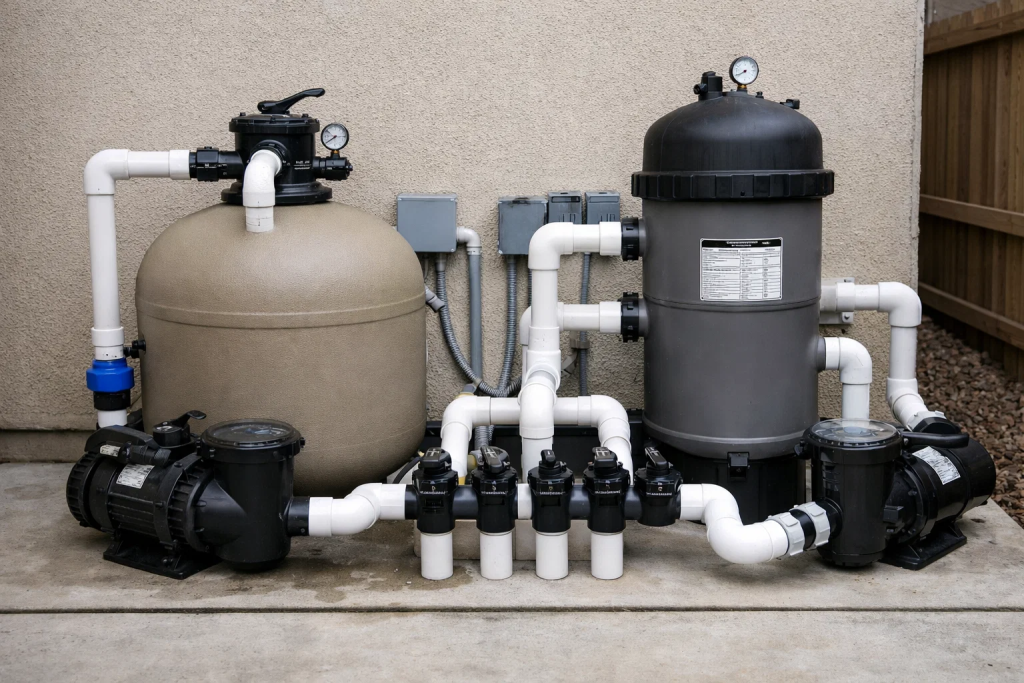
Both filter types integrate with standard pool plumbing using PVC pipes and fittings. Proper plumbing design ensures adequate flow rates, minimizes pressure loss, prevents air entrapment, and optimizes filtration efficiency throughout the circulation system.
Sand filters require additional plumbing for backwash disposal, including a waste line routed to an appropriate drainage location. This backwash line must handle high flow volumes during the cleaning cycle and discharge to an area that can absorb or drain away several hundred gallons of water. Understanding drainage systems and pipe types helps when planning backwash disposal.
Cartridge filters eliminate backwash plumbing entirely, which simplifies installation and reduces the total plumbing footprint. The streamlined plumbing means fewer potential leak points and less complex winterization procedures in seasonal climates.
Sand filters rely on multi port valves that control flow direction for filtration, backwashing, rinsing, waste discharge, recirculation, and winterization. These valves contain multiple internal seals, springs, and channels that require proper alignment and periodic maintenance. Incorrect valve operation can damage pumps, waste water, or reduce filtration effectiveness.
Cartridge filters use simple ball valves or no valves at all for basic operation. The absence of complex valve systems reduces mechanical failure points and simplifies operation for less experienced pool owners. This simplicity appeals to those seeking minimal technical complexity in their pool equipment.
Sand filter installation typically benefits from professional expertise for proper sand bed preparation, multi port valve configuration, backwash line routing, and system commissioning. Incorrect installation leads to channeling, poor filtration, premature equipment wear, and potential warranty issues.
Cartridge filters offer more straightforward DIY installation for mechanically inclined pool owners. The simpler design, fewer components, and absence of backwash plumbing reduce installation complexity and potential for costly mistakes. However, proper sizing remains critical regardless of filter type.
Installation quality directly impacts long term performance and reliability. Professional installers ensure correct pump sizing, proper valve placement, secure pipe connections, and appropriate system balancing for optimal operation.
Cartridge filters eliminate backwash water waste entirely, which can save thousands of gallons annually depending on pool size, usage patterns, and cleaning frequency. This conservation becomes increasingly important in water scarce regions facing drought conditions and strict water use regulations.
A typical residential pool with a sand filter requires backwashing every 4 to 6 weeks. Each backwash cycle wastes 200 to 500 gallons of treated pool water, which then requires replacement with fresh water that needs heating and chemical balancing. Over a six month swimming season, this totals 2,000 to 6,000 gallons of wasted water.
The water conservation advantage of cartridge filters extends beyond just volume savings. Eliminating backwash waste also reduces the need for makeup water, which saves on water heating energy, chemical replenishment, and the environmental impact of wastewater discharge into storm drains or landscaping.
Sand filter backwashing sends chlorinated, pH balanced water directly to waste, requiring complete chemical rebalancing after each backwash cycle. This increases annual chemical consumption and creates additional work for pool owners who must test and adjust water chemistry more frequently.
Cartridge filters maintain stable water chemistry by eliminating the dilution effect of makeup water. This stability reduces chemical consumption, minimizes pH fluctuations, and creates more consistent swimming conditions. Pool owners appreciate the reduced chemical handling and more predictable water conditions.
The lower operating pressure of cartridge filters translates to reduced pump energy consumption, especially when paired with variable speed pumps that can operate at lower, more efficient speeds. This energy efficiency becomes more significant as electricity rates increase and environmental consciousness grows.
Sand filters require higher pump speeds to overcome their greater flow resistance, which increases electricity consumption throughout the filtration cycle. Over months and years, this additional energy use compounds into measurable operational differences between the two filter types.
Sand filter tanks constructed from fiberglass, reinforced plastic, or coated steel can last 15 to 20 years or more when properly maintained. The robust construction withstands constant water pressure, UV exposure, and chemical exposure without degradation. Tank failures typically result from mechanical damage, freeze damage, or installation errors rather than material failure.
Cartridge filter housings similarly last 15 to 20 years when constructed from durable materials and protected from physical damage. The simpler internal design means fewer components subject to wear, though the housing must withstand the same pressure and environmental stresses as sand filter tanks.
Sand filter multi port valves represent the primary wear component requiring periodic attention. Internal seals, springs, and diverter assemblies wear from repeated cycling and chemical exposure. Valve rebuilds or replacements become necessary every 5 to 10 years depending on usage and maintenance quality.
Cartridge elements require the most frequent replacement of any component in either system. Factors affecting cartridge life include water chemistry, cleaning frequency, cleaning technique, and environmental conditions. Proper care extends cartridge life, while aggressive cleaning or harsh chemicals accelerate degradation.
Sand media lasts 5 to 7 years before requiring replacement due to erosion, rounding of sharp edges, contamination, and channeling. The gradual decline in performance becomes apparent through increased backwash frequency, reduced water clarity, and higher operating pressures.
Some pool owners experiment with alternative filter media like glass, zeolite, or ceramic materials that claim extended service life and improved filtration. These alternatives offer varying degrees of success but generally cost more than standard silica sand. Research specific products carefully before making substitutions.
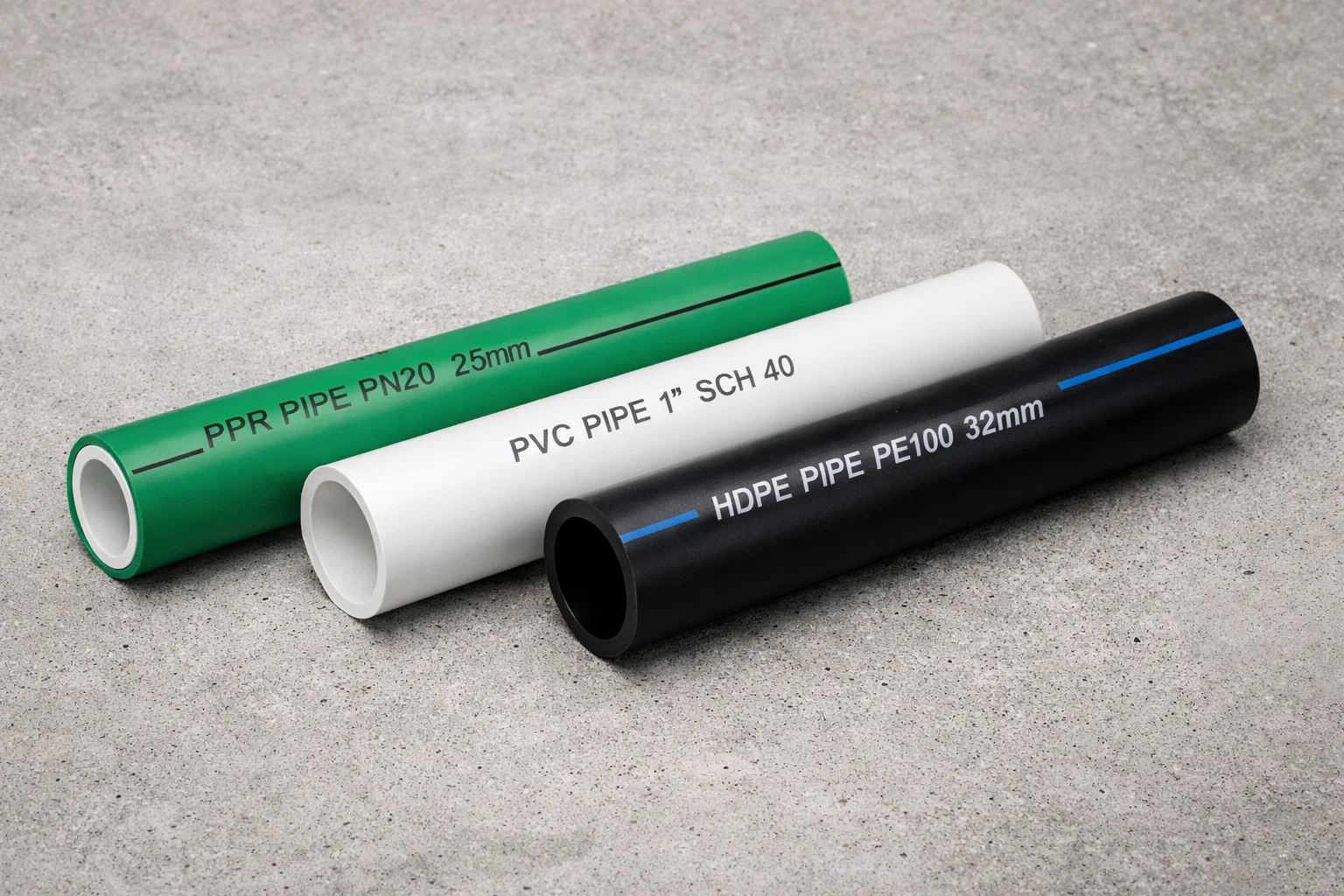
Understanding different pipe materials and their characteristics, like PPR pipes for hot water applications, helps you make informed decisions about all aspects of your pool system.
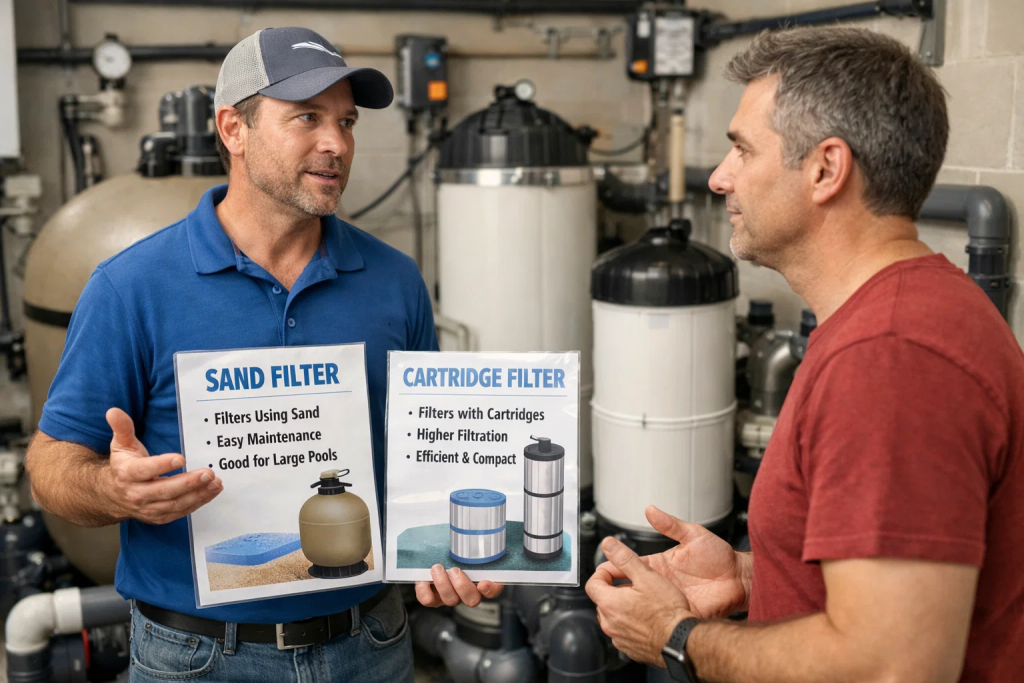
Prefer simple, hands off maintenance: Sand filters require minimal interaction beyond occasional backwashing and annual inspections. The straightforward operation appeals to pool owners who want set and forget convenience.
Have ample equipment space: Larger properties with dedicated equipment pads easily accommodate sand filter tanks and associated plumbing without space constraints limiting installation options.
Prioritize proven technology: Decades of reliable service make sand filters the conservative choice for risk averse pool owners who value long term track records over cutting edge technology.
Don’t mind water consumption: Properties with unlimited water access, low water rates, or wells that provide free water make the backwash waste less concerning from practical and economic standpoints.
Want DIY friendly operation: The simple backwash procedure requires no physical effort, making it accessible for elderly pool owners, those with mobility limitations, or anyone preferring minimal physical interaction with equipment.
Prioritize water conservation: Environmental consciousness, water scarcity, drought conditions, or high water rates make the elimination of backwash waste a compelling advantage worth the additional hands on maintenance.
Value superior water clarity: Showcase pools, commercial installations, rental properties, or personal preference for crystal clear water justify the enhanced filtration capability of cartridge systems.
Have limited equipment space: Urban properties, small yards, or crowded equipment pads benefit from the compact footprint of cartridge filter housings.
Prefer energy efficiency: Pairing cartridge filters with variable speed pumps maximizes energy savings through lower operating pressures and reduced pump speeds.
Don’t mind hands on maintenance: Mechanically inclined pool owners comfortable with regular equipment interaction find cartridge cleaning straightforward and even satisfying when they see visual results.
Want simplified plumbing: The absence of backwash lines simplifies installation, reduces potential leak points, and eases winterization procedures in seasonal climates.
Many professional swimming pool equipment suppliers can provide personalized recommendations based on your specific pool configuration, usage patterns, and local conditions.
Yes, conversion is possible but requires replacing the entire filter unit rather than just swapping internal components. The different operating principles and housing designs mean sand and cartridge systems aren’t interchangeable. However, the existing plumbing typically requires only minor modifications since both systems use standard pipe connections.
Sand media requires replacement every 5 to 7 years under normal operating conditions. Signs that replacement is due include increased backwash frequency, persistent cloudy water despite proper chemistry, visible channeling in the sand bed, and calcium or mineral buildup on sand grains that doesn’t clear with backwashing.
Yes, cartridge filters effectively service pools of all sizes when properly sized. Large pools simply require larger filter housings with more cartridge elements to provide adequate filtration area. Multiple smaller cartridge elements often outperform a single oversized sand filter for very large pools.
Absolutely. Cartridge filters work excellently with saltwater chlorination systems. The absence of backwashing actually provides advantages for saltwater pools by maintaining stable salt concentration and reducing the need to add replacement salt after water loss. Learn more about salt chlorination systems for your pool.
Sand entering your pool indicates damaged lateral pipes inside the filter tank. These pipes distribute filtered water and contain small slots that should retain sand while allowing water flow. When laterals crack or slots enlarge from erosion, sand particles escape into the return lines. This requires draining the filter and replacing the damaged laterals.
Indicators include persistent high pressure despite regular rinsing, visible oil or sunscreen residue that won’t rinse away, yellowing or browning of cartridge pleats, and reduced water flow even after cleaning. Deep cleaning with specialized solutions or diluted muriatic acid removes embedded oils and minerals that simple hosing cannot eliminate.
Sand filters allow pool use during backwashing since the process only takes a few minutes. Cartridge filter cleaning requires shutting down the entire circulation system, so swimming should pause during the 30 to 45 minute cleaning procedure. Most pool owners simply clean cartridges during off peak hours.
Cartridge filters have fewer overall components subject to failure, but cartridge elements themselves require the most frequent replacement of any filter component. Sand filters need periodic valve rebuilds and eventual media replacement. Overall, both systems require similar attention over their service life, just distributed differently among components.
Yes, the lower operating pressure of cartridge filters allows pumps to run at reduced speeds, which significantly decreases noise levels. This benefit becomes especially valuable for equipment located near living spaces, bedrooms, or noise sensitive areas. Variable speed pumps paired with cartridge filters provide the quietest operation.
Both filter types impact heating efficiency differently. Clean filters allow better circulation, which distributes heated water more evenly and maintains temperature more efficiently. Cartridge filters’ lower pressure requirements mean pumps work less, reducing the heat they add to pool water, which benefits pools in hot climates but may affect heating in cooler regions.
Cartridge filters lend themselves to competent DIY installation more readily than sand filters due to simpler plumbing requirements and fewer technical considerations. However, proper sizing, pressure testing, and system balancing benefit from professional expertise regardless of filter type. Incorrect installation voids warranties and can damage expensive equipment. Understanding techniques like proper PVC pipe pressure testing helps ensure quality DIY installations.
The choice between sand and cartridge pool filters depends on your specific priorities, maintenance preferences, and pool requirements rather than one system being universally superior. Sand filters excel in simplicity, proven reliability, and hands off operation, making them ideal for pool owners who value convenience and traditional technology. Cartridge filters deliver superior water clarity, eliminate backwash waste, and reduce operating pressures, appealing to environmentally conscious owners who prioritize water conservation and don’t mind hands on maintenance.
Both systems effectively filter pool water when properly sized, correctly installed, and regularly maintained. Your decision should weigh factors including available equipment space, water availability, desired water clarity, maintenance willingness, and long term operational preferences. Consider consulting with professional pool equipment suppliers who can evaluate your specific situation and recommend the optimal filtration solution.
Whichever filter type you choose, remember that consistent maintenance, proper water chemistry, and adequate circulation remain essential for crystal clear, safe pool water. The filter represents just one component in your complete pool system, working alongside pumps, heaters, sanitizers, and proper plumbing to create the perfect swimming environment.
Ready to upgrade your pool filtration system? Contact Dave Pools today for expert guidance on selecting, installing, and maintaining the perfect filter for your needs. Our team provides comprehensive support from initial selection through installation and ongoing maintenance to ensure years of trouble free pool enjoyment.