
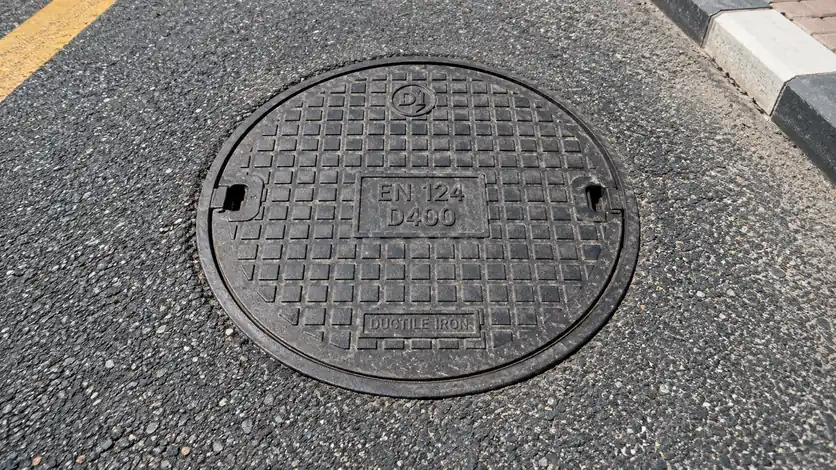
Pick the wrong manhole cover for a Dubai project and you’ll know about it fast. A cover rated for pedestrian traffic installed in a loading bay gets crushed the first time a truck rolls over it. A cover fitted without recessing flush to the road surface becomes a trip hazard, a noise complaint, and a municipality defect notice rolled into one.
Manhole covers in Dubai are not a commodity purchase — they’re a structural and safety specification. The right choice depends on where the cover is installed, what will pass over it, and which load class standard the project engineer has called out. Get that wrong and you’re looking at a replacement cost far higher than the saving you made on the original supply.
This guide covers everything you need to know: the main manhole cover types used in UAE projects, EN 124 load classes from A15 to F900, material comparisons, and how to specify correctly for Dubai’s roads, car parks, pedestrian zones, and building drainage systems.
✅ Quick Reference: What This Guide Covers
📋 Table of Contents
A manhole cover — also called an access cover or inspection chamber cover — is the removable lid that provides access to underground drainage, sewerage, utility, and service chambers. In UAE construction, they appear in roads, car parks, service yards, pedestrian walkways, building basements, pool plant rooms, and landscaped areas.
The specification matters for three reasons:
Understanding what you’re specifying before you order is far less expensive than replacing it after installation. For a broader picture of what Dave Pools supplies for underground infrastructure in Dubai, see our drainage pipes supplier page in Dubai.
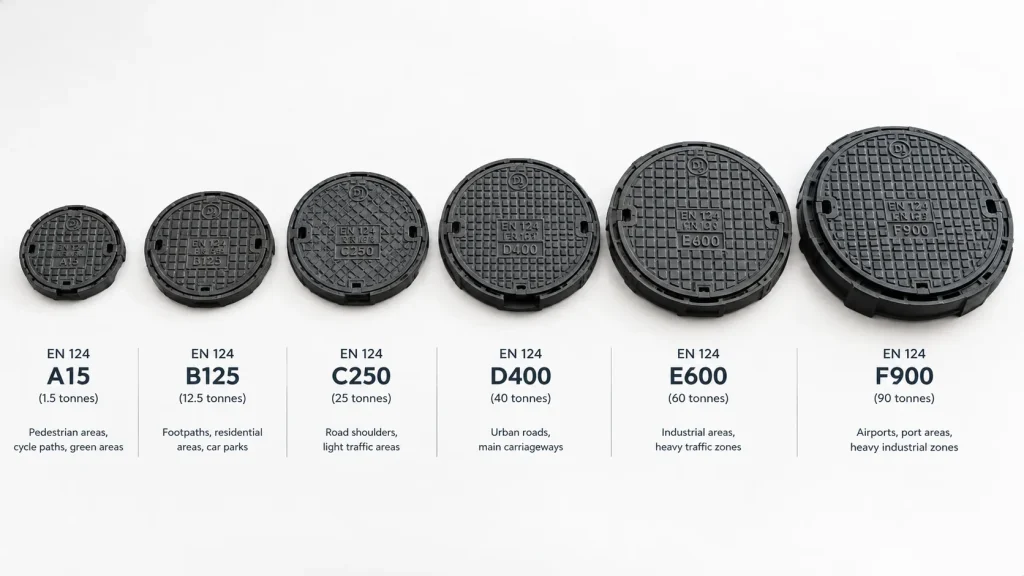
EN 124 is the European standard that classifies manhole covers and access covers by the maximum load they can bear without permanent deformation or failure. It is the reference standard used across UAE construction projects for specifying and procuring access covers. Here’s what each class means in practice:
| Load Class | Max Test Load | Typical Application in UAE | Common Locations |
|---|---|---|---|
| A15 | 1.5 tonnes | Pedestrian and cycle areas only | Walkways, parks, villa courtyards, landscaped areas |
| B125 | 12.5 tonnes | Car parks, light vehicle access roads | Residential car parks, building forecourts, service roads with light vehicles |
| C250 | 25 tonnes | Slow-moving vehicles, verge areas | Road verges, hard shoulders, slow-traffic access areas |
| D400 | 40 tonnes | Carriageways, main roads — most common highway spec | UAE public roads, RTA-governed roads, commercial loading zones |
| E600 | 60 tonnes | Heavy vehicle areas, docks, logistics yards | Industrial estates, freight loading zones, Jebel Ali-area logistics |
| F900 | 90 tonnes | Airport aprons, heavy aircraft areas | Dubai International Airport and Al Maktoum Airport taxiways and aprons |
The most important rule: always match or exceed the load class requirement for the installation zone. Downgrading by one class to save on supply cost is not a saving — it’s a deferred replacement cost with a defect liability attached. On Dubai RTA road projects, D400 is the standard minimum for any cover in or adjacent to a carriageway.
Note that EN 124 has been updated to EN 124-1:2015 and EN 124-2:2015 — which introduced the distinction between covers with and without locking mechanisms, and updated hydraulic clearance requirements. If your project specification references EN 124:1994, it still effectively means the same load classes; the performance requirement is unchanged.
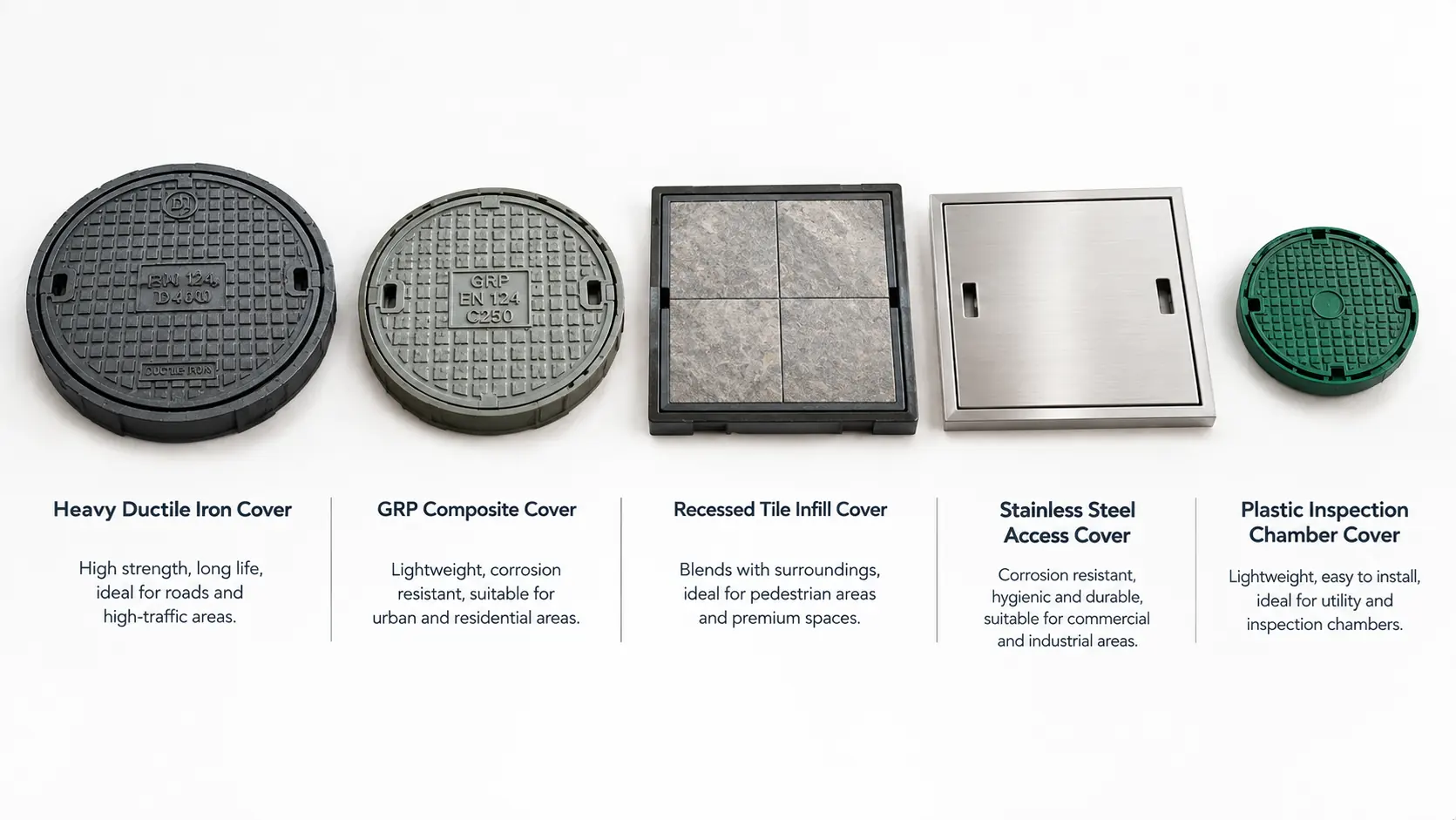
Ductile iron is the dominant material for road-grade manhole covers across the UAE. It’s specified for D400 and above applications — public roads, commercial zones, and any area where heavy vehicle loading is a certainty. Compared to traditional grey cast iron, ductile iron has significantly higher tensile strength and impact resistance, making it the correct material for UAE road infrastructure.
GRP composite covers have become the preferred choice for drainage chambers in non-trafficked and light-traffic areas across Dubai. They’re lighter than cast iron, non-conductive, corrosion-resistant, and — critically for UAE utility areas — they have no scrap metal value, which eliminates the theft risk that affects iron covers in some areas.
Polymer concrete composite covers combine recycled plastic with aggregate fill to produce a heavy, structurally rated cover that sits between GRP and ductile iron in performance terms. They’re used widely in UAE infrastructure projects where road-grade load isn’t required but more structural performance than standard GRP is needed.
Recessed covers have a tray-style lid designed to accept in-situ fill material — ceramic tile, stone, block paving, resin-bound aggregate — so the cover blends invisibly into the surrounding surface. They’re widely used in Dubai’s high-end residential and hospitality projects where flush-to-floor aesthetics are a specification requirement.
Grade 316 stainless steel covers are specified in food processing areas, pharmaceutical facilities, swimming pool plant rooms, and any environment where hygiene standards and corrosion resistance are the primary requirement. More expensive than iron or GRP, but the correct specification for chemical-exposure environments.
Here’s how the three main manhole cover materials compare across the factors that matter most on UAE construction projects:
| Factor | Ductile Iron | GRP Composite | Polymer Concrete |
|---|---|---|---|
| Max Load Class | F900 ✅ | D400 | D400 |
| Weight (600mm cover) | ~35–55 kg | ~8–15 kg ✅ | ~25–40 kg |
| Corrosion Resistance | Moderate (paint-dependent) | Excellent ✅ | Excellent ✅ |
| UV Resistance | Good | Good (if UV inhibited) | Good ✅ |
| Theft Risk | High (scrap value) | None ✅ | None ✅ |
| Noise Under Traffic | High (rocking/rattle risk) | Low ✅ | Low ✅ |
| Road Projects (RTA) | Required ✅ | Not typically accepted | Project-specific |
| Relative Supply | Higher | Lower ✅ | Mid-range |
Bottom line: For any RTA or municipality road project in Dubai, ductile iron at D400 is non-negotiable. For drainage chambers, landscaped areas, car parks, and building services access points, GRP or composite covers are the smarter choice — lighter to handle, corrosion-proof, and quieter in service. For a full overview of drainage pipe infrastructure in Dubai that these covers sit above, see our comprehensive guide to drainage pipe types.
Follow this decision sequence to specify the right cover first time:
Where exactly is this cover going? Your answer determines the minimum load class required:
On most UAE infrastructure and commercial projects, the MEP or civil engineer will have specified the load class in the project’s technical specifications. Always match that requirement exactly — and if the spec says D400, supply D400, not C250. If no load class is specified, ask before ordering.
The cover and frame must be from the same manufacturer or at minimum dimensionally compatible. A cover dropped into a non-matching frame will rock, rattle, and eventually fail — regardless of load class rating. On replacement orders, always measure the existing frame clear opening before ordering a replacement cover.
If the chamber below requires regular maintenance access — a sump pump, drainage inspection chamber, or irrigation valve box — choose a cover with a lifting key mechanism or an anti-theft locking system. A cover that requires breaking out the mortar surround every time it’s opened adds significant operational cost over the life of the installation. Read our guide on clearing blocked drainage pipes to understand how maintenance access requirements affect cover selection.
Correct installation is as important as correct specification. A properly rated cover installed incorrectly will still fail. Here’s what matters most in UAE site conditions:
The most common installation failure on UAE sites is a frame set at a slightly different level to the surrounding road or paving. Even a 5mm difference creates a lip that catches vehicle tyres at speed, causing cover rocking, frame damage, and premature failure of the mortar haunch. Use a straight-edge and spirit level across the frame and surrounding surface before the mortar haunch sets.
UAE summer temperatures cause asphalt to soften and flow slightly around manhole frames, which can raise the surround above the cover face and create a depression. On road projects, ensure the frame is set at the correct finished road level — accounting for the fact that fresh asphalt compacts under roller and traffic. Discuss the frame setting level with the road contractor before the asphalt pour, not after.
In UAE conditions, standard mortar bedding can crack under the thermal cycling between cool nights and 50°C+ summer day temperatures. Use a semi-dry concrete haunch (1:3 cement to grit sand, stiff mix) and ensure it’s placed in a ring around the frame, not as a full-depth bed. Full-depth bedding can trap water and crack the surround from below as temperatures cycle.
A cover opening that’s too small for the chamber below is a common error on UAE drainage projects — particularly for irrigation valve chambers and drainage inspection points where the underground infrastructure was installed by a different contractor. Confirm clear opening size matches the chamber below before the frame is set. For irrigation system drainage chambers, our villa irrigation system design guide covers chamber sizing and layout.
All ductile iron road covers installed on UAE public roads should incorporate anti-rocking adjustment screws or rubber anti-rattle inserts between cover and frame. A rocking manhole cover generates noise, accelerates wear on the cover seating, and is a safety hazard for cyclists and motorcyclists. Most quality D400 covers come with this feature as standard — verify before ordering if it’s a requirement on your project specification.
Why it happens: A contractor installs drainage chambers during the early civil works phase, when the area is still a construction site with only light vehicle access. They spec a B125 cover as a temporary measure.
The problem: The temporary cover never gets replaced, and when the road opens to public traffic, the B125 cover fails within months under D400 loading.
The fix: Always specify the final installed load class from day one, based on the area’s eventual use — not its current construction phase use.
Why it happens: The original frame supplier is out of stock; a different supplier’s cover is used as a substitute.
The problem: Even covers nominally described as the same size may have different seating angles, tolerance bands, or locking mechanisms. A cover that doesn’t sit flat in its frame rocks under traffic, damaging both cover and road surface.
The fix: Always source cover and frame from the same manufacturer, or at minimum confirm dimensional compatibility with the supplier before ordering. Contact our team at Dave Pools to verify compatibility before ordering replacement covers.
Why it happens: GRP covers are cheaper and lighter, so procurement teams substitute them for iron covers to save on material and handling cost.
The problem: Standard GRP covers — even those rated at D400 — may not be accepted by the RTA or Dubai Municipality on public carriageway projects where ductile iron is the specified material. A substitution that gets rejected at inspection means replacement at the contractor’s expense.
The fix: For any project that will be inspected by a UAE road or municipality authority, confirm the accepted materials list before ordering. When in doubt, ductile iron at D400 is the safe choice for road applications.
Why it happens: GRP covers are specified for exposed landscaped areas without checking the UV inhibitor rating.
The problem: Standard-grade GRP resin breaks down under sustained UAE solar exposure — typically within 2–3 years on a south-facing installation with no shade. The cover discolours, becomes brittle, and eventually loses structural integrity.
The fix: Specify GRP covers with UV inhibitor resin as a product requirement. Ask the supplier for UV rating data before ordering. Our manhole cover supplier page in Dubai details the grades we carry and their UAE suitability.
Why it happens: The design team treats the manhole cover as an infrastructure component, not a maintenance access point.
The problem: A cover without a key mechanism, recessed lifting points, or enough clearance above it for safe removal becomes an operational problem the first time the drainage engineer needs to get inside. In some cases, this results in the cover being broken out entirely — a costly repair in a finished surface.
The fix: Design access into the cover from the start. Specify locking covers for security-sensitive areas, lifting-key covers for regular maintenance access, and confirm finished surface clearance allows the cover to be removed without damaging surrounding materials. For underground drainage system maintenance guidance, see our post on how to clear a blocked drainage pipe.
D400 (40-tonne test load per EN 124) is the standard minimum load class for manhole covers installed on public carriageways in Dubai and across the UAE. This applies to all covers in or adjacent to roads governed by the Roads and Transport Authority (RTA) or local municipality. For heavy vehicle logistics zones, E600 may be required. For pedestrian-only areas such as parks and villa walkways, A15 or B125 is typically sufficient. Always confirm the required load class with the project engineer or the relevant authority before ordering. You can browse the covers Dave Pools supplies on our manhole cover supplier page for Dubai and manhole cover supplier page for UAE.
Ductile iron covers are the correct specification for road applications in the UAE — they can reach F900 load class and are required on RTA-governed roads. GRP (glass reinforced plastic) covers are lighter, corrosion-resistant, and have no scrap metal theft risk, making them ideal for car parks, drainage chambers, landscaped areas, and building services access. GRP covers can reach D400, but they are generally not accepted on UAE public road infrastructure in place of ductile iron. The right material depends entirely on where the cover is being installed and what the project specification requires.
Yes. EN 124 is the standard referenced on UAE construction projects — both in project engineer specifications and by the RTA and Dubai Municipality for public infrastructure. Covers supplied to UAE projects should carry EN 124 load class marking on the cover face. Non-compliant covers risk rejection at inspection stage. When sourcing covers for a project with municipality submission requirements, ask your supplier to confirm EN 124 compliance and provide the relevant test certificates. Dave Pools supplies EN 124-compliant covers — contact us through our contact page for documentation.
Yes — GRP manhole covers rated at B125 (12.5-tonne test load) are widely used in residential and commercial car parks across Dubai. They are lighter than ductile iron, corrosion-resistant in the humid underground environment of basement car parks, and carry no scrap metal theft risk. For car parks with access for delivery vehicles, vans, or any vehicle above 12.5 tonnes, upgrade to C250 or confirm with the project engineer. For covered basement car parks with drainage systems, also see our drainage pipe supplier page for the pipe infrastructure that connects to those chambers.
Standard manhole cover clear opening sizes available in UAE supply chains include 300mm x 300mm, 450mm x 450mm, 600mm x 600mm, 600mm x 900mm, and 900mm x 900mm — in both square and rectangular configurations. Circular covers (typically 600mm diameter) are also widely used for road drainage chambers. The correct size is determined by the clear opening required for safe access to the chamber below, combined with the frame size already installed if this is a replacement. Contact Dave Pools with your frame internal dimensions and we’ll confirm the correct cover size — reach us at our contact page or call +971 04 393 4806.
Dave Pools supplies manhole covers across Dubai and the wider UAE — GRP, ductile iron, and composite types across A15 to D400 load classes. We stock covers for drainage chambers, car parks, landscaped areas, and road applications. Our warehouse is in Al Quoz Industrial Area 1, Dubai, with delivery available across the Emirates. For a full overview of what we supply, visit our manhole cover supplier page in Dubai or our UAE manhole cover supplier page. You can also see how our supply capability extends to complete drainage infrastructure on our pipes and fittings supplier page.
Manhole cover specification isn’t complicated once you know the framework. Start with the installation zone, match the load class to what will actually pass over it, choose the right material for the environment, and confirm frame compatibility before ordering. Get those four decisions right and you’ve got a cover that does its job without needing to be revisited for years.
If you’re unsure about which cover is right for your Dubai project, Dave Pools’ team can advise on load class, material, size, and frame compatibility — and supply the cover and frame as a matched set. We stock covers for everything from villa drainage chambers to commercial infrastructure across Dubai and the UAE.
Source Manhole Covers in Dubai — All Types & Load Classes
GRP, ductile iron, and composite covers. A15 to D400. EN 124-compliant. Stocked in Al Quoz, Dubai — delivery across the UAE.
→ Browse Manhole Cover Supplier Page — Dubai
→ Browse Manhole Cover Supplier Page — UAE
→ See Our Full Drainage Pipes Range in Dubai
→ Contact Dave Pools — Get a Quote or Stock Confirmation
📞 +971 04 393 4806 | +971 54 308 1083 | 📧 sales@davepools.com
Al Quoz Industrial Area 1, Street 5, Al Tayer Warehouse #18, Dubai, UAE