![RAKtherm vs Cosmoplast PPR Pipes: Which Is Better for Dubai Projects? [2026]](https://davepools.com/wp-content/uploads/2026/07/a_clean_studio_advertising_product_image_overall.webp "RAKtherm vs Cosmoplast PPR Pipes: Which Is Better for Dubai Projects? [2026] 6")

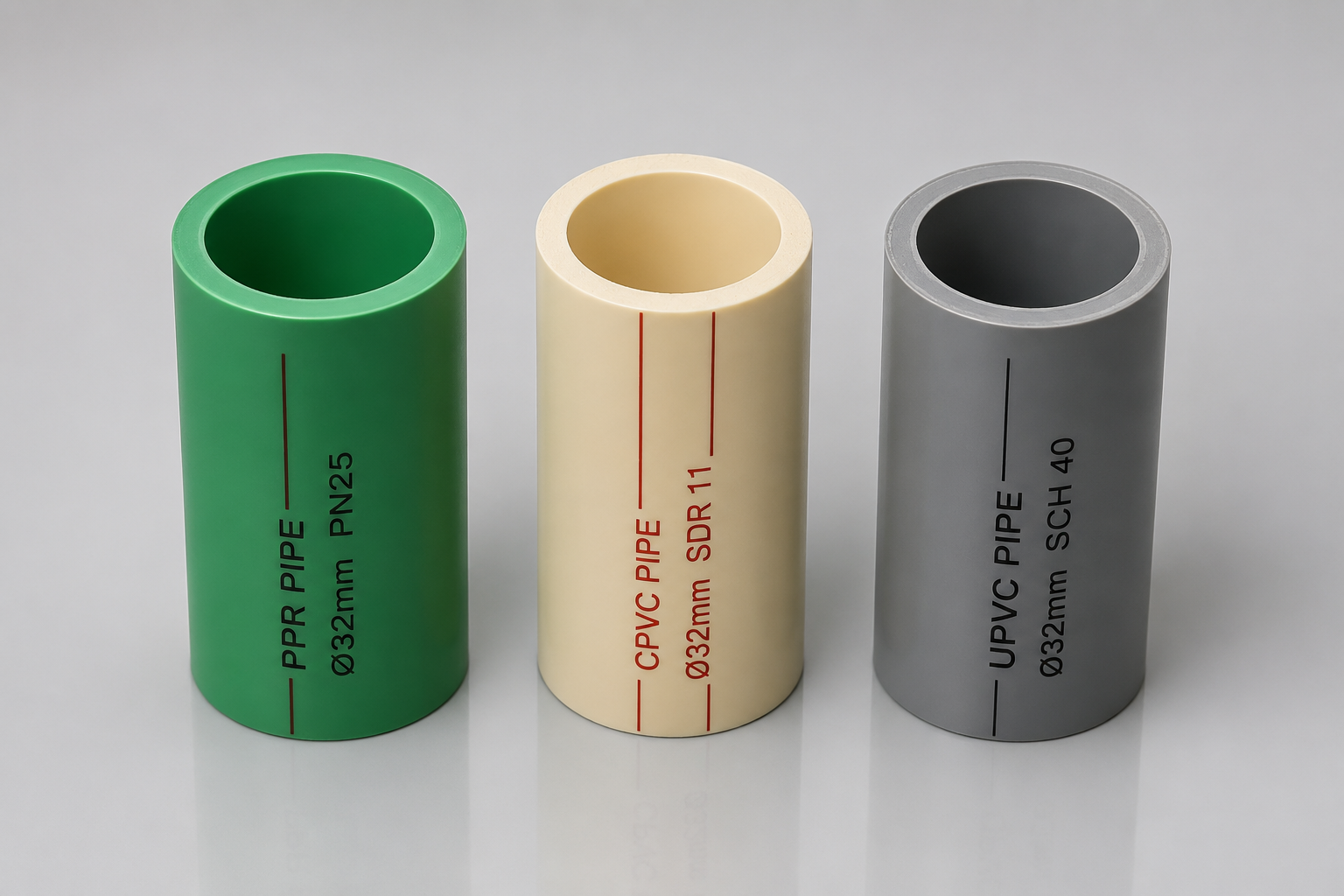
For hot water in Dubai villas and towers, PPR and CPVC are both correct choices — PPR for fused, joint-free runs, CPVC where the highest sustained temperature or a fire-sprinkler listing is required. UPVC belongs on cold water, irrigation, pool circulation and drainage. Choosing wrongly usually shows up as a leak in summer.
Here’s the situation that brings most people to this page.
A consultant has specified one material. The contractor prefers another. Someone on site says “we always use this here.” And nobody has written down why.
That’s how a hot water riser ends up in a material rated for cold service, or how a perfectly good UPVC line gets replaced with something twice the price for no technical reason.
Dubai narrows the choice more than a temperate climate would. Ambient heat, brutal UV, warm “cold” water in summer, and long thermal cycles all push the decision in a specific direction. Let’s make that direction obvious.
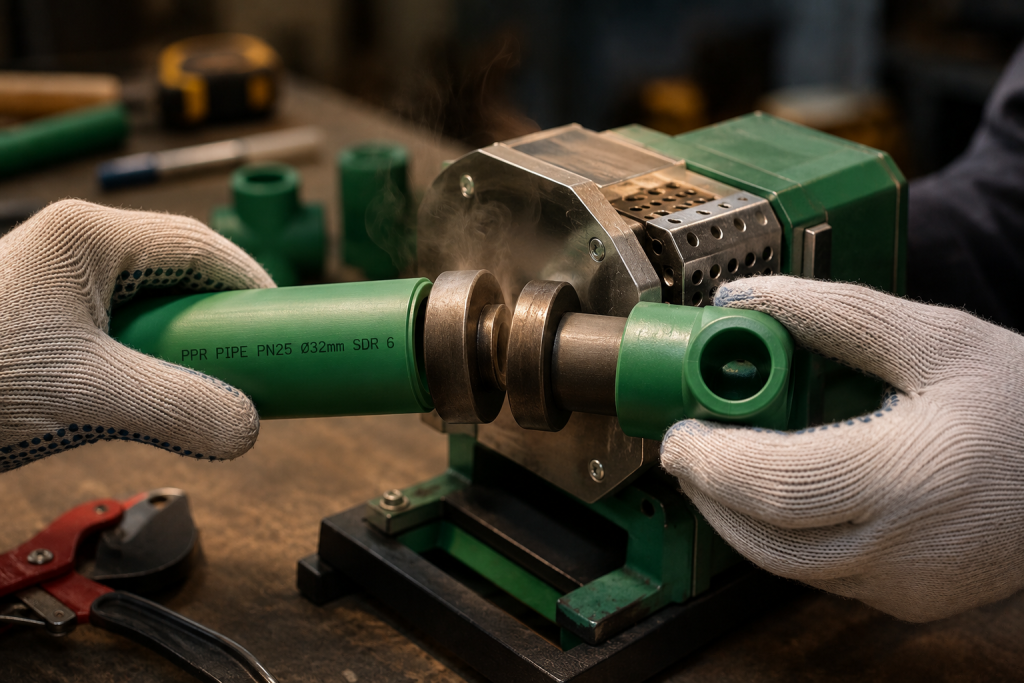
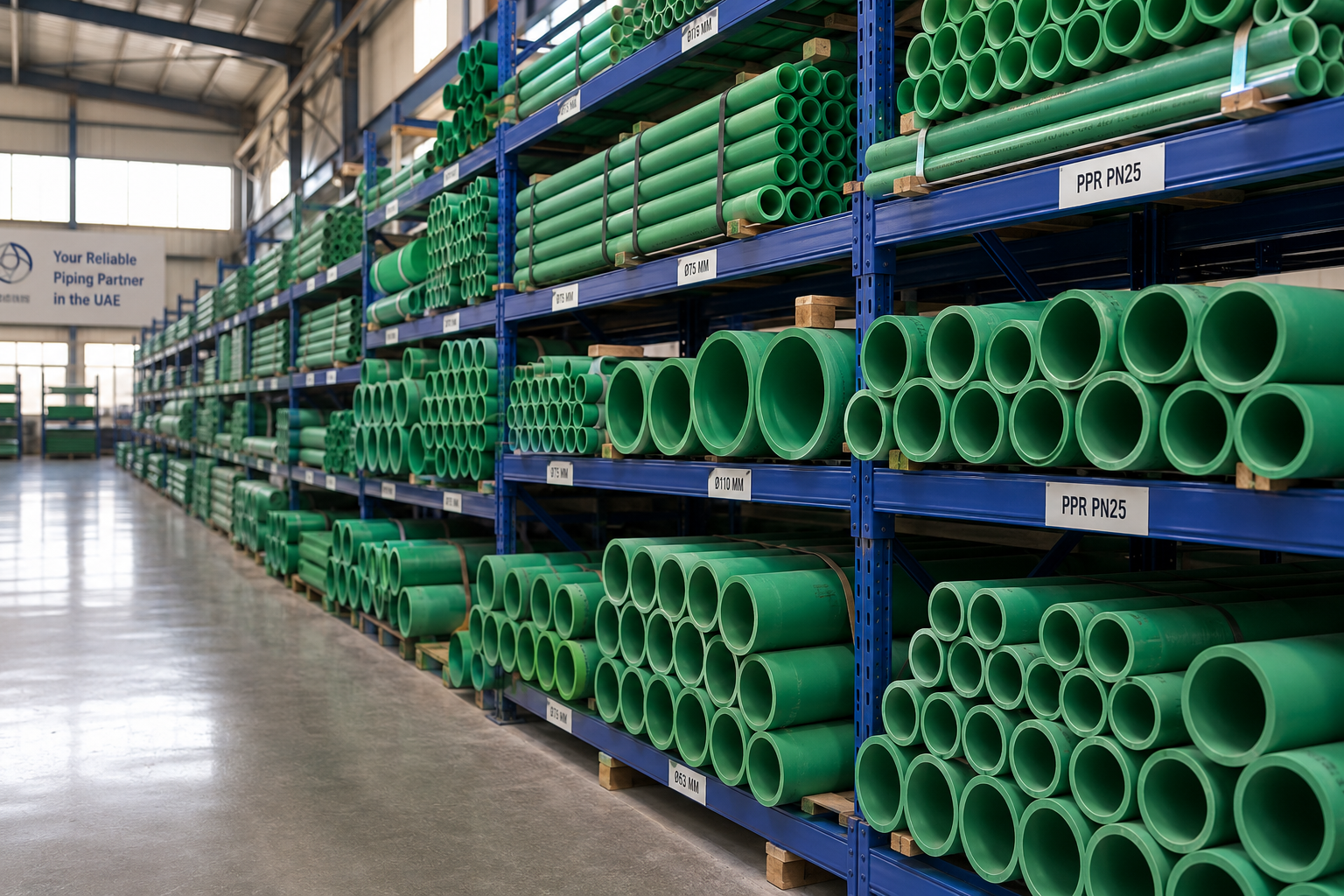
PPR is a semi-rigid thermoplastic used for hot and cold pressurised water. Pipes and fittings are joined by socket fusion — both parts are heated to around 260°C and pushed together, forming a homogeneous joint with no adhesive and no mechanical seal.
Why UAE contractors like it:
The trade-off: plain PPR expands more than the other two, and fusion demands trained operators. New to it? Start with what are PPR pipes and fittings and why PPR pipe is used.
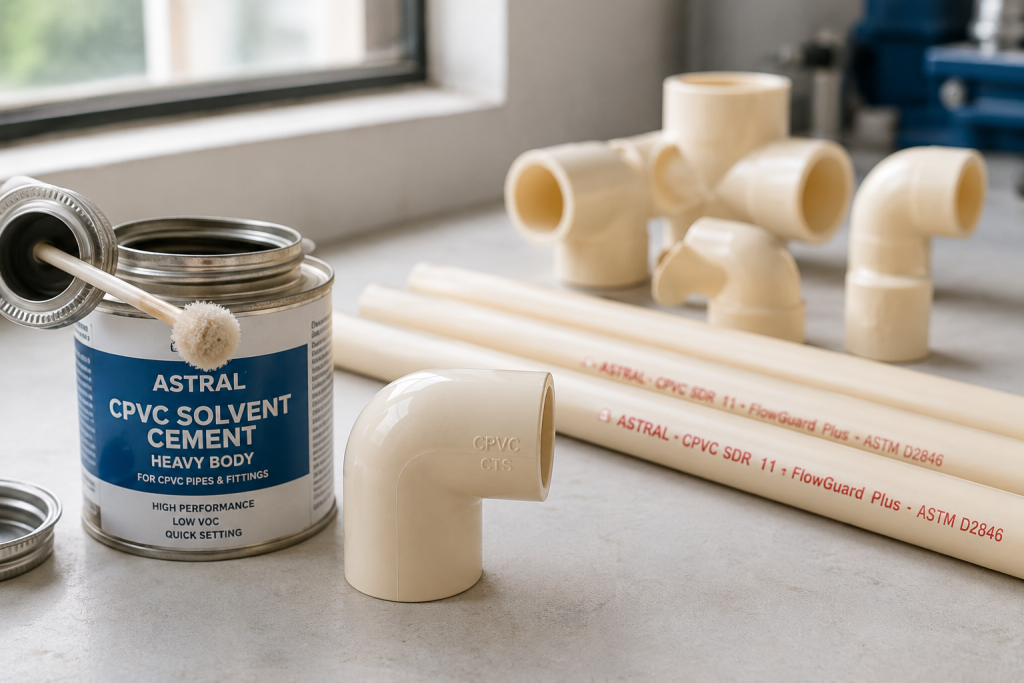
CPVC is PVC that has been chlorinated to raise its heat tolerance. It handles the highest continuous hot-water temperature of the three materials here, stays rigid, and is joined with a one-step solvent cement specifically formulated for CPVC.
Why it gets specified:
The trade-off: it’s brittle compared to PPR, and every joint depends on solvent cement being applied correctly. See difference between UPVC and CPVC pipes.
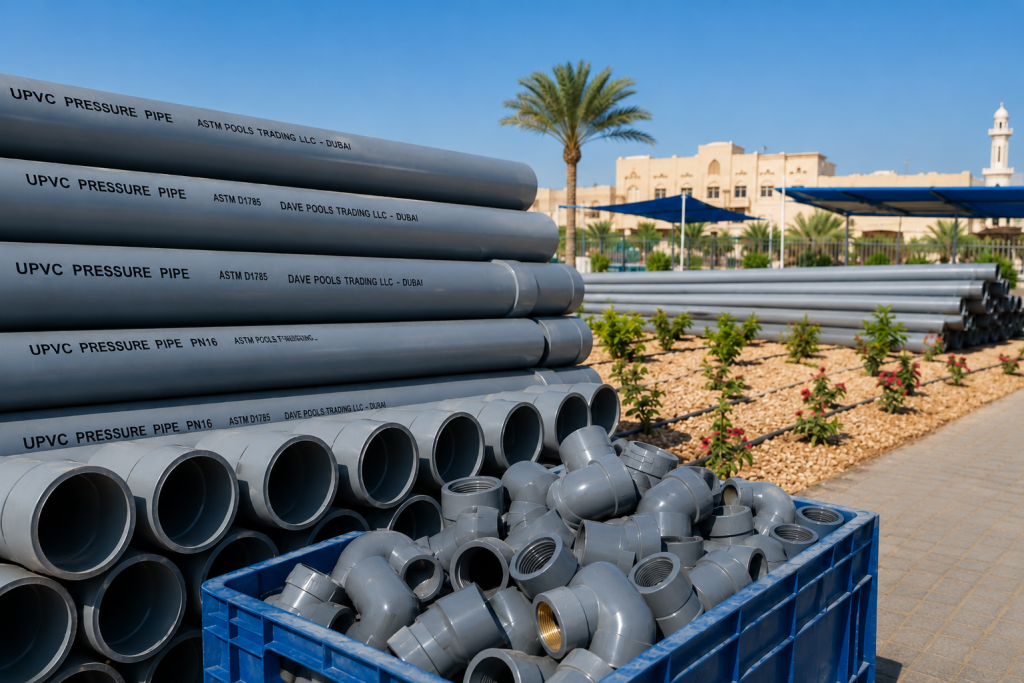
UPVC is rigid PVC with no plasticisers added. It’s the standard choice for cold pressurised water, irrigation mains, pool circulation and above-ground drainage. It is not designed for continuous hot water and should not be used there.
Why it stays popular:
The trade-off: heat is its limit. Full background in what is PVC pipe and PVC pipe temperature rating.
| Factor | PPR | CPVC | UPVC |
|---|---|---|---|
| Material | Polypropylene random copolymer (PP-R type 3) | Chlorinated PVC | Unplasticised PVC |
| Hot water capability | Very good — the UAE workhorse for hot lines | Highest of the three | Not suitable |
| Cold water | Excellent | Excellent | Excellent |
| Joint method | Socket fusion (heat welded) | Solvent cement | Solvent cement |
| Joint character | Homogeneous — pipe and fitting become one piece | Chemically bonded | Chemically bonded |
| Thermal expansion | Highest (plain PPR); very low in fibre/AL composite | Low | Low |
| Rigidity | Semi-rigid, more supports needed | Rigid | Rigid |
| Impact behaviour | Tough, more forgiving of knocks | More brittle | More brittle |
| UV resistance | Poor — must be protected | Poor — must be protected | Better than the others, still needs protection |
| Fire behaviour | Combustible | Inherently flame-retardant | Flame-retardant |
| Fire sprinkler use | No | Yes, listed CPVC only | No |
| Sizing basis | Outside diameter (mm) | CTS / nominal, by system | Nominal, by standard |
| Best fit in Dubai | Hot & cold potable, risers, chilled water | Hot water, sprinklers, chemical duty | Cold water, irrigation, pools, drainage |
Want a two-way view instead? See PPR vs PVC vs HDPE pipes, which is better: PPR or PVC, PVC vs PPR for hot water lines, and CPVC vs PVC pipe.
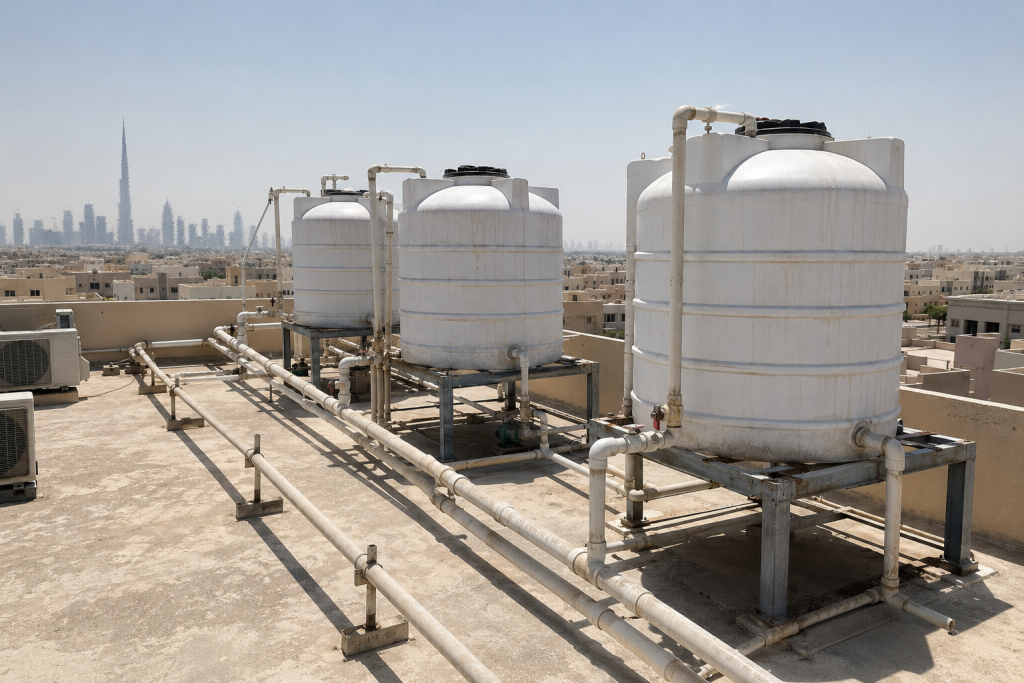
This is the part most global comparison articles skip. Four things happen here that don’t happen in Manchester or Munich.
Rooftop and exposed storage tanks across the UAE can push supply temperatures far above what a designer would assume for a cold line during peak summer. Residents in Dubai villas know the symptom: the cold tap runs hot in August.
What it means for material choice: a line labelled “cold” on a drawing may be running warm for a large part of the year. That’s a genuine argument for putting PPR or CPVC on lines you’d otherwise hand to UPVC — and for reviewing tank insulation at the same time.
All three materials degrade under sustained ultraviolet exposure. UPVC generally holds up best of the three, but “best” is relative — none of them belongs uncovered on a Dubai roof for years.
What it means: specify a UV-stabilised grade, paint with a compatible coating, or physically cover the run. Every time. This is the single most common cause of premature plastic pipe failure we see in the region.
Day-night swings plus hot water cycling means pipework in Dubai moves more often, and further, than in a mild climate. Every cycle loads brackets, fittings and joints.
What it means: expansion provision isn’t optional detail. Fibre composite PPR, correct guides, and properly placed loops or offsets all become part of the specification, not a site afterthought.
UAE water is typically hard, and treatment can carry a meaningful chlorine residual. High chlorine plus high temperature accelerates ageing in every plastic piping system over the long term — CPVC handles it particularly well, and quality PPR is tested against it.
What it means: ask for chlorine-resistance test data if the project has a demanding water treatment regime, and design the wider water management solution as a system, not as a bag of parts.
The material label gets the attention. The joint is what actually leaks.
The pipe end and fitting socket are heated on a fusion tool, then pushed together and held. Done properly, the joint is stronger than the pipe wall.
What goes wrong on UAE sites:
Full method: how to weld PPR pipe and how to connect PPR pipes. When something does go wrong, how to repair a PPR pipe leak covers the fix.
Primer and cement soften both surfaces, which then fuse chemically as the solvent evaporates.
What goes wrong in Dubai specifically:
Practical guides: how to glue PVC pipe, how to remove PVC pipe glue, and the right products from our PVC glue and cleaners range.
The honest summary: fusion needs skill and tooling. Solvent cement needs patience and the right consumables. Pick the method your crew can actually execute well, because that decision will affect the system more than the material name will.
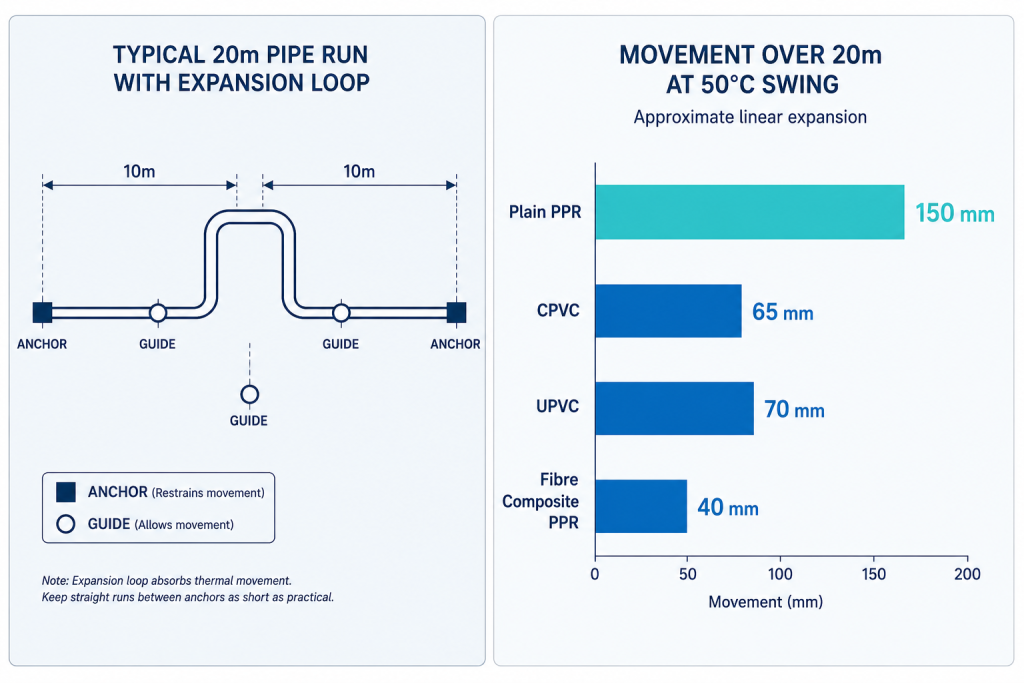
Numbers make this concrete. Take a 20-metre horizontal run with a 50°C temperature swing — realistic for a Dubai hot water line between winter idle and summer operation.
| Material | Approx. expansion coefficient | Movement over 20m @ 50°C |
|---|---|---|
| Plain PPR | ~0.15 mm/m/°C | ~150 mm |
| CPVC | ~0.06–0.07 mm/m/°C | ~60–70 mm |
| UPVC | ~0.06–0.08 mm/m/°C | ~60–80 mm |
| Fibre composite PPR | ~0.03–0.05 mm/m/°C | ~30–50 mm |
One hundred and fifty millimetres of movement in a plain PPR run. That has to be absorbed somewhere — by an expansion loop, a designed offset, and correctly positioned anchors and guides. If it isn’t, it gets absorbed by the fittings and the brackets, and that’s what a bowed pipe in a ceiling void actually is.
Design rules that follow from this table:
Related reading: how to keep PVC pipe stable and our overview of thermoplastic polymers in plastic pipes.
| Application | Recommended | Why |
|---|---|---|
| Villa hot water | PPR (PN20) or CPVC | Fused joints and no adhesive, or CPVC where the highest sustained temperature is needed |
| Villa & tower cold water | PPR or UPVC | PPR where summer supply runs warm; UPVC where it stays genuinely cold |
| Chilled water distribution | PPR (composite) | Low expansion and good insulation behaviour when properly lagged |
| Fire sprinkler pipework | Listed CPVC | Only listed CPVC is approved; PPR and UPVC are not |
| Irrigation & landscape mains | UPVC or HDPE | Cold service, buried, cost-effective at scale |
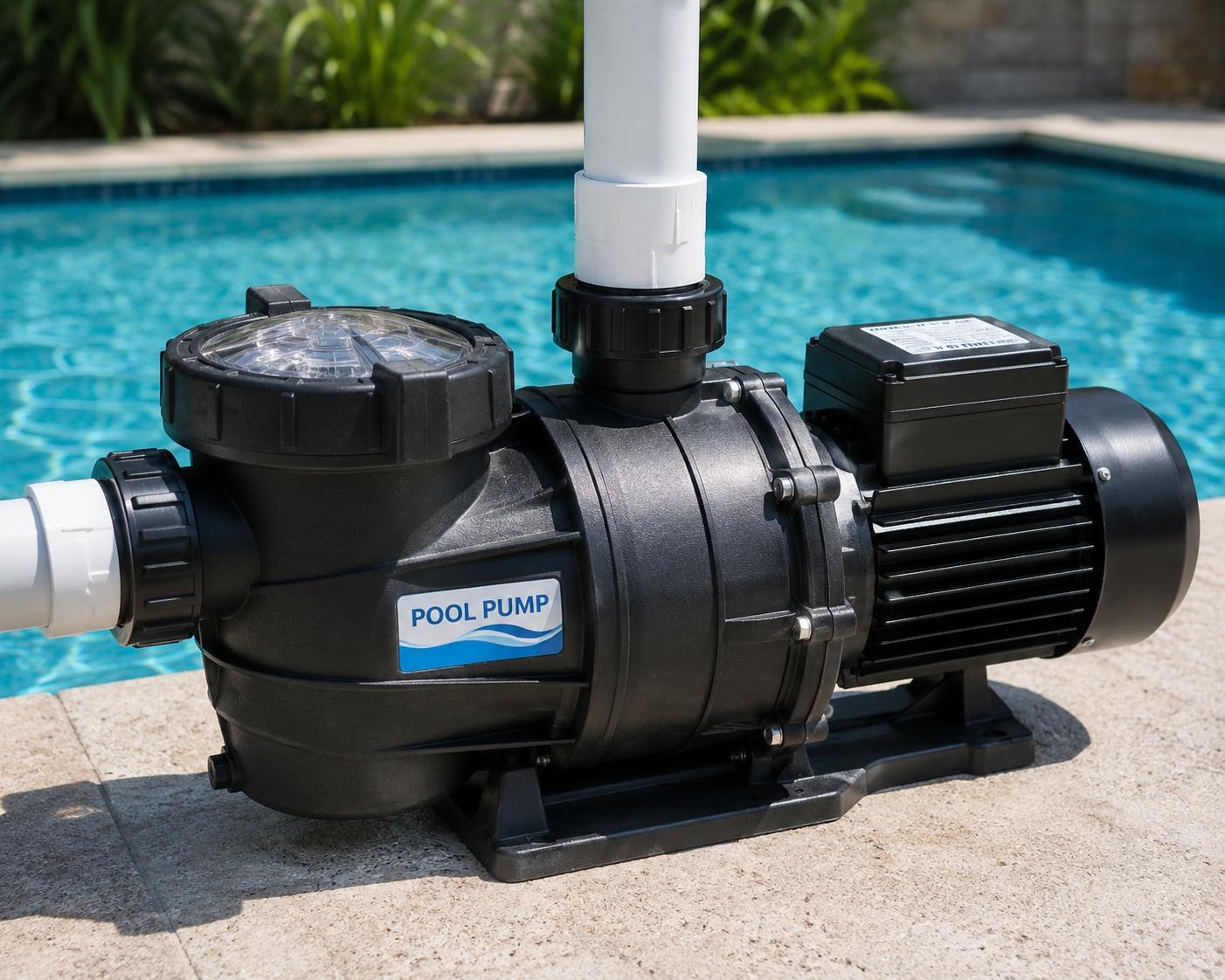
| Swimming pool circulation | UPVC / PVC-U pressure | Standard for pool plant, chemical compatible, full fitting range |
| Above-ground drainage | UPVC drainage | Non-pressure, gravity flow, easy jointing |
| Buried drainage | UPVC / HDPE | Ground load and chemical resistance |
| Industrial & chemical duty | CPVC / high-pressure PVC | Chemical and temperature capability |
Explore each of these directly: PPR pipes and fittings · CPVC pipes and fittings · UPVC pipes and fittings · HDPE pipes and fittings · drainage pipes · high-pressure PVC pipes · irrigation systems · swimming pool equipment.
For irrigation specifically, choosing the best pipe material for an irrigation system goes deeper. For fire systems, see which pipes are used in fire sprinkler systems. For domestic plumbing overall, best pipe for home plumbing and which pipe is used for hot water supply are useful companions.
1. UPVC on a hot water line Why it’s bad: It softens and deforms under sustained heat, and pressure capability collapses. Fix: PPR PN20 or CPVC. No exceptions, and remember that Dubai “cold” lines sometimes qualify as warm.
2. Assuming cold lines will stay cold Why it’s bad: Summer supply temperature from exposed tanks can be far higher than design assumptions. Fix: Check real supply temperature. Upgrade the class or the material where it runs warm, and address tank insulation.
3. PVC cement used on CPVC Why it’s bad: The bond is not equivalent. It’s a slow-motion failure. Fix: Use the manufacturer’s CPVC-specific cement and cleaner, from the correct solvent range.
4. Skipping expansion provision on long PPR runs Why it’s bad: 150mm of unmanaged movement damages fittings, brackets and finishes. Fix: Use fibre composite on long runs, and design loops, guides and anchors properly.
5. Leaving plastic pipe exposed to sun Why it’s bad: UV degradation is progressive and irreversible. It fails without warning. Fix: UV-stabilised grade or full physical covering, on every exposed run.
6. Mixing brands within one fused system Why it’s bad: Socket dimensions and fusion characteristics vary between manufacturers. Fix: One brand family per system. We supply established options including RAKtherm, Cosmoplast, Hepworth and Cepex.
7. Pressure testing before solvent cement has cured Why it’s bad: You break joints that would otherwise have been fine, then chase phantom faults. Fix: Follow the cement manufacturer’s cure schedule for the ambient temperature. See how to pressure test PVC pipe.
8. Ignoring noise in premium residential Why it’s bad: It becomes a handover complaint after everything is closed up. Fix: Consider soundproof pipes and fittings for waste stacks, and read how to soundproof noisy pipes.
Whatever material you choose, run these checks before the pipe goes into the building. It takes ten minutes.
Our detailed method is in how to check PVC pipe quality, and the supplier-side view is in how to choose a pipes manufacturer.
Dave Pools Trading LLC has supplied pipes, fittings, irrigation and pool equipment across the UAE for over 20 years, working out of Al Quoz Industrial Area 1 in Dubai. Customers rate the service 4.7 out of 5.
Practically, that means:
Browse the full product catalogue, the PPR range, or read more about Dave Pools and why buyers in Dubai use us.
Both work. PPR is preferred where fused, adhesive-free joints and impact toughness matter. CPVC is preferred where the highest sustained temperature, chlorine resistance or a fire-sprinkler listing is required. Most UAE villa hot water systems use PPR PN20.
No. UPVC is a cold-water material. Sustained hot water softens it and reduces its pressure capability. Use PPR or CPVC for hot lines, and check whether your “cold” line actually runs warm in summer.
For water temperature, CPVC has the highest sustained rating, with PPR close behind. For ambient heat and UV exposure, all three need protection — no plastic pipe should sit uncovered on a Dubai roof.
Yes. Plain PPR expands roughly twice as much as CPVC per metre per degree. Glass-fibre composite PPR reduces that movement to a fraction, which is why it’s specified on long runs and risers.
Listed CPVC is the plastic pipe used in fire sprinkler systems, alongside steel. PPR and UPVC are not approved for sprinkler service under any circumstances.
Only through proper mechanical transition fittings, never by direct joining — one is heat-fused, the other solvent-cemented. Keep each material in its own zone and transition deliberately at a designed connection point.
There’s no single winner here, and any article that declares one is selling something.
PPR, CPVC and UPVC each own a lane, and Dubai’s climate makes those lanes narrower than they’d be anywhere else. Heat pushes hot lines toward PPR and CPVC. UV rules out any exposed run in any material. Thermal cycling makes expansion provision a design item rather than a detail. And summer supply temperatures blur the line between “cold water” and “warm water” in a way most standard specifications don’t account for.
Get the material right for the duty, get the joint method right for your crew, and protect everything from the sun. That combination outlasts a clever material choice made on price alone.
Next step: send us your line schedule — temperatures, pressures, run lengths and sizes. We’ll tell you which material each line should be, and quote all of them together.
Give us your line temperatures, pressures, run lengths and sizes. Our team will recommend PPR, CPVC or UPVC line by line — then supply everything, fully certified, on one coordinated delivery schedule.
20+ years supplying the UAE · Rated 4.7/5 · Al Quoz Industrial Area 1, Dubai · +971 4 393 4806 · sales@davepools.com