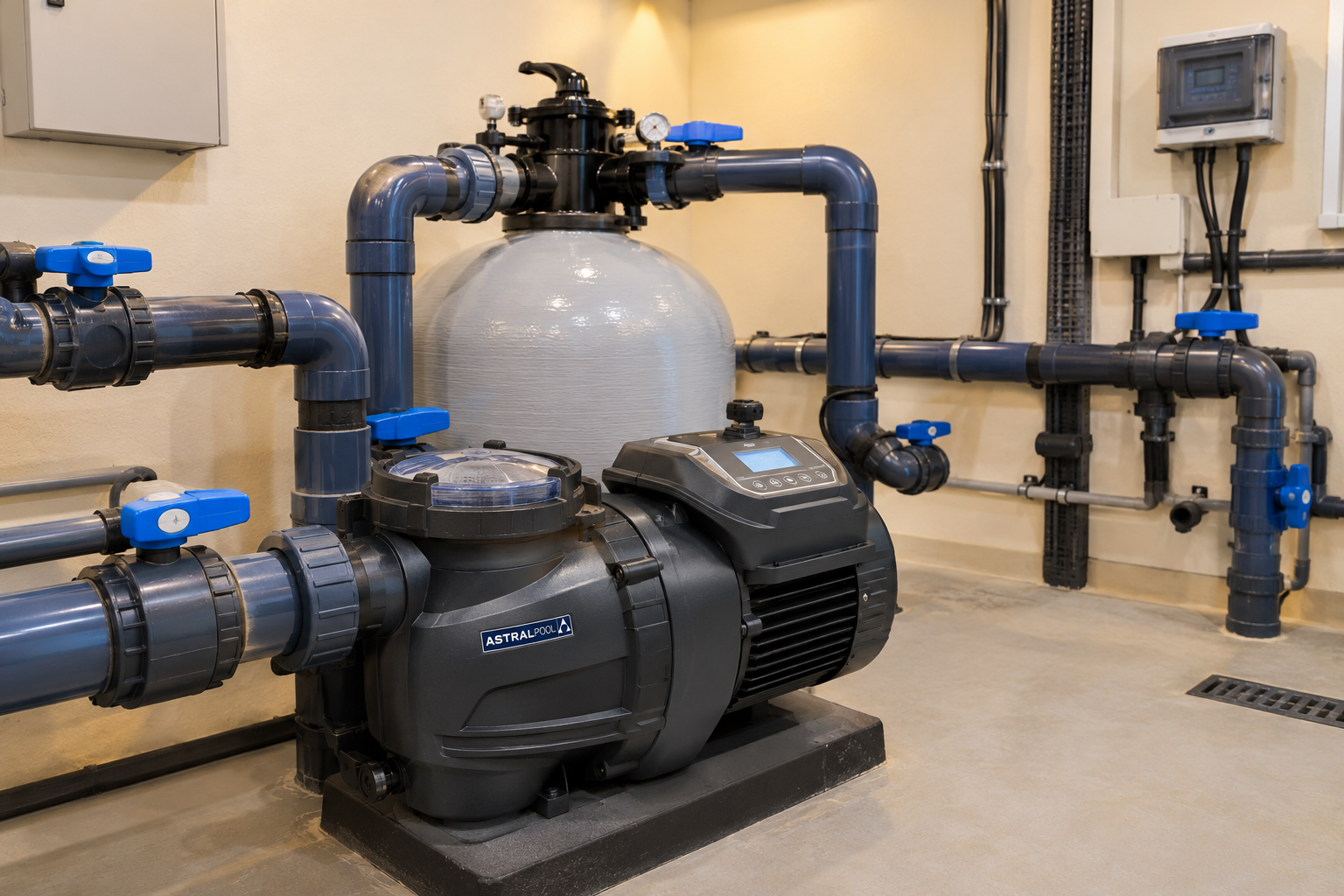

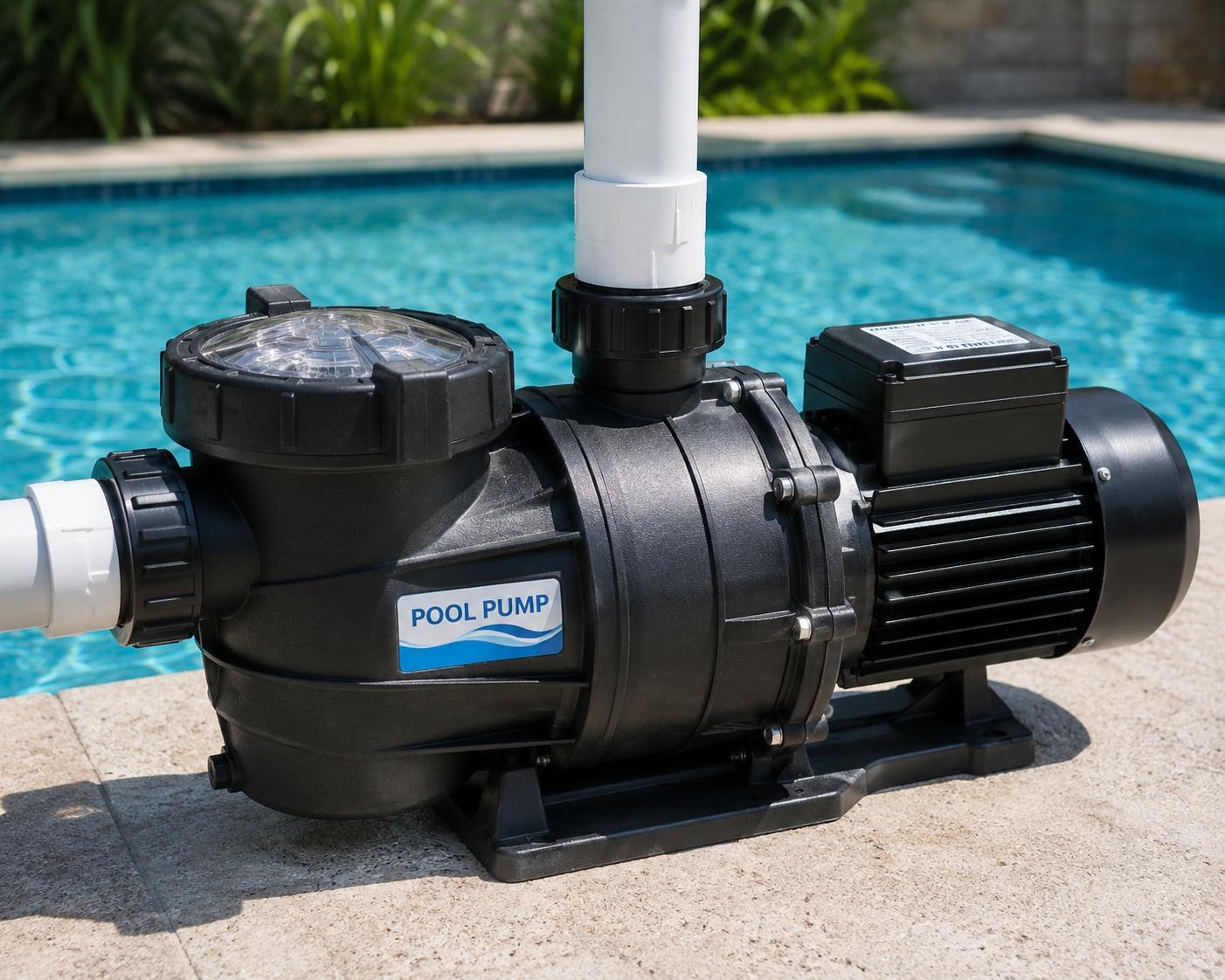
Getting the wrong pump size is one of the most expensive mistakes pool owners make – and one of the most common. Too small, and your water turns green. Too large, and you’re wasting hundreds of dollars a year in electricity.
Pool Pump Sizing Calculator
Enter your pool details below — get your recommended pump size instantly.
The most popular residential pump size. A variable speed 1.5 HP handles the majority of backyard pools and delivers significant energy savings over older single-speed models.
Results are estimates based on standard hydraulic formulas. Consult a pool professional for final equipment selection.
Most people search for “pool pump” and pick the cheapest one that says “1.5 HP” on the box. That’s not pool pump sizing — that’s guessing.
Your pump needs to be sized to:
Get any of these wrong, and no pump HP in the world will keep your water clean.
Step 1 — Enter your pool dimensions
Select your pool shape and enter the length, width, and average depth in feet. The calculator handles the rest.
Step 2 — Set your turnover time
For most residential pools, 6–8 hours is standard. If you have heavy bather load, a heater, or a saltwater system, go with 6 hours.
Step 3 — Select your pipe resistance level
Most backyard pools fall in the “medium” category. If you have a long equipment run (over 60 feet) or 1.5″ piping, select “high.”
Step 4 — Get your result
The calculator shows your pool’s volume in gallons, the minimum GPM (gallons per minute) you need, and the recommended pump HP.
Turnover rate is how long it takes your pump to circulate the entire volume of your pool through the filter once.
The general standard:
Here’s how that translates to flow rate:
| Pool Volume | 8-Hour Turnover (GPM) | 6-Hour Turnover (GPM) |
|---|---|---|
| 10,000 gal | 21 GPM | 28 GPM |
| 15,000 gal | 31 GPM | 42 GPM |
| 20,000 gal | 42 GPM | 56 GPM |
| 30,000 gal | 63 GPM | 83 GPM |
| 40,000 gal | 83 GPM | 111 GPM |
Your pump must deliver at least this much flow at the pressure your specific plumbing creates. That’s what “pump sizing” really means.
Best for pools under 10,000 gallons with short, uncomplicated plumbing runs. Also suited to dedicated spa pumps. Note: many states now prohibit single-speed pumps for new installs — check local codes.
Handles pools up to roughly 15,000 gallons. A 1.0 HP variable speed pump is an excellent energy-efficient option if your pool is on the smaller side and your plumbing is in good shape.
The workhorse of the industry. Handles 15,000–25,000 gallon pools with standard plumbing. If you’re unsure, a 1.5 HP variable speed pump covers the majority of residential pools.
Step up here if you have a pool over 25,000 gallons, a water feature (waterfall, jets, fountain), or a long equipment run. Don’t oversize without need — bigger isn’t always better.
For pools exceeding 40,000 gallons, pools with attached spas, or commercial applications. At this size, variable speed operation isn’t optional — it’s essential for managing energy costs.
The calculator gives you the correct HP. But HP alone doesn’t determine which pump you should buy.
Variable Speed pumps run at lower RPMs for routine circulation and only ramp up when needed. At low speeds, they use dramatically less electricity — often 50–80% less than a single-speed equivalent. Most states now mandate variable speed for residential pools.
Single Speed pumps run full-power, all the time. Lower upfront cost, higher long-term cost. Being phased out in most markets.
Two-Speed pumps are a middle-ground option: high speed for vacuuming and backwashing, low speed for daily circulation. Still available, but increasingly replaced by variable speed.
Recommendation: Unless you’re replacing a pump on a tight emergency budget, always choose variable speed. The energy savings pay back the price difference within 1–2 years in most climates.
Mistake 1: Sizing only by HP rating
HP is output — not a sizing metric. Two 1.5 HP pumps from different brands can have vastly different flow rates. Always check the pump curve.
Mistake 2: Ignoring hydraulic head
The real measure of your pump’s workload is “total dynamic head” (TDH) — the resistance your pump must overcome from pipe friction, filter resistance, elevation change, and fittings. Most homeowners skip this. Don’t.
Mistake 3: Oversizing to “be safe”
Bigger pumps push more water than your filter can handle. This creates channeling — water bypasses the filter media instead of passing through it. Your water goes unfiltered even though the pump is running.
Mistake 4: Not accounting for future additions
Adding a heater, salt cell, UV system, or water feature? All of these add resistance. Size your pump for where your pool is going, not just where it is today.
Don’t trust approximate pool volumes — they cause bad pump sizing. Here’s how to calculate accurately:
Rectangular pool:Length × Width × Average Depth × 7.48 = Gallons
Oval / Kidney pool:Length × Width × Average Depth × 5.9 = Gallons
Round / Circular pool:π × Radius² × Depth × 7.48 = Gallons
(Radius = diameter ÷ 2)
Average depth = (shallow end depth + deep end depth) ÷ 2
The calculator gets you 90% of the way there. But call a professional if:
For a 15,000 gallon pool on a standard 8-hour turnover, you need a minimum flow rate of around 31 GPM. A 1.0 HP to 1.5 HP variable speed pump typically covers this comfortably, depending on your plumbing.
A 20,000 gallon pool on a 6–8 hour turnover needs 42–56 GPM. A 1.5 HP variable speed pump is the standard recommendation for this pool size with typical residential plumbing.
For most backyard pools between 15,000–25,000 gallons, yes. A 1.5 HP variable speed pump handles standard residential plumbing and delivers solid energy savings. For larger pools, water features, or long pipe runs, consider 2.0 HP.
Insufficient flow means your filter can’t process enough water per day. This leads to cloudy water, algae growth, and poor chemical distribution — even if your chemistry is correct.
An oversized pump pushes water through your filter too fast, reducing filtration efficiency. It also creates excessive backpressure, wears out your equipment faster, and wastes electricity.
Divide your pool volume by your desired turnover time in minutes. Example: 20,000 gallons ÷ 360 minutes (6 hours) = 55.6 GPM minimum.
In most U.S. states, yes — variable speed is now required by law for new residential pool pump installations. Even where it isn’t mandated, variable speed saves 50–80% on pump operating costs.
Aim for at least one complete turnover per day. For most pools, that’s 6–8 hours of daily operation. Variable speed pumps can run longer at low speed more economically than single-speed models.
The calculator gives you the right size. Our team helps you choose the right pump — the right brand, model, efficiency rating, and warranty for your specific pool, budget, and local climate.
We supply and install pool pumps across UAE. Call us for a free recommendation or submit your pool details below and we’ll match you to the right pump within 24 hours.